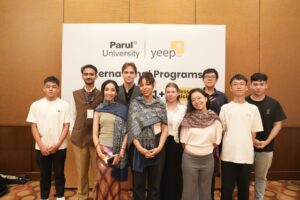
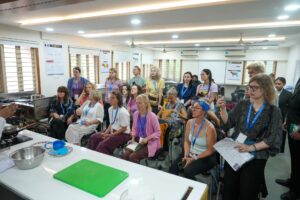
The Delhi Urban Art Commission (DUAC), established by parliamentary act in 1973, is the statutory guardian of Delhi’s aesthetic, environmental, and cultural identity. Parul Institute of Architecture students met its current Chairman, Dr. Ajit Pai, during the Delhi tour. Dr. Ajit Pai is also an Adviser to the Government of India for maintaining the aesthetic quality of urban and environmental design.
Dr. Ajit Pai’s professional history sits at the intersection of policy, economics, and corporate strategy. Before his current role, he served as Group Head of Policy for the OLA Group, which includes OLA Consumers and OLA Electric. Earlier, he was the head of Economics and Finance at NITI Aayog, where he oversaw public disinvestment and the performance of Central Public Sector Enterprises. His private-sector career spans McKinsey, Lazard, Thomas Weisel Partners, and Stifel. Over six years he received five number-one and number-two Star Mine awards from the Forbes Financial Times Best Analyst Survey for forecast accuracy.
The architect's responsibility is to the future, not the past
The responsibility of an Architect is not to design for the past but for the Future.
Dr. Ajit Pai, Chairman, Delhi Urban Art Commission
Dr. Ajit Pai opened the substantive portion of the session with a single principle. The architect’s responsibility is not to design for the past but for the future. Buildings designed for the camera and the news cycle do not last. Buildings designed for the long term outlive their architects, their clients, and often their original civic functions. He tagged the Parul Institute of Architecture students as futurologists. The work of the architect is to look at the surrounding environment, analyse how it is evolving, and predict where it will go.
He acknowledged the historical limitations of the DUAC mandate. When the parliamentary act passed in 1973, the environment was not yet a relevant national concern. Climate change was barely understood. Yet the original act spoke about aesthetics and the urban environment with sufficient generality that the current commission has reinterpreted the mandate to make environmental considerations central. The mandate did not change. The interpretation did.
From Heritage to Urban Futures – Parul Institute of Architecture’s Delhi Tour 2026!
Four Centres of Excellence and the problem with Indian cities
A common observation Dr. Ajit Pai made about Indian cities is that they are, in his words, pathetic. He did not soften the diagnosis. The commission’s response, in coordination with the central government, has been to establish four Centres of Excellence for urbanisation across the four geographic regions of the country: north, south, east, and west.
The purpose of these centres, as Dr. Ajit Pai framed it, is to break the next generation of architects, planners, and urban designers out of a mould the profession has fallen into. The mould has two failure modes. Some practitioners try to build something easy and beautiful that has no economic underpinning. Others are overly practical, meeting today’s needs but designing buildings that will be obsolete in twenty years. The Centres of Excellence aim to integrate economic thinking into design education, so the next generation can build a country and cities that are economically competitive and attract the best quality talent.
Dr. Pai pushed back against the assumption that beautification or cheap utilities are sufficient to attract talent to a city. He used Indore as the working counter-example. Indore is officially one of the cleanest cities in India. Yet it does not attract the migration of human and financial capital that polluted Delhi, messy Mumbai, and congested Bangalore continue to attract. Clean and cheap alone do not constitute urban success. The architecture, the density, the social infrastructure, and the economic opportunity together do.
Race to Zero: why old buildings outlive new ones
Dr. Ajit Pai then made an observation that any Parul Institute of Architecture student who has walked through both an Indian heritage site and a contemporary commercial building will recognise. Old structures are difficult to tear down. Recent buildings, often only 30 to 40 years old, fall apart on their own. They do not need to be demolished.
The reason, Dr. Pai argued, is a policy and procurement pattern he called the Race to Zero. The Parliamentary Act governing architectural commissions stipulates that architects should receive approximately 4 per cent of the total project budget. In practice, government projects routinely pay architects 10 to 20 basis points, which is one-tenth of one per cent or less. The downward economic pressure on the architect’s fee translates directly into the physical environment. Architects forced to accept fees an order of magnitude below the legal benchmark cannot afford the time, the consultants, or the design depth that durable buildings require. The result is weak, low-quality construction that fades next to the robust, deeply considered structures of earlier eras.
Dr. Pai called for better coordination among the architectural community to resist this systematic undercutting. He urged the students entering the profession to avoid compromising and cutting their rates significantly, and to prioritise long-term quality and durable design over short-term cost savings. He acknowledged the practical tension. Frank Gehry famously exceeded his project budgets by enormous margins on the Stata Centre at MIT and the Guggenheim Museum. Not every architect has the luxury of working without financial constraints. Part of the architect’s duty is to deliver excellence within realistic economic frameworks.
The discipline of fee discipline is one the profession has to defend. The B.Arch programme at Parul University includes professional practice modules that walk students through the regulatory frameworks of the Council of Architecture, contract law, and the negotiation of fees with public and private clients. The institutional framing matters because individual architects negotiating one project at a time cannot push back on systemic fee suppression alone.
Plan for the air conditioner even if you do not install it
On the question of designing for different economic realities, Dr. Pai gave a piece of practical advice that captures the discipline of planning. Not everyone needs a palace. Many clients cannot afford high-power air conditioning, robust electrical loads, or premium finishes. The architect’s response should not be to skip the system entirely. The response should be to design for it. Plan the conduit routing. Leave the wall thickness. Specify the structural load capacity. The client does not need to install the system today. The building should be capable of accepting the system when the client can afford it. Design constraints today should not foreclose options tomorrow.
Mr.Gurmeet Singh Chauhan at Parul Institute of Architecture’s Delhi Tour 2026
Aesthetics as a cultural framework
When a student asked Dr. Pai what factors should be considered when discussing aesthetics, his answer was structurally interesting. Aesthetics, in his framing, is a deeply subjective phenomenon, heavily influenced by cultural, religious, and historical contexts. The DUAC’s operational practice reflects this directly. A specific architectural design might be approved for a private religious or charitable institution because it reflects the spiritual comfort of its users. The same design would be rejected for a neutral government building because the context demands different aesthetic values.
Collective perception of beauty shifts over time. Dr Pai used Le Corbusier’s Chandigarh as the worked example. The raw, brutalist concrete structures Le Corbusier built in Chandigarh were initially despised by residents during construction. Today, two generations later, the same residents revere those buildings as beautiful because they have become inextricably linked to local memory and civic identity. Beauty in architecture, in his account, is not bound to a specific stylistic philosophy. It is not about whether form follows function or function follows form.
Timelessness in architecture, Dr. Ajit Pai argued, comes from sincerity, mastery, and relentless effort on the part of the designer. He pointed to the Roman Pantheon and the Hagia Sophia in Istanbul. Both structures have outlasted the civilisations and religions that built them, simply because master-level quality was invested in their creation. The architects who built them did not work for the next election cycle. They worked for the next millennium.
The brutal economics of architecture as a career
Dr. Pai did not soften his account of architecture as a career path. The architect, in his framing, is the ultimate generalist professional. The work requires knowledge of history, science, engineering, business, art, and sociology. The discipline has, by his measurement, an incredibly low probability of yielding fame or significant wealth. Less than 0.1 per cent of architects become famous. The success rate is comparable only to poets.
He cited the cruel economic reality that a young architectural graduate often earns less than an office assistant with five years of tenure. Choosing architecture, in his view, must therefore be a matter of deep internal calling rather than market calculation. For students uncertain about their path upon graduation, he advised gaining 18 to 24 months of experience in diverse, highly inspiring professional practices before committing to graduate school. The graduate-school decision should follow exposure to actual practice, not precede it.
He encouraged Parul Institute of Architecture students not to limit themselves geographically. Just as architects of his generation travelled from Delhi to work with Laurie Baker in Kerala or with practices in Goa, today’s students should seek out mentors whose work genuinely moves them. A lack of hard work in the profession, in his observation, is rarely due to inherent laziness. It is more often due to a lack of inspiration. If students are bored, it is because they are working on mediocre projects. The remedy is exposure to projects worth working on.
AI in architecture: AutoCAD on steroids, or a shortcut to mediocrity
Dr. Ajit Pai divided the impact of artificial intelligence on architecture into two distinct categories. The first is broad and economic. AI will radically change the global economy, transforming how humanity lives, works, and recreates. The functional briefs and requirements for buildings will themselves transform as a result. Entirely new architectural typologies will be needed for an economy that works differently.
The second category is narrower and operational. AI acts as a transformative tool within the architecture office. Dr. Ajit Pai used the description AutoCAD on steroids. He traced the brief history of digital drafting, noting that early CAD software constrained architects to rectilinear forms. The counter-movement by Zaha Hadid and the digital-modelling extension of Antoni Gaudí‘s biomorphic intuitions made complex shapes possible through advanced 3D modelling. AI extends this trajectory to an unprecedented level. The formal possibilities expand.
AI also automates repetitive, error-prone tasks: dimension checking, corridor width verification, circulation flow analysis. The productivity gain is real. Dr. Ajit Pai’s warning, however, was equally real. AI can breed severe intellectual laziness. If students use AI as a shortcut to generate a mediocre project the night before a deadline, they bypass the cognitive struggle that develops genuine design intuition. If you wish to master how AI & Architecture will thrive globally, delay not and enrol in the Bachelor of Design – Building and Infrastructure program of Parul University!
AI must be leveraged to elevate the ceiling of what is possible, not to lower the floor of human effort.
Dr. Ajit Pai, on the use of AI in the architecture profession
Delhi as Shibuya: why density is the solution, not the problem
Dr. Pai compared Delhi to the Shibuya crossing in Tokyo. True cities, in his framing, thrive on high density. Density enables walkability, reduces reliance on energy-intensive automobiles, and produces the intense social and economic interaction that defines successful cities. Density itself, he argued, is not the villain. The villain is informal development that lacks critical infrastructure. The Master of Planning and the Bachelor of Architecture at Parul University train students directly in the density-infrastructure relationship.
He addressed the Yamuna River‘s degradation as a direct example. The Yamuna is polluted because untreated sewage flows from informal settlements directly into the river. Even when large Sewage Treatment Plants (STPs) are built, the logistical challenge of engineering the complex network required to transport waste from informal slums to the STPs remains a massive hurdle. The solution is not less density. The solution is formalised, infrastructure-served density.
The failure of urban devolution and the case for densification
Dr. Ajit Pai addressed the 73rd and 74th Constitutional Amendments, which were intended to devolve real administrative and financial power to Urban Local Bodies. In his assessment, the amendments have failed. Cities like Bangalore and Delhi suffer from overlapping, conflicting jurisdictions because state Chief Ministers refuse to hand real power to local Mayors, fearing the loss of control over their states’ primary economic engines.
In Delhi, the situation is exacerbated by the central government controlling the police while the state government and various municipal councils negotiate infrastructure decisions.
To solve these intractable issues, Dr. Ajit Pai referenced historical figures including Robert Moses in New York and Baron Haussmann in Paris. Both used what would today be considered ruthless or legally grey methods, including eminent domain, but possessed the singular vision and systemic capacity to fundamentally transform their cities. He challenged the Parul Institute of Architecture students to either navigate complex democratic bureaucracy with creative solutions or to completely rethink the basic assumptions of urban governance.
In his concluding remarks, Dr. Ajit Pai turned to the specific future of the NCR. He warned against the sentimentalists on planning commissions who wish to preserve an archaic, low-density version of Lutyens’ Delhi. The result of that preservation, he argued, has been massive capital flight. Because high-end development was restricted in Delhi proper, immense wealth and real-estate investment migrated to satellite cities like Gurgaon and Noida, where luxury flats now sell for astronomical sums. The DUAC strongly advocates for the aggressive densification of Delhi through Transit-Oriented Development (TOD), with high-rises clustered around metro stations, and through incentivising builders to redevelop slums into formalised, multi-storey housing with integrated green spaces and sanitation.
AR. Rajesh Satish at Parul Institute of Architecture’s Delhi Tour 2026
FAQs
Who is Dr. Ajit Pai?
Dr. Ajit Pai is the Chairman of the Delhi Urban Art Commission (DUAC) and an Adviser to the Government of India for maintaining the aesthetic quality of urban and environmental design. He previously served as Group Head of Policy for the OLA Group and as head of Economics and Finance at NITI Aayog, where he oversaw public disinvestment and the performance of Central Public Sector Enterprises. His earlier career spans McKinsey, Lazard, Thomas Weisel Partners, and Stifel. He received five number-one and number-two Star Mine awards from the Forbes Financial Times Best Analyst Survey over six years.
What is the Delhi Urban Art Commission (DUAC)?
The Delhi Urban Art Commission (DUAC) is a statutory body established by parliamentary act in 1973 as the guardian of Delhi's aesthetic, environmental, and cultural identity. The commission reviews and approves architectural designs for public buildings in Delhi against criteria for aesthetic quality, environmental integration, and cultural appropriateness. The current commission has reinterpreted the original mandate to make environmental considerations central, even though climate change was not a relevant concern when the act was passed.
What did Dr. Ajit Pai tell Parul University students about AI in architecture?
Dr. Ajit Pai told Parul Institute of Architecture students that AI in architecture should be understood in two categories. The first is the broad economic transformation: AI will change how humanity lives and works, requiring entirely new architectural typologies. The second is operational, as a tool within the architecture office. He described AI as 'AutoCAD on steroids' that automates dimension checking, corridor width verification, and circulation flow analysis. His warning was that AI can breed intellectual laziness if used as a shortcut to mediocre projects, and that it must be leveraged to elevate the ceiling of what is possible rather than to lower the floor of human effort.
What is the 'Race to Zero' Dr. Ajit Pai criticised?
Dr. Ajit Pai criticised the 'Race to Zero' as a procurement pattern in Indian government architectural commissions where architects are paid 10 to 20 basis points (one-tenth of one percent or less) of total project budget, against the legally stipulated 4 percent. The downward economic pressure on architects' fees translates directly into weak, low-quality construction that fades next to robust earlier-era buildings. Dr. Pai called for coordination among the architectural community to resist systematic undercutting and to prioritise long-term quality over short-term cost savings.
Why does Dr. Ajit Pai advocate for densification of Delhi?
Dr. Ajit Pai argues that true cities thrive on high density because density enables walkability, reduces reliance on energy-intensive automobiles, and fosters intense social and economic interaction. He compared Delhi to the Shibuya crossing in Tokyo. The actual problem in Indian cities is informal development without critical infrastructure, not density itself. He warned that sentimentalist preservation of low-density Lutyens' Delhi has driven capital flight to Gurgaon and Noida. The DUAC under his chairmanship advocates aggressive densification through Transit-Oriented Development (TOD), high-rises clustered around metro stations, and the redevelopment of slums into formalised multi-storey housing.