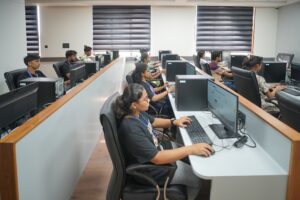
Most placement preparation at Indian engineering colleges is structurally unguided. Students are told to practice DSA, told to revise core subjects, told to build projects. They are rarely given a sequenced curriculum that takes them from where they actually are to where they need to be on the day of the first technical interview.
Impact Training at Parul University is the programme designed to close exactly that gap. It is run by the Training and Placement Cell as the institutional placement preparation programme for final-year B.Tech students.
The full operational account, drawn from the experience of a Class of 2026 B.Tech CSE student who used the programme to land HCL Technologies and IBM offers, is below.
What Impact Training covers
Impact Training at Parul University is the placement preparation programme delivered to final-year students by the Training and Placement Cell. The programme is structured rather than open-ended, covering the technical and professional content that the most common corporate placement interviews actually test.
The coverage spans:
- Data Structures and Algorithms (DSA): arrays, strings, linked lists, stacks, queues, trees, graphs, time complexity analysis, and the standard problem-solving patterns including two-pointer, sliding window, recursion, and dynamic programming.
- Core computer science subjects: operating systems concepts, database management systems, computer networks fundamentals, and OOP principles.
- Object-oriented programming: design patterns, encapsulation, inheritance, polymorphism, and applied OOP design questions of the kind that corporate technical interviews directly test.
- Aptitude and logical reasoning: the standard first-round filter content used by HCL Technologies, IBM, Infosys, TCS, and similar recruiters in their initial online MCQ tests.
- Career mentorship: what to learn after B.Tech, which technologies the industry is actively hiring for, which external learning platforms are worth student time.
The placement outcome documented in the hub article on Naga Chandrika Eluru’s HCL and IBM placement rests directly on this coverage. The HCL technical interview, the IBM technical assessment, and the parallel preparation each candidate needs to complete for both processes all test exactly the material Impact Training covers.
Read more: The 4-stage interview process by HCL tech
How one student used the programme: the Java-to-Python translation
Naga Chandrika Eluru‘s account of how she actually used Impact Training is worth documenting because it captures a structural learning principle that the programme accommodates. The training is delivered primarily in Java. Java had been her early stumbling block. She had started programming seriously only in her second year, with Python as the language that finally worked for her.
The decision she made for Impact Training was practical rather than dogmatic. She would not abandon the structured programme because of a language mismatch. She would translate every Java-based problem into Python on the side, preserving the algorithmic and structural learning while bypassing the language barrier.
The training used to be in Java. The teacher used to tell the exact algorithm for that problem: tell me to do it in Java: but instead I chose to do it in Python. And doing this Impact Training helped me to explore and revise all these concepts: all the problems like trees, graphs, linked lists: all these concepts. It helped me revise everything.
Naga Chandrika Eluru, on translating Impact Training to Python
The logic was the same. The algorithmic approach was the same. The structure of the problem was the same. Only the syntax differed. This decision allowed her to receive the full benefit of the structured curriculum without being derailed by the language she found difficult.
It is also a model that other Parul University CSE students with similar language preferences can apply directly. Impact Training’s value is in the algorithmic structure and the sequenced topic coverage, not in the specific implementation language.
Striver's A2Z DSA Sheet: structure over volume
The other component that closed the gap between Chandrika’s casual second-year LeetCode practice and her interview-ready third-year preparation was Striver’s A2Z DSA Sheet. The sheet is a structured roadmap for Data Structures and Algorithms that organises topics in a deliberate sequence rather than offering a flat list of mixed problems.
The structural insight is straightforward. Random problem-solving produces random improvement. Sequenced problem-solving, in a known progression from basic concepts to advanced applications, produces the methodical depth that interview rounds actually test.
I used to solve random problems. When I started doing them in a correct flow: what is time complexity, the two-pointer approach: it was at a proper flow. I used to come to know the approaches. These kinds of problems, if we do these kinds of solutions, it will be optimal. I used to find the approaches to solve a problem.
Naga Chandrika Eluru, on the shift from random to structured DSA
Using the Striver sheet alongside the Impact Training sessions, Chandrika worked through approximately 200 problems covering arrays, strings, linked lists, stacks, queues, and trees. The number of problems was less important than the structure.
What the structure produced was a clear understanding of:
- Time complexity analysis: for any given problem, the ability to reason about whether a candidate solution is O(n), O(n log n), or O(n²), and whether the chosen approach matches the constraints of the input.
- Pattern recognition: identifying when a two-pointer approach is the optimal strategy, when a sliding window applies, when a hash map is the right data structure, when recursion or dynamic programming is necessary.
- Methodical approach: developing a sequenced thinking process when first encountering a new problem rather than diving immediately into code.
- Optimal solution recognition: the ability to identify when a working solution is also an optimal solution, and when a working solution still has improvement headroom.
Mentorship beyond the syllabus
Impact Training at Parul University also operates as career mentorship, not only as a technical preparation programme. The instructor guided students on what comes after B.Tech: which skills to build for the first one to two years of corporate work, which technologies the industry is actively hiring for, and which external learning platforms beyond the classroom are worth student time.
He used to tell me what to do next: what comes after B.Tech if you are in the company, what to learn. He also showed me several technologies, some other websites that help to learn technologies. Like a good mentor who is helping the students to grow their career.
Naga Chandrika Eluru, on the mentorship dimension of Impact Training
The mentorship dimension is the part of structured placement preparation that purely-technical programmes often miss. A student who clears the placement interview but does not know what skill development trajectory to follow at the company faces a different kind of career risk: stagnation in the first two years that compounds across the decade.
Impact Training’s instructor-led mentorship reduces that risk by anchoring placement preparation in a longer-term career plan rather than treating the placement itself as the terminal goal.
Read More: How Chandrika prepared herself for the placement drive?
The sufficiency claim: was Impact Training enough?
The most direct measure of Impact Training’s effectiveness is the student’s own assessment after the placement is confirmed. When asked whether Impact Training was sufficient preparation for the HCL Technologies and IBM technical interviews she faced, Chandrika’s answer was unambiguous.
Actually, the concept that was covered in training was enough for the placements. I think so.
Naga Chandrika Eluru, on the sufficiency of Impact Training for HCL and IBM placements
The technical interview content at HCL Technologies for the Autonomics Engineer role drew directly from the concepts covered in Impact Training. Operating systems concepts, DBMS principles, OOP design questions, applied DSA problem-solving: the same material the training covered was the material the interviews tested.
The preparation did not need to be reinvented for the placement window. It needed to be applied. The dedicated HCL placement deep-dive documents the four-stage drive and the interview content alignment in detail.
CGPA management as part of placement preparation
One operational reality that most placement preparation guides do not address openly is the trade-off between academic margin and skill development time. Chandrika’s CGPA across the eight semesters demonstrates how the trade-off actually plays out for a student deliberately balancing both demands.
From my fifth semester I kept focusing on the skills. I wanted to maintain both, but I took more time on skills rather than academics. I just learned from academics just before the semester. So my CGPA went from 8.8 to 8.3. But the overall result of both together: that is what matters.
Naga Chandrika Eluru, on CGPA versus skills
Her first four semesters produced 8.8 to 8.9 per semester with primary focus on academic performance. The fifth, sixth, and seventh semesters produced 8.0 to 8.1 per semester as she deliberately shifted attention toward DSA discipline, portfolio projects, and Impact Training preparation.
The overall 8.35 CGPA reflects a measurable, deliberate trade-off between academic margin and placement-ready skill development. Neither extreme (CGPA maximisation at the expense of skills, or skills development at the expense of placement-eligibility CGPA thresholds) would have produced the dual-offer outcome.
Read more: How placement cell helps to get placed before graduation at Parul University?
The advice she gives second-year CSE students who started late
Naga Chandrika Eluru is herself a documented late starter. She did not code in her first year. Her serious engagement with programming began only in her second year. The advice she offers to second-year CSE students at Parul University right now who are in the same position is short, specific, and unadorned. Start DSA as soon as possible. Use a structured path, like Striver’s A2Z, that has a defined sequence. Stop doing random problems. Start immediately.
The advice carries weight precisely because she is the student who followed exactly that recommendation, with the structural support of Impact Training, and is now holding two full-time offers from established technology companies. No motivational framing. No promise that starting late is costless. Just operational instruction from a student who walked the same path.
How the programme connects to the broader Parul University placement infrastructure
Impact Training is one component of a broader placement preparation infrastructure at Parul University. The other components include the Training and Placement Cell‘s direct recruiter coordination with over 2,200 recruiting companies, the Faculty of Engineering and Technology’s core subject teaching across the B.Tech CSE curriculum, the Lakshya 2047 Centre for Future Skills infrastructure with its fifteen-laboratory operational environment, and PIERC for students pursuing entrepreneurial paths rather than direct corporate placement.
The integration matters. A student following the Impact Training programme also has access to industry internship coordination, real placement drives with named recruiters, advanced laboratory infrastructure for project building, and entrepreneurial support for post-placement venture pathways.
The combination of these components is what converts a structured DSA preparation programme from a syllabus into an actual placement outcome. Impact Training alone, without the surrounding infrastructure, would be one preparation among many. Impact Training inside Parul University’s full placement ecosystem is what produced two offers for one student in one placement window.
FAQs
What is Impact Training at Parul University?
Impact Training is the placement preparation programme delivered by Parul University's Training and Placement Cell to final-year B.Tech students. The programme covers Data Structures and Algorithms (DSA), operating systems concepts, database management systems, object-oriented programming, computer networks fundamentals, aptitude and logical reasoning, and career mentorship on post-B.Tech skill development. The training is delivered primarily in Java but supports students who prefer other implementation languages including Python. The programme is structured and sequenced rather than open-ended, covering exactly the technical content that the most common corporate placement interviews test.
What is Striver's A2Z DSA Sheet?
Striver's A2Z DSA Sheet is a structured roadmap for Data Structures and Algorithms preparation that organises problem-solving topics in a deliberate sequence from basic concepts to advanced applications. The sheet is widely used by B.Tech engineering students preparing for corporate placement interviews. Topics covered include arrays, strings, linked lists, stacks, queues, trees, graphs, dynamic programming, and the standard problem-solving patterns including two-pointer, sliding window, recursion, and backtracking. The structural value of the sheet is in its sequencing: random problem-solving produces random improvement, while sequenced problem-solving produces the methodical depth that interview rounds actually test.
How many DSA problems should a CSE student solve before placement interviews?
Naga Chandrika Eluru, B.Tech CSE Class of 2026 at Parul University, worked through approximately 200 DSA problems covering arrays, strings, linked lists, stacks, queues, and trees through the combination of Striver's A2Z DSA Sheet and Parul University's Impact Training programme. The number of problems is less important than the structure. 200 sequenced problems, worked through methodically with explicit attention to time complexity analysis and optimal solution recognition, produced the interview-ready depth that converted into a full-time HCL Technologies offer and an IBM Letter of Intent. Random practice on 400 problems would not have produced equivalent results.
Can I use Impact Training in Python if it is delivered in Java?
Yes. Impact Training at Parul University is delivered primarily in Java, but students with stronger Python fluency can translate the algorithmic content into Python on the side. Naga Chandrika Eluru, who used the programme to land HCL Technologies and IBM offers, applied exactly this approach: she would receive the algorithm explanation and Java implementation in the training session, then translate the solution into Python on her own. The algorithmic structure, the problem-solving approach, and the time complexity reasoning are language-independent. Only the syntax differs. The decision to translate preserves the full structural learning while accommodating individual language preference.
What advice would a placed CSE student give to a second-year student who started late?
Naga Chandrika Eluru, who is herself a documented late starter who did not code seriously until her second year and went on to receive HCL Technologies and IBM offers, gives short and specific advice to second-year CSE students at Parul University in the same position. Start DSA as soon as possible. Use a structured path, like Striver's A2Z DSA Sheet, that has a defined sequence from basic concepts to advanced applications. Stop solving random problems. The structural shift from random to sequenced practice produced the placement-ready depth she carried into her HCL technical interview. The advice carries weight precisely because she followed exactly that recommendation and is now holding two full-time offers.