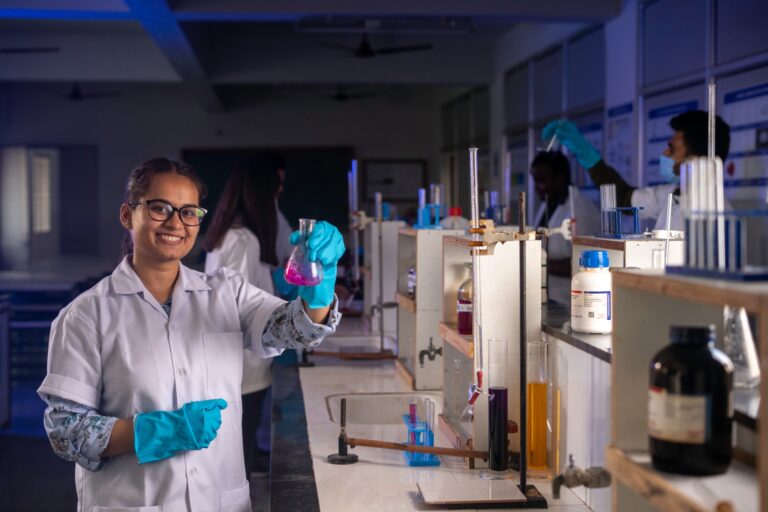
Explore how Chemical Engineers improve medicine manufacturing, optimise energy use and reduce waste through process design and innovation.
Chemical Engineering is used in many areas that affect daily life, from medicines and fuels to water treatment and industrial production. For students planning a B.Tech, the field gives a way to understand how raw materials are changed, processed and managed at a larger scale.
It also brings together chemistry, mathematics and engineering to solve practical problems related to production, safety, energy use and waste.
How Can Chemical Engineers Support Pharmaceutical Manufacturing?
Making medicine at a large scale is very different from creating a small sample inside a laboratory. The process has to be carefully designed so that materials move through different stages under controlled conditions.
Chemical Engineers may work in areas such as:
• Process design:
Developing systems for producing pharmaceutical ingredients at a larger scale
• Heat and mass transfer:
Managing temperature and movement of materials during production
• Separation processes:
Helping separate and purify required materials from a mixture.
• Production efficiency:
Studying processes to reduce unnecessary material or energy use.
This connection is important in India. As of March 2026, the Production Linked Incentive Scheme for Pharmaceuticals had attracted cumulative investment of ₹45,774 crore. (PIB)
For a B.Tech Chemical Engineering student, pharmaceuticals can therefore be one area where subjects like reaction engineering, process control and separation technology find practical use.
What Role Does Chemical Engineering Play in the Energy Sector?
Energy production involves much more than generating electricity. Fuels have to be processed, gases may need separation, raw materials need treatment, and industrial plants need to manage heat and energy efficiently.
Chemical Engineers can contribute to these areas because thermodynamics, fluid flow, heat transfer and process design form an important part of their training.
Their work may involve petroleum refining, natural gas processing, industrial energy systems and process optimisation. As energy technologies change, the same engineering basics can also help professionals understand newer processes involving cleaner fuels, carbon management and different forms of energy conversion.
The exact work depends on the organisation and technology being used, so students should see Chemical Engineering as a process-based field rather than a course linked with only one energy source.
How Is Chemical Engineering Connected to Sustainable Industries?
Sustainable manufacturing is not simply about using a green label. Industries have to think about how much material, water and energy a process uses and what happens to waste after production.
Chemical Engineers can examine these systems at different stages:
• Waste treatment:
Understanding how industrial waste can be treated before disposal or reuse
• Process efficiency:
Finding where raw material, heat or energy is being unnecessarily lost
• Water management:
Designing processes that use or treat water more carefully
• Carbon management:
Working on technologies that deal with industrial carbon emissions
Get Complete Details From Expert
Why Are Process Simulation and Automation Becoming Important?
Before changing a large industrial process, engineers often need to understand what may happen when temperature, pressure, flow rate or another condition changes.
Process simulation gives engineers a way to study such conditions using computer-based models. It can help them understand a system before changes are applied to an actual plant.
Automation also allows industrial systems to measure and control process conditions continuously. For students, this means Chemical Engineering is not only about equations and chemical reactions. Data, simulation, process control and analytical thinking can also become useful skills.
A student entering the field today may therefore work with both physical industrial equipment and digital tools during their career.
How Does Parul University Prepare B.Tech Chemical Engineering Students for the Industry?
Parul University’s four-year B.Tech Chemical Engineering programme combines basic Chemical Engineering knowledge with practical learning. Its curriculum covers areas such as fluid mechanics, heat transfer, mass transfer, reaction engineering and process design.
Students receive practical exposure through laboratory work, pilot plant operations and process simulation. Industrial visits and real-world projects are also included in the learning approach.
The programme also pays attention to process safety, sustainable engineering practices and process optimisation. These areas can help students understand how Chemical Engineering is used in sectors including pharmaceuticals, energy, petrochemicals, food processing and environmental engineering.
Students interested in this field can explore the curriculum and programme details.
Where Could the Next Chemical Engineering Problem Come From?
It could begin inside a pharmaceutical plant where a process needs better control. It could be an energy system using too much heat. It could even be a manufacturing unit trying to reduce its waste.
For a Chemical Engineer, these are not separate problems. They all involve understanding how materials and energy move through a system and finding a practical way to improve it.
That is also what makes B.Tech Chemical Engineering worth exploring for students who enjoy chemistry and mathematics but also want to understand how these subjects work outside the classroom. The next step is learning how to turn those basic principles into working industrial solutions.