From fixing engines to petroleum engineering
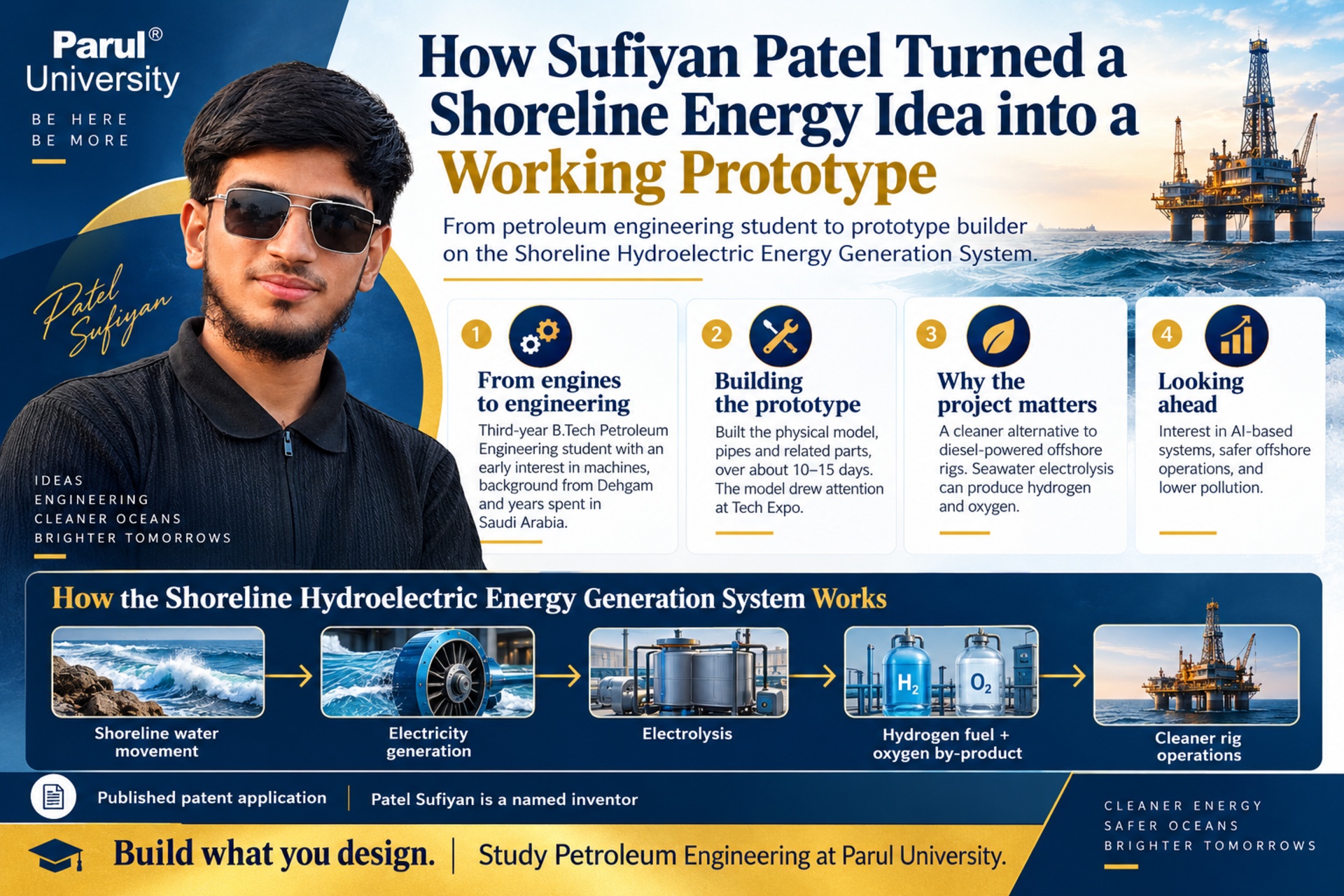
Patel Sufiyan is a third-year, fifth-semester B.Tech Petroleum Engineering student (batch 2024 to 2028) at the Parul Institute of Engineering, Parul University. Indian by nationality, he spent about thirteen years of his life in Saudi Arabia before moving to India in the seventh standard, and completed his schooling in his hometown of Dehgam. His first love was machines: as a teenager he stripped and rebuilt his own motorcycle engine and spent time with mechanics at a garage near his home. He chose petroleum engineering as a broad course that could take him to work in many countries, and he still travels daily to campus from Bharuch, about 50 km away. Alongside the patent project, he is working to shift a mechanical petroleum-engineering lab experiment fully onto an AI-based computer system.
Building the prototype
On the Shoreline Hydroelectric Energy Generation System team, Sufiyan was the one who built the physical model, including the pipes and related parts, a job that took him about ten to fifteen days. The working prototype demonstrated the concept, drew crowds at the Tech Expo stall, and helped carry the project toward its published patent application, on which Sufiyan is a named inventor. He credited every member of the group for the work that went into the patent. The full technical description of the system is covered in the project’s hub article.
Why the team pursued a cleaner option for rigs
Sufiyan frames the project around a clear problem: an offshore rig has to make its own power, and today it does so with diesel generators, which produce heavy emissions and burn costly fuel that cuts into the profit from the crude oil produced. The team’s answer is to make hydrogen from seawater by electrolysis and use it in place of diesel, leaving only water as exhaust, while selling the oxygen, for example to hospitals, and any surplus hydrogen. In his account, comparable systems are running experimentally in China while India has not yet turned its focus to this direction, partly because established diesel systems are familiar and a shift is hard. These are his observations, offered as the team’s view.
A view of the future
Looking ahead, Sufiyan sees hydrogen reducing dependence on diesel and crude oil, and imagines quieter, more efficient hydrogen engines becoming a practical everyday fuel. He also points to artificial intelligence as the next step for the project, both to reduce manual work and cost and to lower the safety risk of offshore operations by putting machinery in place of people in hazardous tasks. For him, the value of the work is national as much as technical: innovation of this kind, he says, could help bring down rising pollution and move the country forward.