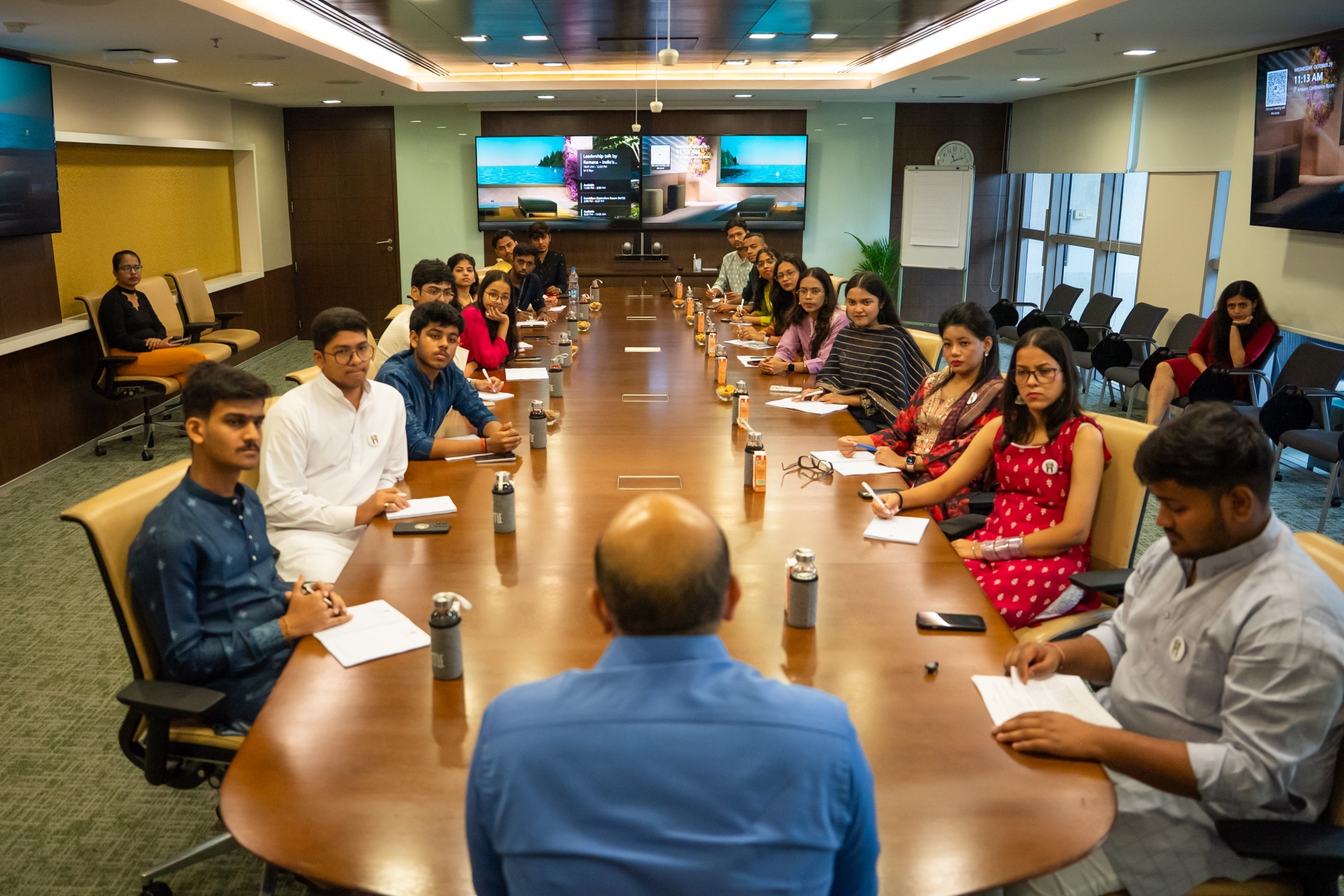
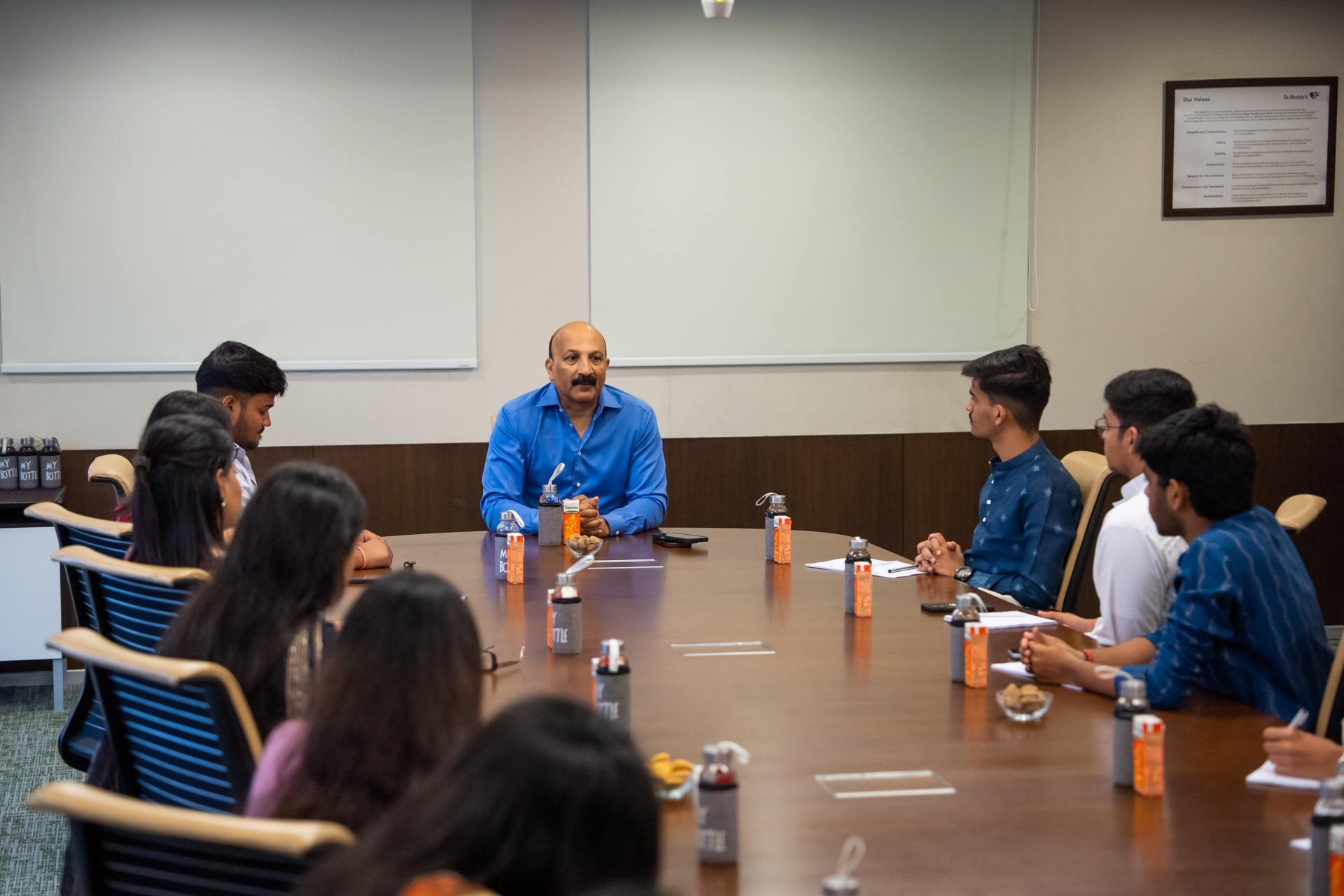
Dr Reddy’s Laboratories is one of the largest pharmaceutical companies in India. The company have global ties with over fifty countries. Mr. Raman addressed ten Parul University students and inspired them to take up a career in pharmacy. The session’s time limit exceeded the schedule given.
The session was based on five themes:
- Ownership: every employee at every level must take personal responsibility for outcomes, not just their part of the outcome
- Indian leadership on the global stage: Indian leaders are uniquely adaptable because India itself is diverse enough that managing across it is already a global skill
- Integrity as commercial advantage: a professional with integrity builds a reputation that compounds over decades, not a moral argument but a strategic one
- Women’s empowerment: companies that systematically exclude half the talent pool are competing with their best hand tied behind their back
- Operational excellence versus innovation: operational excellence can always be copied, innovation cannot
“Each one of us has to be the cause in the matter. Not the effect. The cause.”
The fifth theme got the most airtime. Operational excellence can be copied; that is, doing the current work slightly better than any competitor can be copied. Whereas innovations cannot be copied because they require a whole process from ideation to result, which cannot be produced overnight.
“Operational excellence can be copied. Innovation cannot.”
Session Two: Mr Chaitanya Shravan at T-Hub
The largest startup incubation center in India is T-Hub, based in Hyderabad. It has helped more than 2800 startups since their foundation, giving them a workspace, mentorship, and direct investor introductions. Mr. Chaitanya, who is a senior associate in innovation management at T-Hub, led the session. He opened by walking the students through how T-Hub actually supports startups at different stages. Each stage has different needs. An early-stage founder needs problem clarity more than capital. A growth-stage founder needs operational discipline more than vision.
The most practical section was on common founder mistakes. Mr. Shravan listed several in detail:
- Chasing investors before validating the product with real customers
- Hiring too fast and too expensively in the first year
- Ignoring the roadmap and chasing shiny distractions
- Treating investor meetings as a substitute for strategy
- Assuming a clear roadmap is optional rather than the foundation
“A clear roadmap and a strong business plan are the foundation. Investors are the afterthought, not the goal.”
The students asked how to validate a startup idea with no money for market research. Mr Shravan’s answer was direct: talk to 50 potential customers. Not 5. Not 10. 50. Ask them to describe the problem you think you are solving. If they describe it the way you do, you are onto something. If they describe it differently or not at all, rethink the problem.
Students interested in building their own ventures can explore the Parul Innovation and Entrepreneurship Research Centre (PIERC) which has incubated 254 startups and provided over Rs 20 crore in funding support.
Session Three: Mr Gaurav Wadhwa at Microsoft Garage
The Microsoft Development Centre in Hyderabad, it happens to be Microsoft’s largest research and development facility outside the United States. Within it sits Microsoft Garage, Microsoft’s experimentation and innovation part, it is a space made for employees to work and plan on ideas that are not yet official company products. Mr. Gaurav Wadhwa works as an innovation manager at Microsoft Garage. He led the session.
“You can be creative at any age. It is not something you were born with or without. It is something you practise.”
Let’s have a look at the four principles of Microsoft Garage:
- Association: A single person is not capable of having the full picture of the complex problem
- Trial & Error: Many ideas are based on experiments and trial & error, the faster you learn this, the faster you move on
- Creativity: Creativity comes out with practice and consistency, it is not a gift you receive
- Continuously Learn: the technology and art change with time, every year indicating stagnation can be a real risk.
Session Four: CSIR-IICT With Dr Rajendra Reddy and Team
The CSIR Indian Institute of Chemical Technology is one of India’s most important chemistry research institutions. It is part of the Council of Scientific and Industrial Research and is based in Hyderabad. Four researchers led the Parul University session: Dr Rajendra Reddy, Dr Surrendar Reddy, Dr Ramkrishan, and Dr Priyanka. The session was the most scientifically dense of the seven covered in this article.
The guiding principle at CSIR-IICT, repeated several times, is waste to value. The institute works on problems where something currently being thrown away can be converted into something useful. The four active research streams demonstrated to the students:
- Molecule development for COVID vaccines: the institute contributed to several vaccine programmes during the pandemic
- Conversion of wet waste into biogas: anaerobic digestion produces cooking fuel from organic waste that would otherwise end up in landfills
- Biodegradable plastics: materials that break down in reasonable timeframes rather than persisting in the environment for centuries
- PAT traps for eco-friendly pest control: reducing dependence on chemical pesticides in agriculture
One specific demonstration involved anaerobic digestion to produce an LPG-like fuel. The researchers showed how wet waste from a canteen could, through controlled fermentation, produce enough gas to cook the next day’s meal. The economics were not quite at commercial scale yet, but the direction was clear.
Session Five: Dr K. Mruthyunjaya Reddy at Birla Science Centre
The B.M. Birla Science Centre in Hyderabad is one of India’s oldest dedicated science education institutions. Dr K. Mruthyunjaya Reddy, Director at GPBAASRI, led the session for the Parul University students. The session was quieter than the corporate and research visits earlier in the tour. It was framed as a reflection on the arc of Indian science rather than a technical overview.
Dr Reddy walked the students through the evolution of technology from the early 20th century to the present, with a particular focus on India’s contributions. He spoke at length about the Indian Space Research Organisation, not as a list of missions but as a story of how a developing country built a space programme despite early skepticism. He spent particular time on Dr. A.P.J. Abdul Kalam, whose work underpins much of what ISRO and DRDO now do, and who served as a personal model of humility combined with ambition.
The core themes Dr Reddy emphasised:
- India’s space programme is a case study in building capability despite limited initial resources
- Dr A.P.J. Abdul Kalam’s legacy spans both ISRO missile and satellite work and DRDO defence research
- Humility combined with ambition is the pattern that shows up in every great Indian scientist
- Curiosity that never stops is the trait that separates sustained contributors from one-time performers
- Staying grounded in the work itself matters more than the recognition that follows it
“Being humble does not harm. It is the ones who forget to be humble who stop learning.”
Session Six: Daaji at Heartfulness Kanha Shanti Vanam
Kanha Shanti Vanam is the global headquarters of the Heartfulness movement, located on the outskirts of Hyderabad. It is one of the world’s largest meditation centres. Daaji, the fourth and current spiritual guide of the global Heartfulness movement, led the session for the Parul University students. The session was deliberately different in tone from every other session on the tour.
Daaji’s core message was about the relationship between mental well-being and sustained performance:
- Students and young professionals are increasingly told to work harder without being taught how to recover
- Productivity in short bursts followed by burnout is not a sustainable career model
- Meditation is not a luxury or a religious practice, it is a practical tool for managing mental load
- Heartfulness charges no fee for spiritual practice, access should not be gated by wealth
- The Kanha Shanti Vanam campus is entirely free to attend and can accommodate hundreds of thousands of visitors
“When you call your heart, nothing could go wrong.”
Session Seven: Ms Manju Latha Kalanidhi at Her Home
Ms. Manju Latha Kalanidhi is the City Editor at The New Indian Express in Hyderabad and the founder of the Rice Bucket Challenge, a grassroots social initiative that encouraged Indians to donate a bucket of rice to a person in need rather than pour ice water over their heads. The initiative went global in 2014 as an Indian counter to the ice bucket challenge. The final session of the tour was held at her home rather than at a newspaper office.
Her position on modern journalism was direct. She had watched the industry change from the 1990s to the present and she did not think the changes had been good. Her core observations:
- Rewards in Indian journalism have shifted from accuracy to speed
- Reporting has been replaced by opinion and commentary at many publications
- Depth has been replaced by virality as the success metric
- Readers increasingly cannot distinguish a trained journalist from an influencer
- Print media in its current form will be dead within the next decade unless readers learn to pay for quality
She also spoke about the values of The New Indian Express specifically: honesty and integrity as the non-negotiable core of the work, even when those values cost the publication stories or readership. A journalist who chases the viral story sacrifices the one thing that made journalism valuable in the first place, which is the trust of the reader.
How These Sessions Map to Parul University Programmes
Each of the seven sessions maps to specific Parul University academic pathways. A student who leaves this article wondering which program fits their interests can trace the connection directly:
- Dr Reddy’s session: B.Pharm, M.Pharm, B.Sc Chemistry, MBA at the Parul Institute of Management, Biotechnology programmes
- T-Hub session: BBA, MBA, Parul Innovation and Entrepreneurship Research Centre (PIERC) which has incubated 254 startups
- Microsoft Garage session: B.Tech Computer Science, B.Tech IT, B.Tech AI/ML, Apple Lab, Cloud Computing Lab
- CSIR-IICT session: B.Tech Chemical Engineering, B.Sc and M.Sc Chemistry, Environmental Engineering, Micro Nano Research and Development Center
- Birla Science Centre session: B.Sc and M.Sc Physics, B.Tech Aerospace programmes
- Heartfulness session: relevant to holistic wellness and campus counselling programmes
- New Indian Express session: Bachelor and Master programmes in Journalism and Mass Communication, Film and Journalism Studio on campus
How Parul University Students Documented These Sessions
Multiple Parul University students wrote detailed LinkedIn posts covering these seven sessions. Ms.Monika Sachdeva published four dedicated episode posts covering Dr Reddy‘s and T-Hub, Microsoft Garage and Birla Science Centre, MCEME and The New Indian Express, and CSIR-IICT and Heartfulness. Ms. Namita wrote separate posts on the Microsoft Development Centre and Dr Reddy’s Laboratories sessions.
Frequently Asked Questions
Who represented the Dr. Reddy's Laboratories?
Dr. Reddy's Laboratories' Vice President and Head of Branded Markets Mr. M.V. Ramana spoke at the event and shared his views about responsibilities, integrity, women's empowerment, and Indian leaders and mentioned the difference between operational excellence and innovations.
What is T-Hub?
T-Hub is India's largest startup incubation center in Hyderabad. They have supported more than 2800 startups in India.
What is Microsoft Garage and where is it located?
Microsoft Garage is Microsoft's innovation and experimentation arm, housed within the Microsoft Development Centre in Hyderabad, Microsoft's largest research and development facility outside the United States. Mr Gaurav Wadhwa leads Innovation Management at Microsoft Garage.
What research does CSIR-IICT do?
CSIR Indian Institute of Chemical Technology works on waste-to-value research, including molecule development for COVID vaccines, conversion of wet waste into biogas through anaerobic digestion, biodegradable plastics, and PAT traps for eco-friendly pest control.
Who is Daaji at Heartfulness?
Daaji is the fourth and current spiritual guide of the global Heartfulness movement. He leads Kanha Shanti Vanam on the outskirts of Hyderabad, one of the world's largest meditation centres. Heartfulness does not charge fees for its spiritual practices.
Who is Ms Manju Latha Kalanidhi?
Ms Manju Latha Kalanidhi is the City Editor at The New Indian Express in Hyderabad and the founder of the Rice Bucket Challenge, a grassroots initiative that encouraged Indians to donate rice to those in need as an Indian counter to the 2014 ice bucket challenge.
How do Parul University students gain access to such a range of Hyderabad institutions in one tour?
Through fully sponsored programmes like the IIMUN Hyderabad Leadership Tour, where Parul University covered 100 percent of the costs for 10 merit-selected students. The university runs similar programmes regularly as part of its broader 146 Practical Learning Tours across 280 companies in 19 cities.