From Tribal Gujarat to National Recognition: Parul University's Sickle Cell Research Journey!
- → Research that started by accident.
- → Building the work.
- → Into the communities!
- → The team, and the leadership behind it.
- → Frequently asked questions.
Research that started by accident
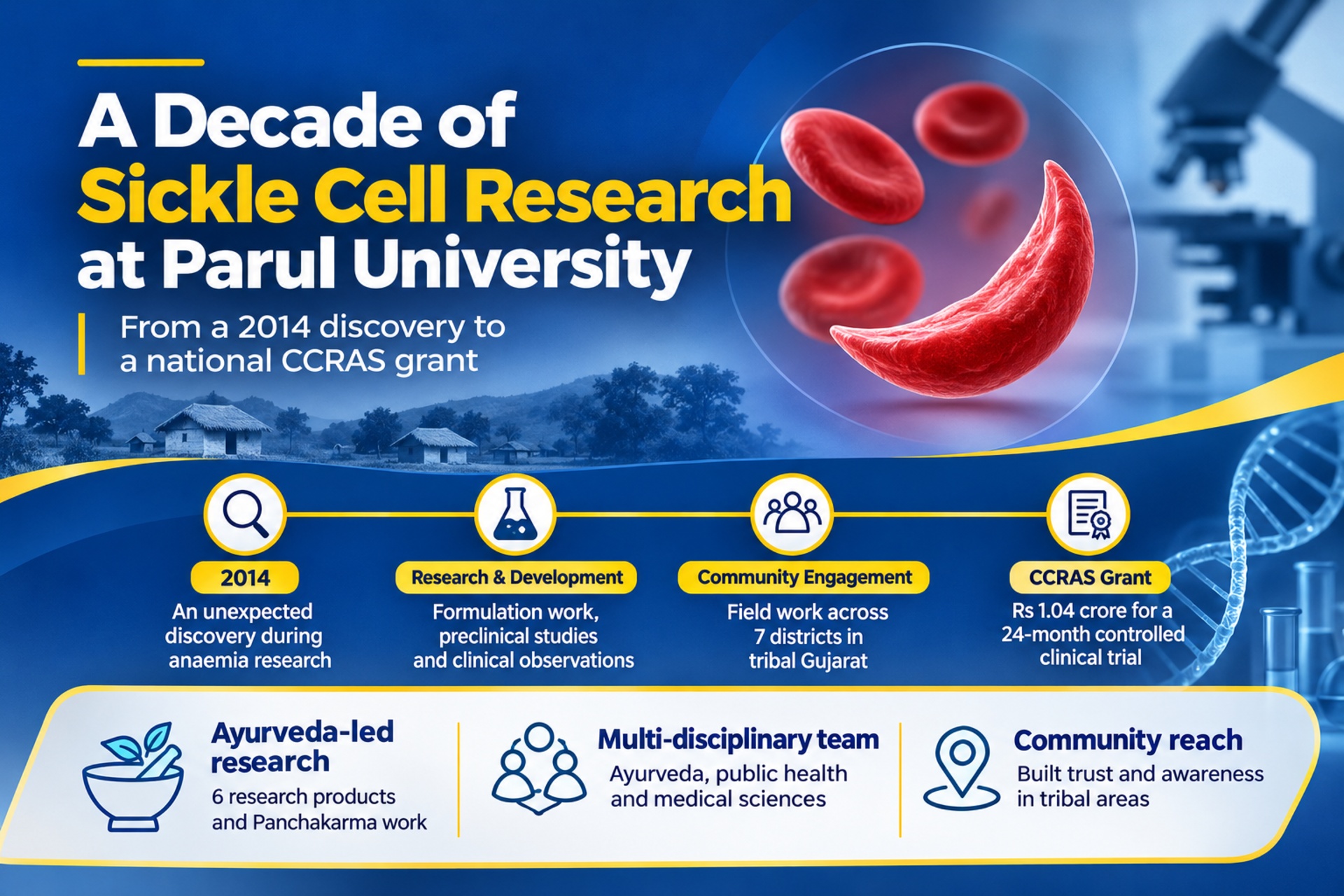
The national grant did not arrive out of nowhere. It rests on more than a decade of work at Parul Institute of Ayurveda, and the way that work began is instructive. In 2014, postgraduate researchers at the institute set out to study iron deficiency anaemia. As they worked through cases, they kept finding that the condition underneath was something else: sickle cell disease. Dr. Akruti Gupta was an early mover in that research, and those first observations turned the team’s attention toward a condition they had not set out to study.
Building the work!
What followed was slow, cumulative work rather than a single breakthrough. With Dr. Madhusudan Pandya, the team began developing early formulations and running preliminary studies, including preclinical safety work in laboratory animals. Over time, and with contributions from researchers including Dr. Siddhi Patil and Dr. Anita H., the institute developed six research products through its research and clinical work, and it explored Panchakarma approaches alongside them.
The honest way to read that early phase is as encouragement rather than proof. The team has described promising observations in its earlier work, and those observations are what justified carrying the research forward into a formal, controlled trial. They are the reason to run a rigorous study, not a substitute for one, which is exactly why the national trial is designed the way it is.
The communities!
The harder half of the work was never in the laboratory. Sickle cell disease sits in communities where awareness of it varies and where a hereditary condition can be difficult to explain to families, and research there depends entirely on trust. The team extended its field activities across seven districts, including areas around Dahod and Chhota Udaipur, visiting locations, engaging patients, and offering access to its research-based interventions, while patients also came to the institute for care.
That reach was built person by person. Dr. Swapnil Raskar credits Dr. Pina Patel, whose familiarity with the Valsad region helped the researchers connect with the local community and earn the confidence needed for people to take part in clinical examinations. Local medical professionals, among them Dr. Dexter Patel at the Bharuch government hospital and Dr. Kairav Patel, helped strengthen that engagement, and a collaboration with Aarogya Bharti, through Dr. Jayeshbhai Pandya, extended the outreach further across south Gujarat. Explaining the disease to parents and caregivers, its hereditary nature and the importance of timely and continued medical attention, became as much a part of the work as any clinical procedure.
The team, and the leadership behind it!
The research has grown into a wider group, with researchers including Dr. Trupti Gamit, Dr. Vidhi Patel, Dr. Pragya Sharma, Dr. Rajvi Pandya, Dr. Rohan Dodiya and Dr. Mansi Mistry carrying the work forward, with operational and administrative support from Dr. Ravi Pandya, Deputy Medical Superintendent, who has coordinated transport, manpower, and sample handling for the fieldwork.
The program has been supported through the institute’s leadership by Prof. Dr. Hemant D. Toshikhane, Dean and Principal of Parul Institute of Ayurveda, and by Dr. Geetika Madan Patel, Vice President for Quality, Research, and Health Sciences, and Dr. Komal Patel, Vice President for Medical and Paramedical Health Sciences, whose backing gave the team academic guidance, institutional support, and access to healthcare resources.
The through-line across the decade is consistency. A line of research that began with a misdiagnosis in 2014 became a sustained program of formulation work, preclinical study, community engagement across tribal Gujarat, and clinical experience, and it is that accumulated understanding of the condition, of the patients, and of the difficulty of doing research among affected communities that the national trial is built on. Check out how it’s ideated and aimed for:
| The research program at a glance | Detail |
|---|---|
| Began | 2014, from research into anaemia at Parul Institute of Ayurveda |
| Field reach | Seven districts of Gujarat, including Dahod and Chhota Udaipur |
| Research outputs | Six research products were developed; Panchakarma approaches were explored |
| Community partners | Aarogya Bharti and local medical professionals across South Gujarat |
| Where it led | A national CCRAS-funded clinical trial, Project CPH0014 |
Source: Parul Institute of Ayurveda research team.