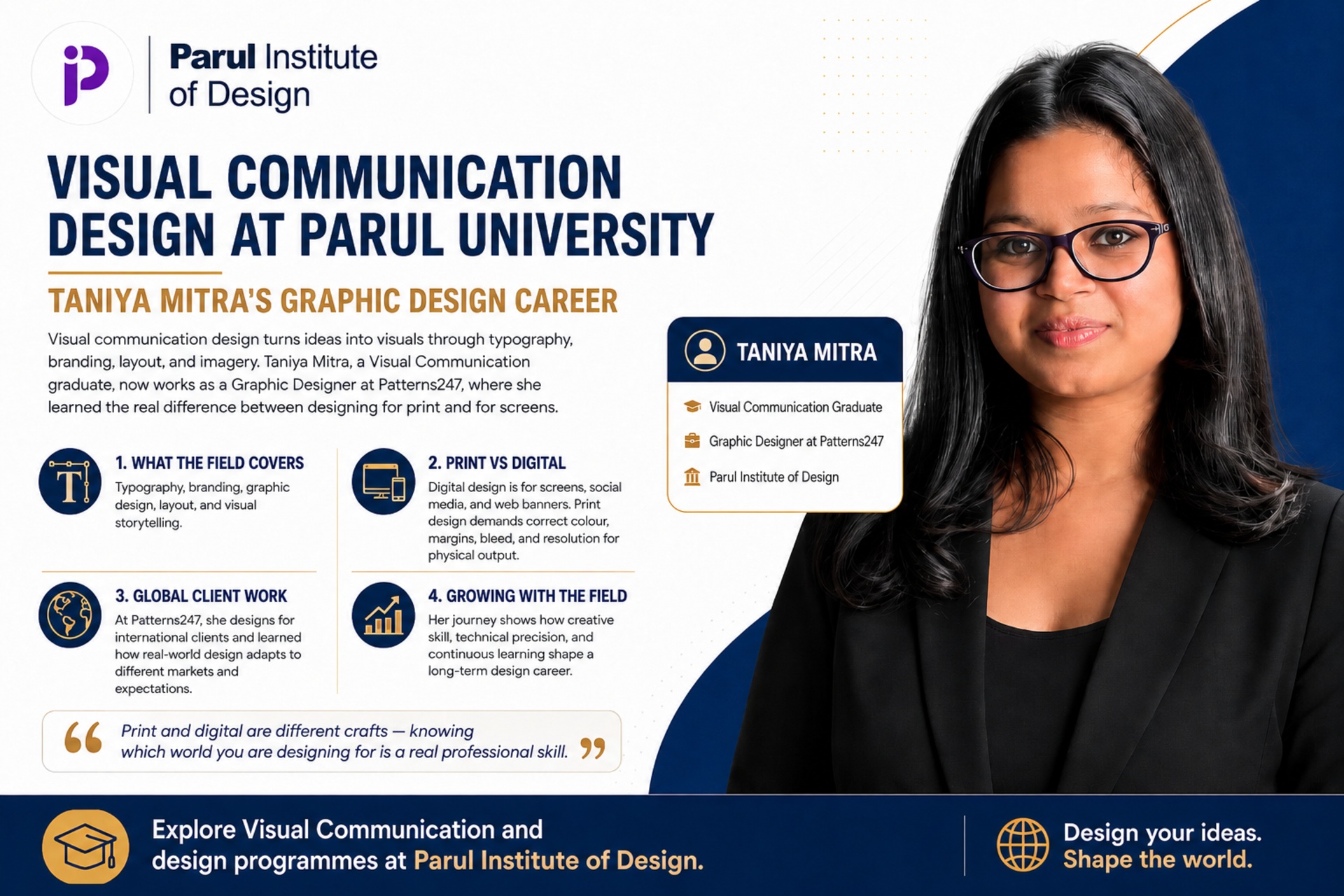
Every logo, poster, package, and app screen you notice is the work of visual communication, the discipline of conveying ideas and information through visuals. Taniya Mitra, a visual communication graduate of Parul Institute of Design, now works as a graphic designer at Patterns247, a Vadodara studio serving international clients. Her path shows both what the field involves and a practical reality of the work that classrooms rarely emphasise.
A quick clarification, because the terms confuse people: visual communication (graphic design, typography, branding) is about creating visuals to communicate and is different from visual merchandising, which is about arranging products in retail spaces. This article is about the former.
Visual communication is a field that requires you to build on core skills. Taniya’s project work includes them as well. The areas covered are typography, user experience concepts, general graphic design and branding. Together, these let a designer turn a message into something people understand and respond to at a glance. It is a field that rewards both a strong visual sense and technical precision, and it underpins everything from
The Print Versus Digital Divide
One thing that students should observe is the divide between digital and print design. They are both different crafts. At Patterns247, she learned that design work has different departments, split into two, one digital and the other print. Digital focuses on social media, graphics, website banners, etc., while print focuses on paper, fabric, or other surfaces, etc.
Taniya works in print, and every file she creates is formatted knowing it will be physically printed. Print design demands a different technical understanding of colour, margins, and resolution than digital, and knowing which world you are designing for is a real professional skill.
Designing for International Clients
Taniya’s studio works primarily for clients in the United States, which unusually shapes her day: because of the time difference, she works night shifts, designing for American clients while much of India sleeps. It is a reminder that a design career can be global from the start and that adaptability to different markets, expectations, and even working hours are part of the professional reality. Working with international clients also sharpens a designer’s understanding of how real, paying clients think, which differs markedly from academic briefs.
Also Read: How to Make a Career in UX/UI Designing: A Career Guide
Growing With the Field
Taniya is candid that her professional experience reshaped how she sees the work, and she speaks warmly about how much the design programme itself has evolved. Having watched the department grow, she notes that concepts once taught late in the degree are now covered much earlier, and she encourages prospective students that a design career at the institute is a genuinely strong choice today. She views her current role as a learning phase and plans a master’s degree later to move toward a senior design position, a considered, long-term approach to a creative career.
Frequently Asked Questions
What is visual communication design?
Visual communication design is a field of design where ideas and information are expressed through graphic design, typography, branding, layout and imagery. Logo design, posters, packaging, marketing materials, and digital graphics are a few examples. It is different from visual merchandising. Visual merchandising focuses on arranging products in retail spaces.
What duties does a graphic designer perform?
Graphic designers work on creating content that can be communicated through typography, images, colour and layout. The work spans across branding, marketing materials, social media, packaging and print. Graphic designers combine visuals and imagination to communicate the idea in a way that the audience can understand easily.
How are print and digital design different?
Digital design includes designing for screens such as social media, websites, ads, etc. While print design includes creating the design layout and working in a way that can be used for physical form such as newspapers, fabric or any other surface. Print design requires knowledge of colour systems, margins, bleed and resolution that suits the physical printing, which differs from designing for screens.
What subjects are important in visual communication design?
The important subjects that one shall study are typography, graphic design, branding, and user experience concepts. Students should also know about layout, colour theory, and relevant design software. These concepts together build the foundations of technical and creative knowledge required for print and digital media.