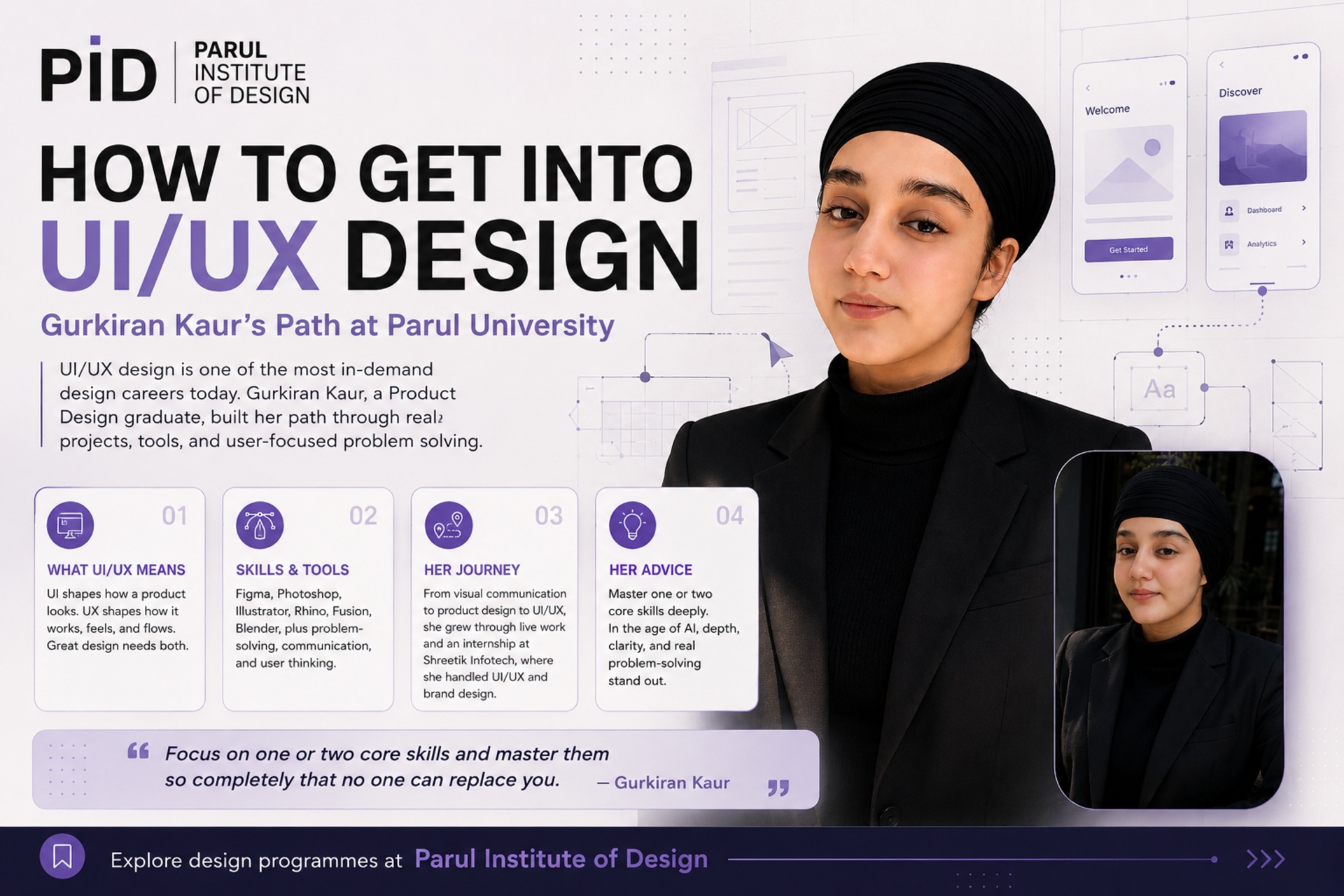
UI/UX design, shaping how people interact with digital products, has become one of the most sought-after paths in design. Gurkiran Kaur, a product design graduate of Parul Institute of Design, moved into it and, during an internship at Shreetik Infotech, ended up as the company’s only designer, handling UI/UX and brand design single-handedly. Her experience is a realistic guide to what the field asks of you and how to prepare for it.
UX/UI design is related to how applications, websites, etc., look and work. UI is User Interface, and it is related to how a digital product looks, including how it looks on the screen, layout, and visual elements, while UX is User Experience, which focuses on how it works, how it feels to use and the flow, the logic that goes behind making it, and the ease of the whole journey. The two are adjacent areas, different but inseparable: an interface that is smooth and elegant but confusing fails to find its usability, and a logical flow that looks unfinished also struggles to win.
A UI/UX designer holds both together, which is why it is as much about thinking clearly as designing attractively.
Also Read: Industrial Design Career at Parul University: Puja Sarmah on Designing for Manufacturing
The Skills and Tools You Need
Gurkiran studied the market well, built an industry-standard toolkit during her studies and brought it directly into use in her role. Her software spanned Figma, Photoshop, Illustrator, Rhino, Fusion, and Blender, with Figma at the centre of interface work. But tools are only half of it. She designed an entire digital platform from scratch; she made this as the role tested her on it. It also included a project in the Banking, Financial Services and Insurance (BFSI) sector, and present her work to share what decisions she took in high-stakes meetings. Through this, her skills, such as designing, communication and problem-solving, were tested.
You Do Not Have to Start in UI/UX
Gurkiran’s path is a useful counter to the idea that you must choose your specialisation and never move.
Her initial instinct was inclined towards visual communication; she spent the initial few months in it, then made the shift to product design and found herself settling in UI/UX. As the different fields of design share a common foundation, the shift was not dramatic. The common foundation focuses on visual thinking, user thinking, and problem solving, so skills built in one transfer to another. Many UX/UI designers come to the field from different starts and unrelated or related fields.
Advice That Matters
Focus on one or two core skills and master them so completely that no one can replace you.
– Gurkiran Kaur
Gurkiran’s strongest advice is about depth over breadth, and she ties it directly to artificial intelligence. She advised taking up one or two core skills and becoming advanced in them. As AI is quick with automating routine and average-level work, she argues, a designer whose skills are just average will struggle. It is best to master the core skill and level up, as it is hard to replicate. She urges students to stay updated with the industry and work on the roles and skills that are in demand related to their skillset rather than investing in skills the market no longer needs.
Theory and Practical Knowledge
Like others, Gurkiran noticed a gap between classroom theory and practical knowledge: Students, after studying the theory, struggle with solving real problems. They struggle with practical work, the live projects. Real work demands constant adaptation, thinking about ideas on the edge, staying on your toes and combining ideas to solve problems that don’t come with a textbook answer. The point isn’t that theory is useless; it’s that theory only becomes real skill through actual projects, internships, and live work. How students can find that kind of experience is covered separately in how design students actually get hired.
FAQs
How can one get into the UX/UI designing field?
To get into the UX/UI design field, make your foundations strong in visual and user-centred design. Practise and learn the industry-standard tools such as Figma, and practise by taking projects that require designing real interfaces and user flow for actual or self-initiated projects. Do as many projects as possible, to include them in the portfolio. Develop a portfolio and understand UX and UI in depth through real examples and experiences with internships or live projects.
How to differentiate between UX and UI?
UI (User Interface) and UX (User Experience). The two fields are different yet inseparable. UI focuses on a digital product's look, its screens, layouts, colours and visual elements. UX design focuses on how it should work, the feel, the logical flow and overall ease of the journey.
What skills and tools does a UI/UX designer need?
Core tools include Figma for interface design and prototyping, alongside software such as Photoshop and Illustrator. Beyond tools, UI/UX designers need user-centred thinking, problem-solving, visual design sense, and strong communication to present and defend design decisions. Increasingly, deep mastery of a few core skills is valued over broad, shallow knowledge.
Is UI/UX design a good career with AI advancing?
It can be, but the advice from working designers is to develop deep, hard-to-replace expertise rather than average general skills, since routine work is most exposed to automation. Mastering core UI/UX skills, staying current with industry demand, and focusing on problem-solving and user understanding, which AI does not replace easily, are the ways to build a resilient career.