- The Journey
- Modernising ancient heritage
- The brands
JP Name
A Vadodara fragrance and incense enterprise founded by Hardik and Yash Buddhdev, it carries a family identity, the JP name, that goes back to the founder's grandfather and his cousins
Ancient Heritage
If we track back to time India has a good history of incense, aromatic woods, ittar, flowers, essential oils, and traditional fragrances. When it comes to mass production, the heritage formula might struggle to find its place. JP Perfumery Works didn't leave the old formula instead used to make it relevant for present-day customers
Different Brands
The founder described a broader ambition running through the range: to challenge the dominance of synthetic products, or in his words, to break the synthetic market.
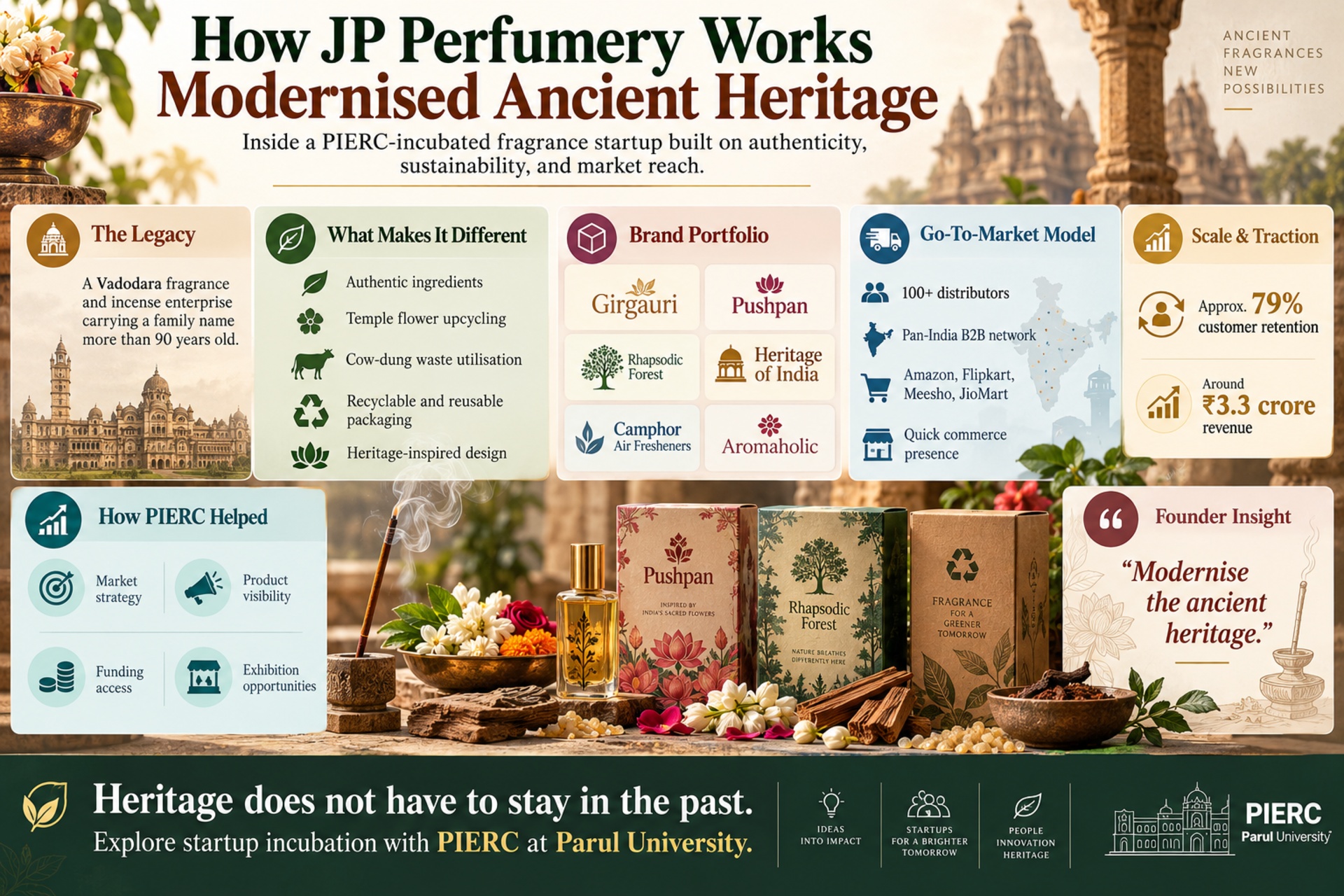
Most startups begin from scratch. JP Perfumery Works began from a 90-year-old name. A Vadodara fragrance and incense enterprise founded by Hardik and Yash Buddhdev, it carries a family identity, the JP name, that goes back to the founder’s grandfather and his cousins. The present generation’s work has been to take that inherited trust and build a contemporary business around it, with incubation support from PIERC, the Parul Innovation and Entrepreneurship Research Centre at Parul University. The founder’s phrase for the whole project is simple: modernise the ancient heritage.
The contemporary chapter of the business started with a question rather than a product. During the COVID-19 pandemic, the founders began reflecting on how synthetic everyday life had become, and asked whether the ingredients in the things people use most routinely were authentic. Applied to their own category, the question was direct.
“What we are breathing in incense and perfumes, are we breathing in synthetic or harmful chemicals?”
That concern, framed by the founder as the motivation behind the venture, pointed them toward incense and fragrance for a practical reason: it is an established, fast-moving category people already use daily, in homes, places of worship and personal routines. Rather than invent a new habit, they set out to change how an existing one could be produced and experienced, combining traditional materials and cultural practices with contemporary formulation, packaging and distribution.
Modernising ancient heritage, as an operating model
If we track back to time India has a good history of incense, aromatic woods, ittar, flowers, essential oils, and traditional fragrances. When it comes to mass production, the heritage formula might struggle to find its place. JP Perfumery Works didn’t leave the old formula instead used to make it relevant for present-day customers. Market where there is a lot of competition and prices are competitive, it is difficult for brands that have established themselves to make a mark and revive the old formula. This company came with a credible story, having authenticity, sustainability, and heritage giving it a new layer to communication.
Here, for this business, authenticity is how it work on to develop the product from reused formulas and resources and the packaging is designed.
The brands, and the idea behind each one
The clearest way to understand the company is through its brands, each of which attaches a product to a larger purpose.
- Girgauri develops products using cow dung from the Gir A2 breed. The deeper purpose is economic: non-milking cows become difficult for cowsheds to maintain, and the company tries to build an economic model, with guidance on animal care, that supports cowsheds and reduces the risk of distress sales.
- Pushpan: Pushpan is the temple flower waste collected. The flowers are usually dumped, but when they are used, and converted into natural fragrance, this in turn becomes a sustainable product. Giving a material that has completed its original purpose a second one.
- Rhapsodic Forest This is related to rare fragrant woods. It is agarwood, and juniper. The founder says real, authenticity is hard to be found in the market. So sourcing and authenticity are the priority. The stated ambition is to offer customers the original character of traditional fragrant woods rather than a synthetic approximation.
- Heritage of India is the cultural line: five heritage fragrances presented through incense, with packaging drawing on the traditional art of Meenakari, so the product carries its heritage through design as well as scent.
- Camphor air fresheners were reworked using 100 percent Camphor with jute-based outer packaging designed to be recyclable, biodegradable and reusable until the product expires.
- Aromaholic is the perfume line, developed in India using a French pyramid formulation that layers multiple essential oils, presented as an alternative to conventional chemical-and-fixative perfumery.
The founder described a broader ambition running through the range: to challenge the dominance of synthetic products, or in his words, to break the synthetic market. That is a deliberately hard target, because synthetic fragrances are familiar and widely available, so an alternative has to give customers a convincing reason to change what they already buy.
Sustainability and social purpose, built into the product
The company’s sustainability thinking extends past ingredients to the whole product experience, on the logic that an eco-conscious product wrapped in single-use plastic undermines its own purpose. Recyclable and reusable packaging sits alongside the waste-utilisation brands. The founder specifically identified women empowerment and rural empowerment as focus areas, with Girgauri as the rural dimension and the waste-based lines as the environmental one. The common thread is a view that a product’s value should not be measured only by its selling price, but also by where its materials come from and what happens to them after use.
Going to market: why offline mattered as much as online
A good product is only half a startup; the other half is reaching customers. JP Perfumery Works deliberately chose not to rely on e-commerce alone, recognising that fragrance remains strongly tied to physical retail and B2B distribution. The founder’s aim was for the company’s alternative to be available wherever a customer already decides to buy a fragrance or incense product. That produced a dual model: a Pan-India distributorship the founder describes as more than 100 distributors supplying a B2B chain of wholesalers and retailers, alongside an online presence across Amazon, Flipkart, Meesho and JioMart, with Girgauri also on Blinkit as the company moves into quick commerce. According to the founder, roughly 90 percent of sales are B2B, with e-commerce serving awareness as much as direct revenue.
The company reports a customer retention ratio of approximately 79 percent and revenue of around 3.3 crore rupees, figures stated by the founder and company profile. Its B2B network, the founder says, was built largely through exhibitions, where potential customers could experience the products and understand the thinking behind them before ordering.
“A relation was built, the product experience was there.”
The role of PIERC
The founder credited PIERC, the incubation ecosystem at Parul University, with support that went beyond infrastructure. By his account, PIERC helped the company examine its market strategy, work on product visibility, and access government funding opportunities, and opened doors to exhibitions connected with Vibrant Gujarat, the GCCI and the Odoo Experience in Gandhinagar. For a growing company, that kind of exposure is valuable precisely because it substitutes direct, credibility-building customer interaction for expensive paid advertising. PIERC is positioned as open to both Parul University students and external founders, and JP Perfumery Works is an example of the latter: an established family business using an institutional incubator to build its contemporary chapter.
Also Read: How Incubators Support Startups from the Initial Stage
The founder's lessons for other entrepreneurs
Several points from the interview generalise well beyond fragrance. The first is the value of a Standard Operating Procedure, an SOP, as identity rather than paperwork. The founder’s point was that entering an existing category does not create differentiation on its own; a startup has to define how it will operate differently. For JP Perfumery Works, that SOP is built around recycled materials, heritage and authenticity, and it is what lets the company state plainly how it differs from others.
The second is patience, stated without the gloss social media usually puts on entrepreneurship.
“It will not be a complete empire overnight. It has to be given time and it will be achieved.”
The third is the hardest and most useful: when you build a product without an established market, you cannot wait for demand to appear. You invest before you know the market will respond, and you create the market alongside the product.
“We have to make the requirement and the market.”
The founder was candid that this means difficulty, in his words, every hour, and that the real test is how an entrepreneur responds to it rather than whether difficulty appears. The company’s answer has been to keep developing customer awareness rather than abandon an idea because a ready-made market did not exist.
Heritage, awards and the road ahead
The 90-plus-year JP name is the company’s distinctive asset, and the founder is clear about what it now means.
“It has become a trust and a legacy.”
That trust is both an advantage, a familiar name eases entry into a market, and a responsibility, because a family legacy must be protected with every new product. The company has combined that heritage with modern distribution, product innovation, sustainability and digital visibility rather than choosing between tradition and modernity. Its recognitions include an MSME Award and a Best Brand and Packaging Award of the Year, which the founder valued less as personal achievement than as visibility alongside older, larger businesses in an established industry. His stated ambition for the future is as much about example as expansion. Learn about startups and innovation with an MBA in innovation and entrepreneurship.
“We want to be an inspiration for people who want to do something good.”