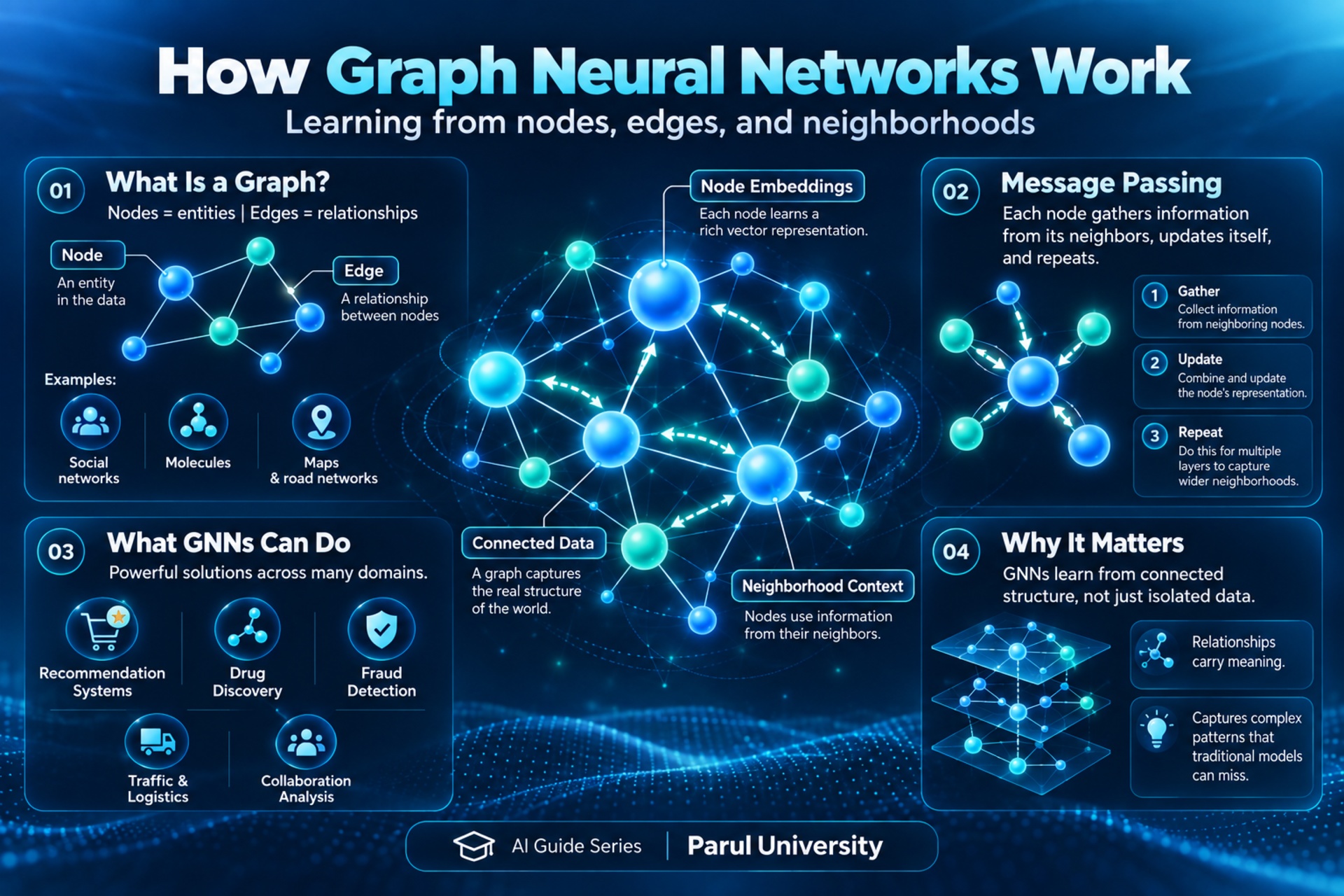
When Parul University researchers studied academic collaboration as a network, they reached for a specific AI tool: the graph neural network. It is one of the most important recent advances in artificial intelligence, and understanding it is easier than it sounds.
First, What Is a Graph?
In computing, a “graph” does not mean a bar chart. It means a network: a set of items (called nodes) connected by relationships (called edges). Your social network is a graph, people are nodes, friendships are edges. So is a molecule (atoms and bonds), a road map (junctions and roads), a citation network (papers and references), and a research community (authors and collaborations). Graphs are everywhere, because so much of the world is defined by how things connect.
What Is a Graph Neural Network?
A graph neural network (GNN) is a type of AI, a neural network, designed specifically to learn from data structured as a graph. This matters because most traditional neural networks expect neat, regular data: a grid (like an image) or a sequence (like text). They struggle with the irregular, interconnected structure of a network. GNNs are built for exactly that structure. Crucially, they learn not just from each item’s own features, but from its connections, capturing the information hidden in relationships that other models miss.
How Do GNNs Work? The Idea of “Message Passing”
The core idea behind most GNNs is beautifully intuitive: you are shaped by your neighbours. A GNN works through a process often called “message passing.” Each node gathers information from the nodes it is connected to, combines that with its own, and updates its understanding of itself. Repeat this over several rounds, and each node’s representation comes to reflect not just itself, but its wider neighbourhood in the network. The result is a rich numerical summary (an “embedding”) for each node that captures its position and role in the graph, which the AI can then use to make predictions.
What Can GNNs Do?
Because so many important problems are really network problems, GNNs have a wide and growing range of uses:
- Recommendation systems, suggesting friends, products, or content based on the network of users and items.
- Drug discovery and chemistry, predicting the properties of molecules by treating them as graphs of atoms and bonds.
- Fraud detection, spotting suspicious patterns in networks of transactions.
- Traffic and logistics, forecasting flow across road and transport networks.
- Social and collaboration analysis, understanding how influence and information move through communities, as in research on academic collaboration networks.
Why GNNs Matter
The rise of graph neural networks reflects a deeper insight: in many systems, the relationships between things carry as much information as the things themselves. A person, a molecule, or a paper cannot be fully understood in isolation, only in the context of its connections. GNNs give AI a way to learn from that context, opening up problems that were previously hard to model. As part of the fast-moving world of modern AI, alongside advances like agentic AI, they are a field where researchers and students are actively shaping what comes next.
Quick Answers/ FAQs
What is a graph neural network in simple terms?
A graph neural network (GNN) is a type of AI designed to learn from data structured as a network, that is, items (nodes) connected by relationships (edges). Unlike traditional neural networks that expect grid or sequence data, GNNs learn from connections, making them ideal for social networks, molecules, maps, and collaboration networks.
How do graph neural networks work?
Learning and understanding about the technology is interesting. GNNs is one of them. Most of GNNs use "message passing". Here each node collects or gathers information. The information is collected from its neighbours. It is combined with its own and updated to represent it. Repeated over several rounds, this lets each node’s representation capture its wider neighbourhood in the network, producing a rich summary (an embedding) the AI uses to make predictions.
What are graph neural networks used for?
GNNs are used in recommendation systems, drug discovery and chemistry (modelling molecules), fraud detection (transaction networks), traffic and logistics forecasting, and social or collaboration analysis, essentially, any problem where the relationships between items matter as much as the items themselves.