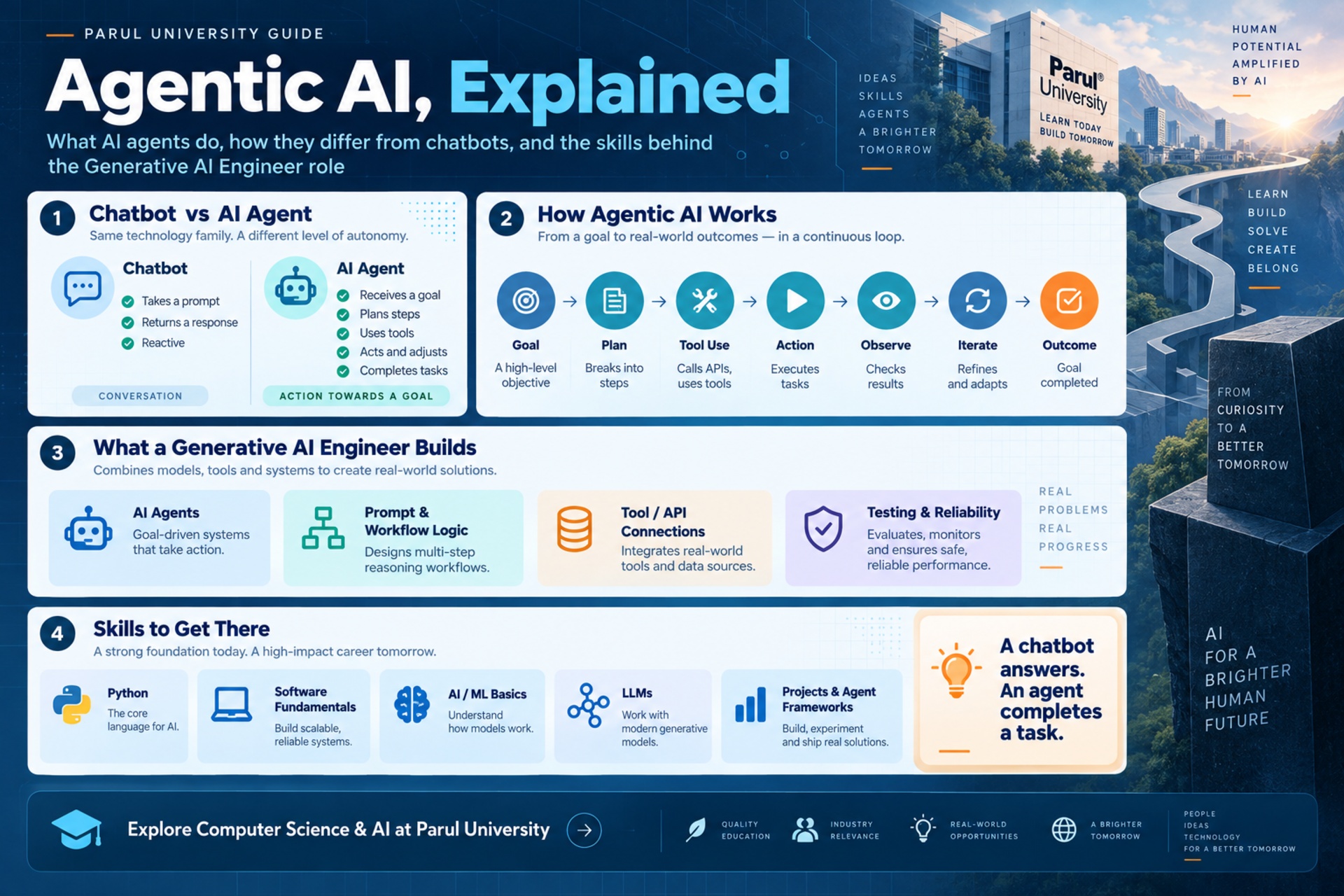
Most people’s experience of artificial intelligence is a chatbot: you ask, it answers. But AI is rapidly moving beyond that, from systems that respond to systems that act. This shift, called agentic AI, is reshaping the field and creating brand-new careers. A recent Parul University graduate, Vishnu Vardhan, now works as a Generative AI Engineer building exactly these systems, so this is not a distant future; it is a job students can aim for today.
A traditional generative AI model, like a basic chatbot, is reactive: it takes your prompt and returns a response, and stops there. An AI agent is different. Given a goal, it can plan the steps needed to reach it, take actions, use external tools (searching the web, running code, calling other software), observe the results, and adjust, often looping through this process until the task is done. In short, a chatbot answers a question; an agent completes a task. That leap, from answering to acting, is the essence of agentic AI.
Agentic AI Explained
Today, with increasing usage of AI, many new developments have emerged. Companies have started using bots and agentic AI. Agentic AI refers to AI systems built around autonomous agents that can solve queries, make plans, make schedules, and pursue a goal with only a few instructions. Rather than giving a prompt and one reply, agentic AI breaks a complex goal into smaller tasks. It then decides how it should be answered. It uses tools to get things done and chains the steps together into a workflow. For example, if asked to research a topic and produce a report, an agent might plan the sections, search for information on each, draft the content, and assemble the result, coordinating multiple steps on its own. These “agentic AI workflows” are what a Generative AI Engineer designs and builds.
What Does a Generative AI Engineer Do?
A Generative AI Engineer builds applications on top of generative AI models, and increasingly, that means building agents. The role typically involves designing AI agents and agentic workflows, connecting AI models to tools and data sources, engineering the prompts and logic that guide an agent’s behaviour, and testing and refining the whole system so it is reliable. It sits at the intersection of software engineering and AI, one of the most in-demand combinations in technology right now, precisely the combination Vishnu Vardhan built during his CSE (AI) degree.
The Skills to Get There
Agentic AI is advanced, but the path into it builds on familiar foundations:
- Strong programming (Python is standard) and solid software fundamentals.
- AI and machine learning basics, and a working understanding of large language models (LLMs).
- Skills: The skill of directing AI models effectively.
- Familiarity with agent frameworks and tools that connect models to actions and data.
- Project experience, building real applications, since this field rewards builders over theorists.
This is a natural extension of becoming an AI Engineer, with a focus on the newest layer of the stack. Students at Parul University build these foundations hands-on, training on GPU-powered infrastructure at Lakshya 2047, including the NVIDIA lab.
Why This Is the Career to Watch
Agentic AI is widely seen as the next major phase of the AI revolution, moving AI from a helpful assistant to an autonomous doer across industries, from customer service and software development to research and operations. That makes the Generative AI Engineer one of the most future-proof roles a student can aim for. As Vishnu Vardhan’s path shows, the route is clear: build strong AI and programming fundamentals, learn to work with LLMs and agents, and, above all, build real projects. The students who start now will help define what comes next.
Frequently Asked Questions
How to define agentic AI?
To understand AI, you should know its meaning too. AI includes agentic AI. Basically, agentic AI is an AI system for creating autonomous agents. So, they pursue goals with only a few instruction steps. It is different from a chatbot that is designed to answer questions. AI agents help with planning, scheduling, taking actions, observing results and making variations till the task is completed. It shifts AI from answering questions to completing tasks.
How is an AI agent different from a chatbot?
Chatbots and agentic AI are different. A chatbot is designed to answer. It is reactive. You give a prompt, and in return it gives a response. Whereas an AI agent is goal-directed. It has an aim, an objective to serve. It is designed to help you with planning steps, uses external tools, takes actions and loops until the task is done. In short, a chatbot answers a question, while an agent completes a task.
What should one do to become a Generative AI Engineer?
Those who pursue engineering wish to land at the best workplace with a good brand. Vishnu Vardhan, through his efforts, could achieve that. One should work on making their foundations strong. Especially Python and software fundamentals; learn AI/ML basics. You should also learn how large language models work. Study and practice how to develop prompt-engineering skills. Study in depth to understand frameworks for agents and tools. Most importantly, build one real AI project. The role combines software engineering with AI and rewards hands-on builders.


