Turning Collaboration Into a Network
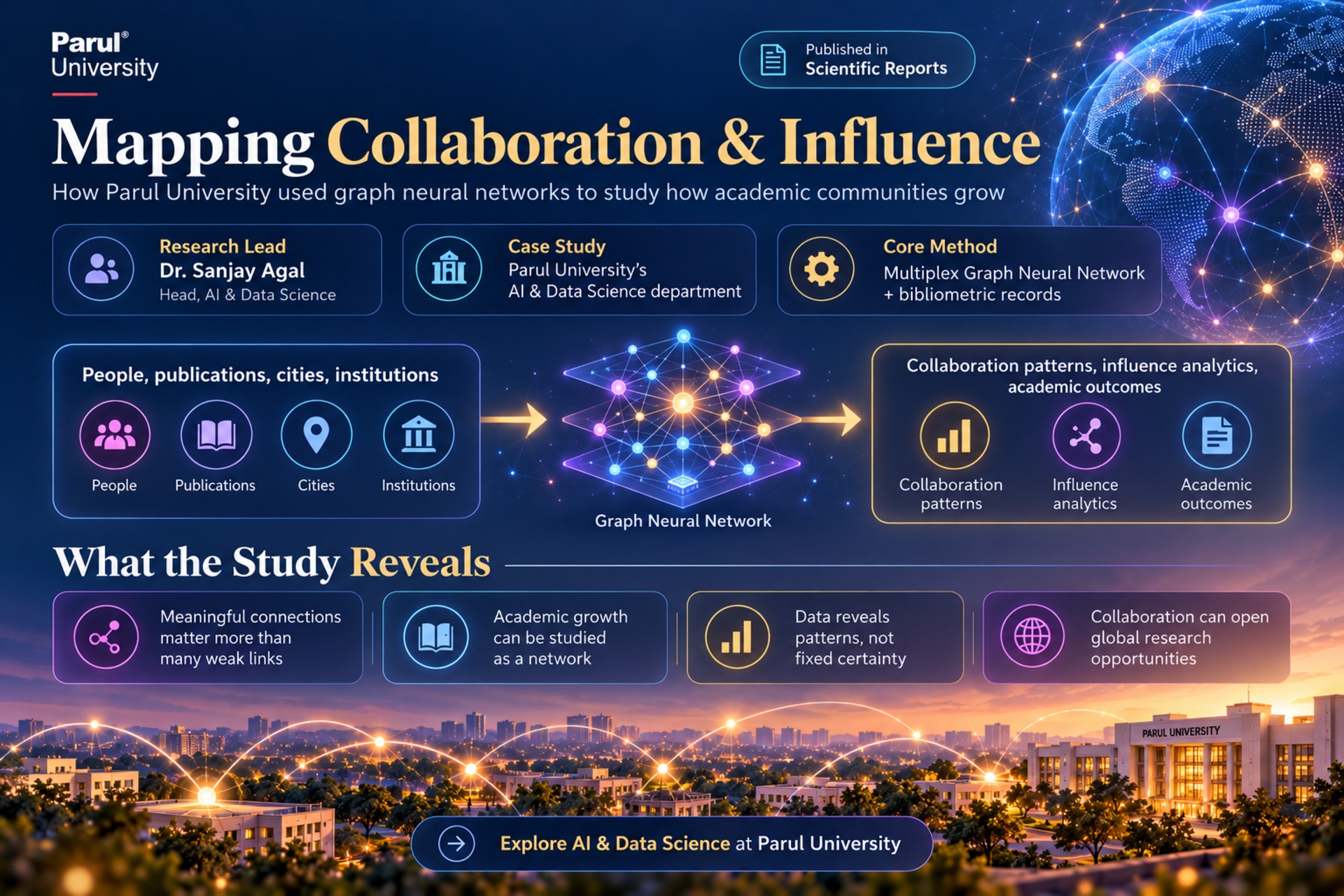
The paper’s central move is to treat collaboration not as a simple list of co-authors, but as a network. If a Parul University researcher publishes with authors from Pune and Noida, those links become part of a larger academic network; gather many such collaborations across people, cities, and organisations, and you can visualise the collaboration structure of an entire department. Using graph neural networks (a form of AI designed for exactly this kind of connected data) and bibliometric records, the study maps these multi-relational networks and examines a fascinating question: does a researcher’s position within the collaboration network relate to their academic outcomes? In other words, could your environment and connections shape what you achieve?
Why Parul University Became the Case Study
Rather than study an abstract dataset, Dr. Agal turned the lens on Parul University itself. The university’s scale, a large faculty community, strong infrastructure, and institutional support from the research department, Dean, and management, made it a substantial environment for studying collaboration and influence. The AIDS Department’s own faculty research activity and collaboration patterns became the basis of the case study. It is a striking idea: an AI and Data Science research question, explored using the real academic data of the very institution conducting it.
The Human Challenge in Data Science
Predicting human behaviour, though, is not like predicting a machine. As Dr. Agal emphasised, people can change unexpectedly: historical data may show one pattern, but a single new decision can redirect it entirely. For that reason, the research does not claim to predict human behaviour with certainty. Instead, it explores patterns within networks and the influence of meaningful connections, treating humanity itself as one of the great challenges of behavioural data science. It is a refreshingly honest stance: the goal is insight into structure and possibility, not a crystal ball.
Meaningful Connections Over Many Connections
One of the most resonant ideas to emerge is the difference between many connections and meaningful ones. In a digital world, a person may have thousands of online followers, yet numbers say little about the strength or usefulness of those relationships. Dr. Agal stresses selective, meaningful influence: choosing collaborations that genuinely advance learning, research, and growth. In an academic setting, that means working with people who encourage research, share expertise, and open doors, and the effect is often gradual, someone develops a new research interest because of the people around them, without at first recognising the source..
Research as Happiness, and Open Data for All
Asked what research means to him, Dr. Agal’s answer was disarmingly simple: “Happiness.” Reading people, reading books, and talking with others give him ideas to write; writing itself brings satisfaction, with publication a separate outcome. That openness shows in his cross-disciplinary work, including helping pharmacy faculty develop a Python programming book for B.Pharm students. It also shapes his future plans: he aims to create and freely share very large datasets (he described a financial-technology dataset of some 256 GB, offered free for research), so that researchers everywhere can experiment without being limited by expensive or inaccessible data.
An Open Door to Global Collaboration
The larger message reaches beyond one department. The research shows how a university’s own academic ecosystem can become the foundation for work that engages global conversations, and Dr. Agal was explicit that the AIDS Department is keen to build more international collaborations with leading universities and researchers worldwide. Parul University, he stressed, is not only seeking opportunities abroad but positioning itself as an institution with the researchers, infrastructure, and capabilities to contribute to international projects. It is an open invitation: collaboration can move in both directions.
His Advice to Young Researchers
For anyone beginning research, Dr. Agal’s advice is practical: read, but do not try to read everything. Narrow your search by time and domain, starting, say, with recent work from the current year in your specific field, to understand what the world is working on now, what approaches exist, and where the gaps are. He likens it to music: before creating something new, a musician must understand what already exists, what instruments are used, and what others are making. Research follows the same principle, you must understand the landscape before you can meaningfully add to it.
Frequently Asked Questions
What is Dr. Sanjay Agal’s collaboration and influence research about?
It is a study, published in Scientific Reports (Nature Portfolio), that treats academic collaboration as a network and uses graph neural networks to analyse how collaboration and influence shape an academic community. Using Parul University’s AI and Data Science department as a case study, it examines how a researcher’s position within a collaboration network may relate to their academic outcomes.
Why did the research use Parul University as a case study?
Because the university offered a substantial, real environment for the study, a large faculty community, strong infrastructure, and institutional support. Using the AIDS Department’s actual faculty research and collaboration data allowed an AI and Data Science research question to be explored with genuine academic data rather than an abstract dataset.
Can data really predict human behaviour?
Not with certainty, and the research is careful about this. Because people can change their behaviour unexpectedly, the study does not claim to predict individuals precisely. Instead, it explores patterns within networks and the influence of meaningful connections, offering insight into structure and possibility rather than firm predictions.