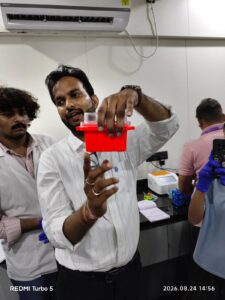
After students at Parul University’s molecular diagnostics workshop amplified DNA by PCR, they faced a simple question: did it work? To find out, they used gel electrophoresis. Here is what it is and how to read one.
What Is Gel Electrophoresis?
Gel electrophoresis is a laboratory technique for separating DNA (or other molecules) by size. The idea is beautifully simple: you load your DNA into a slab of jelly-like gel and apply an electric current, and the DNA moves through the gel, with smaller fragments travelling faster and further than larger ones. The result is a set of separated “bands,” each representing DNA of a particular size, which you can then see and measure.
How Does It Work?
Two simple pieces of physics make it work:
- DNA carries a negative charge, so when an electric field is applied, it moves toward the positive electrode.
- The gel acts as a sieve, usually made from agarose (a jelly-like substance). Its mesh of pores lets small DNA fragments slip through quickly while larger fragments are slowed down.
So over time, the DNA spreads out along the gel by size: small fragments near the far end and large fragments near the start, forming distinct bands. The gel is then placed under UV light (or in a gel-documentation system like the one students used) to make the DNA visible.
The Ruler: A DNA Ladder
A band on its own tells you little; you need to know its size. That is the job of a “DNA ladder,” a reference mixture containing DNA fragments of known, precise sizes (for example, from 100 to 1500 base pairs). Run alongside your samples, the ladder forms a column of evenly spaced reference bands, a ruler. By comparing where your sample band sits against the ladder, you can read off its size. In the workshop, students confirmed their amplified product by matching its band to the ladder, landing exactly where the target sequence should be.
How to Read a Gel?
Reading a gel is a skill, and a few principles guide it:
- One clean, sharp band at the expected size means a successful, specific amplification.
- No band means the reaction failed or the yield was too low to detect.
- Multiple unexpected bands suggest non-specific amplification.
- A long smear suggests degraded DNA or an overrun reaction.
Interpreting these patterns is central to PCR Troubleshooting, because the gel is where a molecular experiment finally reveals whether it worked.
Why Does It Matter?
One of the most basic procedures in all molecular biology is gel electrophoresis. It is used to determine whether a PCR has occurred, to test for the quality of DNA extracted and, importantly, to show the patterns of fragments in the process of DNA fingerprinting. It is the point at which invisible molecular work becomes visible and readable; hence, every student of life sciences learns to run and read a gel. Fond of biology, PCR & diagnostic startups? Build a successful career in molecular diagnostics and genetic science with a B.Tech in Biotechnology, a B.Sc. (Honours) in Biotechnology, or an M.Sc. in Biotechnology at Parul University.
FAQs
What is gel electrophoresis used for?
DNA (or RNA or proteins) can be separated by size using gel electrophoresis to be seen and measured. It is used in molecular biology to check whether a PCR has amplified the correct product, to see if DNA is of good quality, and to see the fragment patterns in DNA fingerprinting, forensics, and diagnostics.
Why does DNA move through the gel?
DNA is negatively charged, and the charge applied across the gel will push the DNA towards the positive electrode. The gel is a "sieving medium": The smaller the pieces of DNA, the larger the pores they can fit through, and the further they get through the gel.
What’s a DNA ladder?
A DNA ladder is a sample of DNA that is made up of fragments with known sizes, such as 100 base pairs to 1500 base pairs. It runs along with your samples, forming a column of regularly spaced reference bands, like a molecular ruler, with which you can determine the size of your sample bands by measuring how far they are from the ladder.