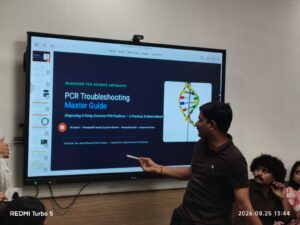
The final act of Parul University’s molecular diagnostics workshop was to turn amplified DNA into a fingerprint. To do that, students used restriction enzymes. Here is the science behind them.
What Are Restriction Enzymes?
A restriction enzyme is a protein that is like a molecular scissor that recognises a short sequence of DNA (called the ‘recognition site’) and cuts DNA at that exact site. Restriction enzymes provide the scientist with a very specific, programmable control over the place of cutting the DNA, as each enzyme cleaves only at its specific sequence. These are in two general categories, and the difference is important:
- Endonucleases cut DNA internally, scanning the strand and cutting at a recognition site somewhere in the middle. These are the tools used for DNA fingerprinting.
- Exonucleases chew DNA from the outer ends inward, rather than cutting in the middle.
Where do these enzymes come from? Bacteria, which use them as a defence against invading viruses. Their names reflect their bacterial origin: HinfI, the enzyme used in the workshop, comes from the bacterium Haemophilus influenzae (the first letters of the genus and species give the name).
Sticky Ends and Blunt Ends
When a restriction enzyme cuts, it leaves one of two kinds of ends. A blunt end is a clean, straight cut through both strands. A sticky end is a staggered cut that leaves a short single-stranded overhang. Those overhangs are chemically “sticky”: they readily pair with a matching overhang from another piece of DNA cut by the same enzyme, snapping together. This ability to join DNA fragments predictably is the foundation of genetic engineering and recombinant DNA technology.
What Is RFLP?
RFLP is an acronym for restriction fragment length polymorphism, which is one of the older ways of distinguishing DNA samples. The idea is simple and beautiful. There is a small variation in the DNA sequence for each individual, so the exact location of the recognition site for an enzyme is different in each individual. If you cut two people with the same restriction enzyme, you will have different-length fragments. Separate the fragments by size on a gel, and each sample will create a unique banding pattern or DNA fingerprint.
How a DNA Fingerprint Is Made?
The workshop followed the full sequence, which is essentially how DNA fingerprinting works:
- Extract the DNA from a sample.
- Take enough material by amplifying the target region using PCR.
- Digest it with a restriction enzyme (such as HinfI) at 37°C to produce fragments.
- Separate the fragments by size on a gel and get the unique banding pattern.
DNA fingerprinting is so useful in forensics because it allows one to match a suspect with a crime scene DNA sample, in paternity testing to determine a father, or in diagnostics to identify disease-linked variations in DNA. Moreover, a well-designed RFLP test can also be performed on low-cost PCR machines, making it a potential pathway to cheap and easy genetic screening.
FAQs
What’s the in-depth meaning of restriction enzyme?
A restriction enzyme is like a molecular scissor that will recognise a short DNA sequence and will cut the DNA at that location. Restriction enzymes are enzymes naturally found in bacteria that defend them from viruses and are used by scientists to cut DNA at a specific site when making a DNA fingerprint and conducting genetic engineering.
What is RFLP?
RFLP (Restriction Fragment Length Polymorphism) is a method to break the DNA into fragments using restriction enzymes and comparing the sizes of the fragments. The bases are arranged in different patterns of nucleotide sequences so that the enzyme creates different patterns of fragments that can be seen on a gel for each individual: a DNA fingerprint.
How is DNA fingerprinting done?
The general outline of DNA fingerprinting is the extraction of the DNA, then the amplification of the DNA using PCR, and the digestion of the DNA with a restriction enzyme and the separation of the DNA from the restriction enzyme products by gel electrophoresis. Banding pattern is unique to the individual (or specific to a pathogen or variant) and can be utilised in forensics, paternity testing, and diagnostics.