You cannot learn molecular diagnostics from a textbook. On 24 and 25 August 2026, the Department of Life Sciences at the Parul Institute of Applied Sciences (PIAS), with the university’s Research and Development Cell (RDC) and industry partner Siriprogen Life Sciences, ran a complete hands-on journey through PCR- based molecular diagnositcs and DNA fingerprinting, from raw blood to a finished genetic fingerprint.
Day One: Theory and DNA from Blood
The first day paired theory with wet-lab practice. Principal Dr. Trilok Akhani opened with a direct message aligned to Skill India: theoretical knowledge is of little use without practical skill at the bench. A keynote by Dr. Varsha Raimalani, a molecular pathologist at Kailash Cancer Hospital, reframed diagnostics as answering a clinical question and walked students through the PCR thermal cycle and real-time TaqMan chemistry. Then, in groups of six, students performed a complete DNA extraction from blood, ending Day 1 with purified genomic DNA in their tubes (and a valuable lesson when two groups’ yields came out faint).
Day Two: The Crucible of Amplification
Day two moved to the sterile precision of the RDC. Guided by Dr. Nil Patil, students set up their PCR reactions with exacting care: a 20-microliter mix of master mix, forward and reverse primers, molecular-grade water, and their own extracted DNA template. Before touching a machine, they were made to manually calculate the run time of a 30-cycle program, learning firsthand why, as the instructor laughingly said, you cannot start a PCR at 4 p.m. and expect to leave at 5. Then the thermal cyclers ran, and roughly two hours later, the moment of truth arrived.
Reading the Result: Gel Electrophoresis
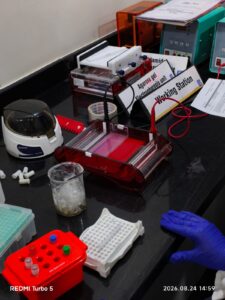
To see whether their amplification worked, students ran their products on an agarose gel and read them on an I-Bright 1500 gel documentation system. Using a DNA ladder as a ruler, they measured their bands, which were clean, sharp, and exactly where expected. Most striking was the redemption of the two groups whose Day-1 extractions had looked almost empty: PCR had multiplied their few remaining DNA strands into bright, clear bands, a vivid demonstration that amplification overcomes scarcity. Before the reveal, a research scholar, Ms. Rupal Dhariwal, had also delivered a PCR troubleshooting masterclass, teaching students to read a failed gel and trace the error to its source.
Making a Fingerprint: Restriction Digestion
With clean amplified DNA in hand, students moved to the technique that gives the workshop its name. Using a restriction enzyme (HinfI, a molecular “scissor” that cuts DNA at a specific sequence), they set up a digestion reaction and incubated it at 37°C, cutting their DNA into fragments of characteristic sizes, the basis of a DNA fingerprint. It was a complete arc: extract, amplify, visualise, and finally cut DNA into a unique, readable pattern.
From the Bench to a Business
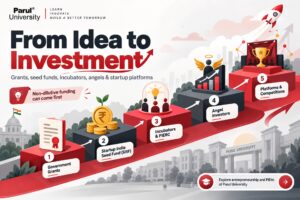
Dr. Mukul Jain gave a commercial master class to the students, where he encouraged them to think like an innovator and not a technician. He noted there was a real gap in the availability of advanced technologies such as next-generation sequencing, which can cost tens of thousands of rupees per test and is not affordable for mass and accessible screening. The opportunity is to develop cost-effective, PCR-based diagnostic assays for early detection and a greater move towards non-invasive testing, he said. He pointed students to real funding routes (CSR partnerships and government SSIP grants) and made an open offer: The RDC’s doors are open for students to build a prototype, patent it, and take it to industry, a path the university’s innovation ecosystem actively supports.
Pathway for Biotechnology Passionate
The workshop concluded with a valedictory and final assessment, where Priyanshi Patel and Priyadarshini Vaishnavi had the top position in the list. The host, with his characteristic wisdom, pointed out the fact that such timed quizzes are digital and require instant recall and speed, and one must not assume that a student who didn’t earn the top spot is less capable at the bench. It captured the spirit of the two days, which sent students home not just understanding molecular diagnostics but also being able to perform them, troubleshoot them, and imagine building the diagnostic tools of the future. Get hands-on with molecular biology, genetics, and biotechnology by studying B.Sc. Biotechnology at Parul University.
FAQs
What did students do at the PCR workshop?
For two days at the Parul University laboratory, students isolated the DNA from blood, amplified it through PCR, ran gel electrophoresis to visualise the DNA and then used a restriction enzyme to create a fingerprint pattern. They also received training on PCR troubleshooting and the process of developing an affordable diagnostic start-up, covering the entire process from raw sample to completed genetic analysis.
What is DNA fingerprinting?
DNA fingerprinting is a technique that produces a unique pattern from an individual’s DNA. In this workshop, students amplified DNA by PCR and then cut it with a restriction enzyme (HinfI), producing fragments of characteristic sizes that, when separated on a gel, form a distinctive banding pattern, the basis of the RFLP method used in forensics and diagnostics.
Why do hands-on lab workshops matter?
Because diagnostic and biotech careers demand practical skill, not just theory. Performing a real experiment, complete with the failures and troubleshooting that happen in any lab, prepares students for industry and research far better than lectures alone, in line with outcome-based education and Skill India goals.