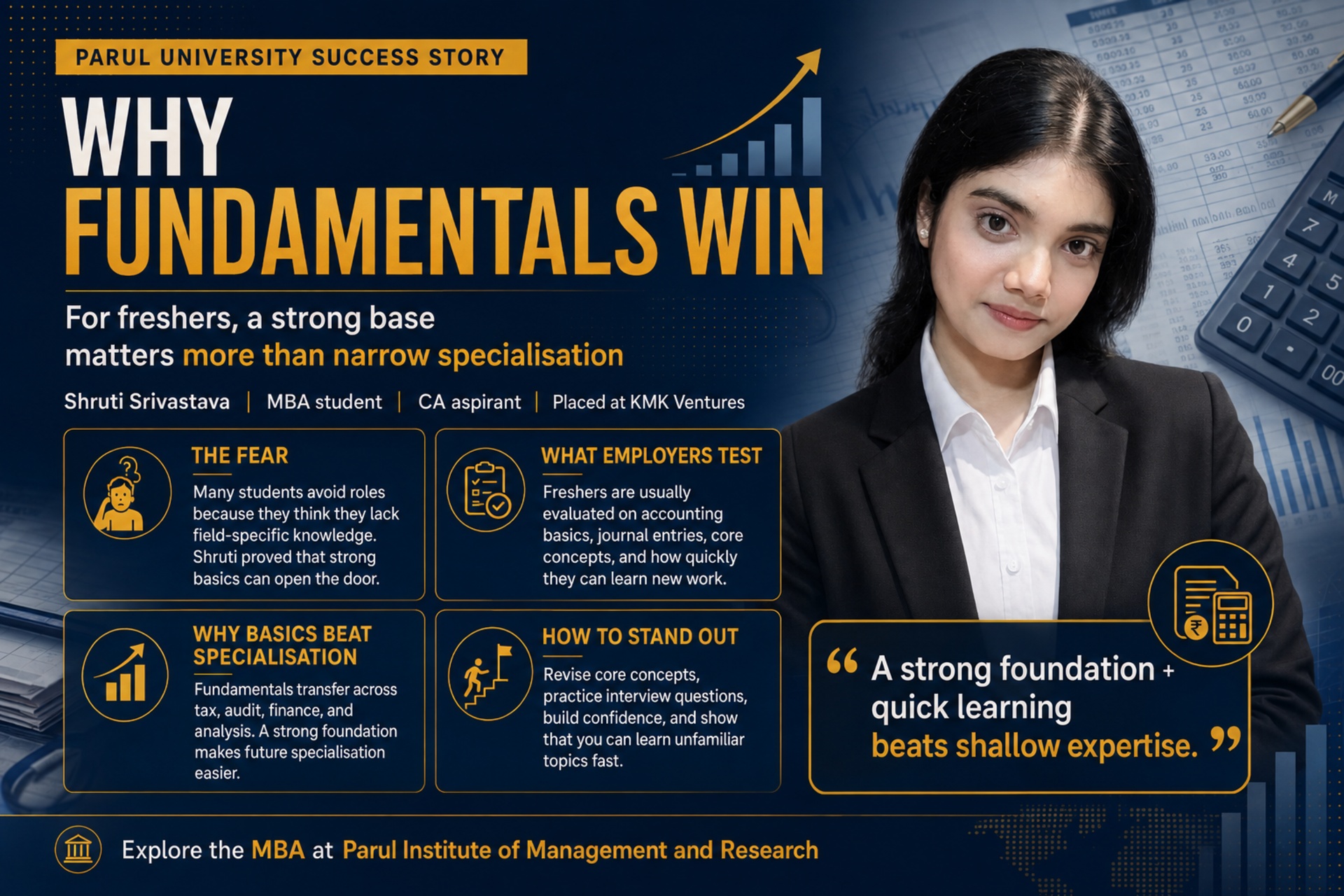
There is a fear that stops many capable students from even applying: “I do not know enough about this specific field.” It is worth challenging, because it misunderstands what employers actually look for in a fresher. Shruti Srivastava, a Parul University MBA student, was selected for a role in US taxation, a subject she had never formally studied, at KMK Ventures. What carried her was not specialised knowledge, but a strong foundation. Her experience holds a lesson every student should absorb early.
What Employers Really Test in Freshers
When Shruti sat her interview, she expected advanced, specialised questions. Instead, the questions leaned on basic accounting, journal entries and core concepts at roughly the 11th and 12th standard level. The reason is revealing: the interviewer was not testing existing expertise a fresher could not be expected to have. They were testing two things: whether her foundation was solid, and whether she could learn quickly.
The interviewer wanted to assess: are we strong about our accounts foundation or not, and am I good at quick learning. – Shruti Srivastava, on what her interview really tested
This is how most fresher hiring works, across fields. Specialised, job-specific knowledge is taught on the job. What cannot be taught quickly is a shaky foundation or a slow, reluctant learner. So employers screen for the base and the learning ability, and trust themselves to teach the rest.
Why Fundamentals Beat Specialisation Early On
A strong foundation is more valuable than narrow specialisation for a simple reason: it transfers. Someone with solid accounting fundamentals can move into US taxation, Indian taxation, audit, or financial analysis, because all of them rest on the same base. Someone who has memorised one narrow specialism, without the underlying understanding, is stuck the moment the job shifts. Fundamentals are the platform every specialisation is built on, and for a fresher whose exact role is still unknown, the platform matters far more than any one specialism. The same principle holds in technology, where a strong grounding in fundamentals and problem-solving matters more than knowing any single tool.
Being a Quick Learner Is a Skill You Can Show
If employers value learning ability, it helps to know that you can demonstrate it. Shruti did, without US-tax knowledge, by working thoroughly through the preparation material the company shared and practising it until she was confident. That act, taking unfamiliar material and mastering it quickly through disciplined practice, is itself a demonstration of quick learning. You show you are a fast learner not by claiming it, but by visibly getting up to speed on something new.
How to Build Strong Fundamentals
The encouraging part is that fundamentals are entirely within your control. Master the core concepts of your field deeply rather than memorising surface facts, understand why things work, not just what the answer is, and revisit the basics regularly so they stay sharp. When a new, specialised topic appears, a strong base makes it far easier to absorb. As Shruti’s Story shows, the student with strong fundamentals and the willingness to learn will often beat the one with narrow, shallow expertise.