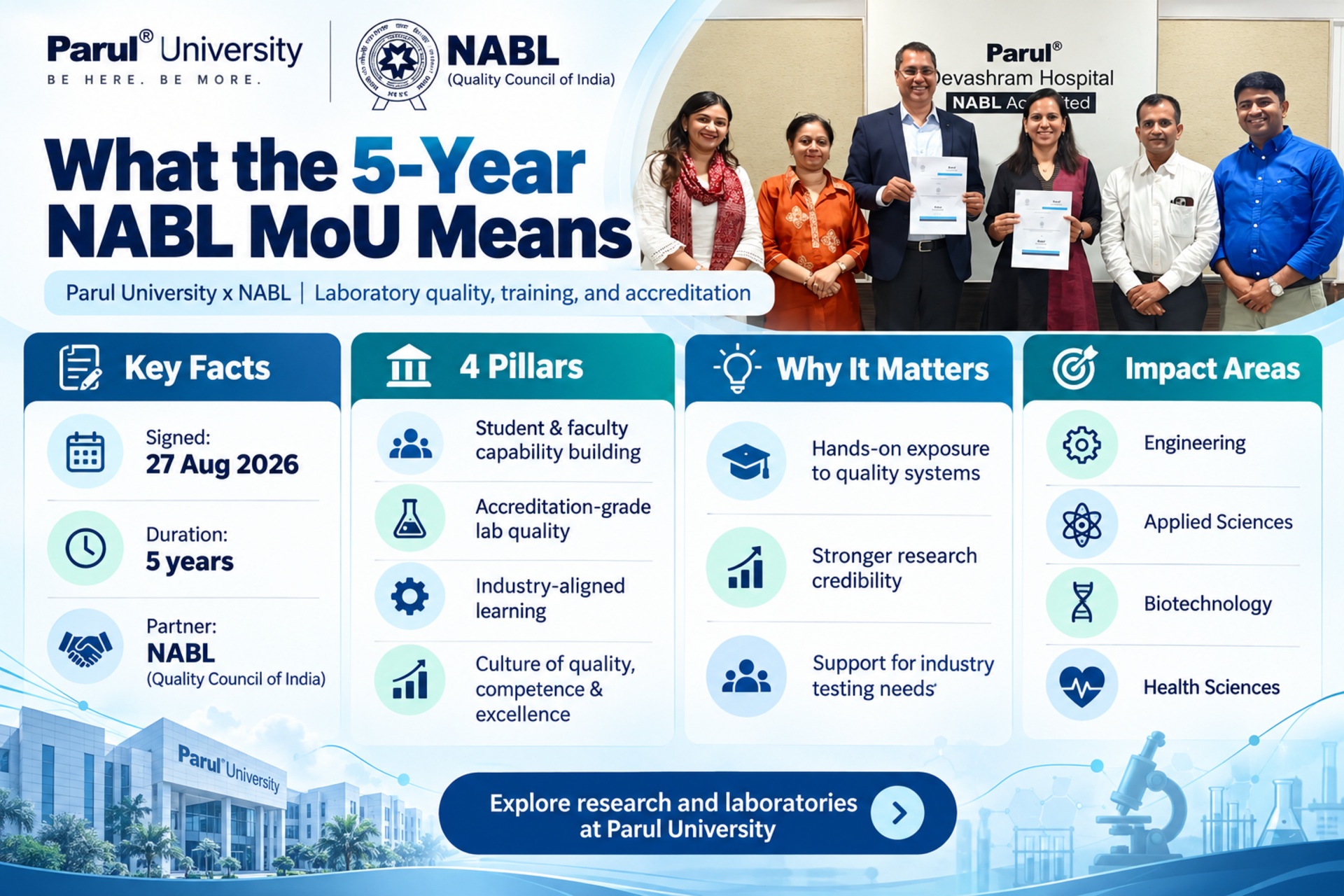
Every work and test becomes real and trustworthy when they are attached with facts. Facts are produced when experiments are conducted. On 27 August 2026 Parul University signed MoU with National Accredition Board for Testing and Calibration Laboratories (NABL). It is India’s main body for laboratory accreditation. It is also a constituent board of the Quality Council of India (QCI).
The agreement was signed on campus by Dr. Ramanand N. Shukla, Chief Executive Officer of NABL, and Dr. Geetika Madan Patel, Vice President for Quality, Research and Health Sciences at Parul University. Senior representatives including Dr. Sandip Shah and Kannan Chakravarthy were present, reflecting the seriousness both sides attached to the collaboration. NABL shared the milestone in a LinkedIn announcement, and it was welcomed warmly by the university’s quality and healthcare leadership.
Partnership Based on Four Pillars
The MoU, which runs for five years, is built around four connected commitments:
1. Building quality capabilities among students and faculty.
2. Make the lab quality superior and accredited to fulfil the industry and research needs.
3. This helps to bridge the evolving industry requirements. They take care of whether courses align with actual world expectations or not.
4. Promoting a culture of quality, competence and excellence across the institution.
Each pillar is designed to reinforce the others, making this a programme of capability-building rather than a one-time recognition.
Building on an Established Foundation
What makes this partnership notable is that it builds on something already in place. Parul University already operates an NABL-accredited medical and clinical-research laboratory as part of its diagnostic work, and holds NAAC A++ status alongside recognitions from NABH, DSIR, and the Ministry of AYUSH. The MoU treats this as a starting point, not the goal, aiming to extend accreditation-grade practices into the engineering, applied sciences, biotechnology, and health-science divisions. In plain terms, the university is beginning to treat more of its laboratories as places that must produce data capable of standing up to outside scrutiny.
Training, Awareness, and Assessor Development
A large part of the collaboration is about people. Under the MoU, NABL is expected to help train Parul University faculty and experts, some of whom can go on to become assessors within the national accreditation system, and to support awareness and training through two named initiatives: Gunvatta Yatra (an awareness programme introducing students, faculty, and nearby industry to accreditation) and Gunvatta Pathshala (a structured training programme on the technical requirements of ISO/IEC 17025). Participants who complete these programmes receive certificates jointly issued by NABL and Parul University. Over time, Parul-trained assessors joining NABL’s national pool would place the university’s expertise directly within the country’s accreditation ecosystem, a form of recognition few institutions achieve through research output alone.
A Regional Testing Hub, and Stronger Research
The partnership’s benefits are expected to reach beyond the campus. Once laboratories become NABL-aligned, they can serve as third-party testing hubs, offering formally recognised testing to organisations, such as the many small and medium enterprises across Gujarat, that cannot justify building their own accredited facilities. Just as important is the effect on research. Data produced in an accredited, traceable system is generally seen as more defensible by journals, reviewers, and patent examiners, which can strengthen the university’s research and patent work and its path toward technology licensing. As the source of data becomes more credible, so does the innovation built on it.
Part of a National Pattern
The agreement is not an isolated event. NABL has pursued similar university partnerships elsewhere in the country, part of a wider national push to fold accreditation directly into higher education rather than treat it as a credential chased only when required. For Parul University, the MoU positions quality as a long-term operating discipline: over its five-year term, it is expected to influence how faculty are trained, how laboratories are equipped, how curricula are structured, and how research data is used. As Dr. Ashish Jawarkar noted in a post welcoming the agreement, it is a step toward building a stronger culture of quality and excellence in laboratory and healthcare practice. Make your work globally valid with support from Parul University NABL approved laboratories.
Frequently Asked Questions
What is the NABL-Parul University MoU?
It is a five-year Memorandum of Understanding, signed on 27 August 2026, between the National Accreditation Board for Testing and Calibration Laboratories (NABL), a constituent board of the Quality Council of India, and Parul University. It aims to bring national accreditation standards across the university’s laboratories through training, capacity-building, assessor development, curriculum integration, and joint quality initiatives.
What does the MoU mean for students?
Students in engineering, applied sciences, biotechnology, and health sciences are expected to gain hands-on exposure to accreditation-grade practices, calibration, documentation, quality assurance, as part of regular coursework, rather than encountering them for the first time in the workplace. This can give graduates an advantage in industries where such compliance knowledge is usually learned on the job.
Did Parul University already have NABL accreditation?
Yes, in part. Parul University already operates an NABL-accredited medical and clinical-research laboratory. The new MoU builds on that foundation, aiming to extend accreditation-grade practices, and, over time, formal accreditation, into more of its laboratories across engineering, applied sciences, biotechnology, and health sciences.


