When Parul University partnered with NABL to bring accreditation standards across its laboratories, it was pursuing a change that runs far deeper than new equipment. To understand why, you have to understand what makes an accredited laboratory different, and it is not what most people assume.
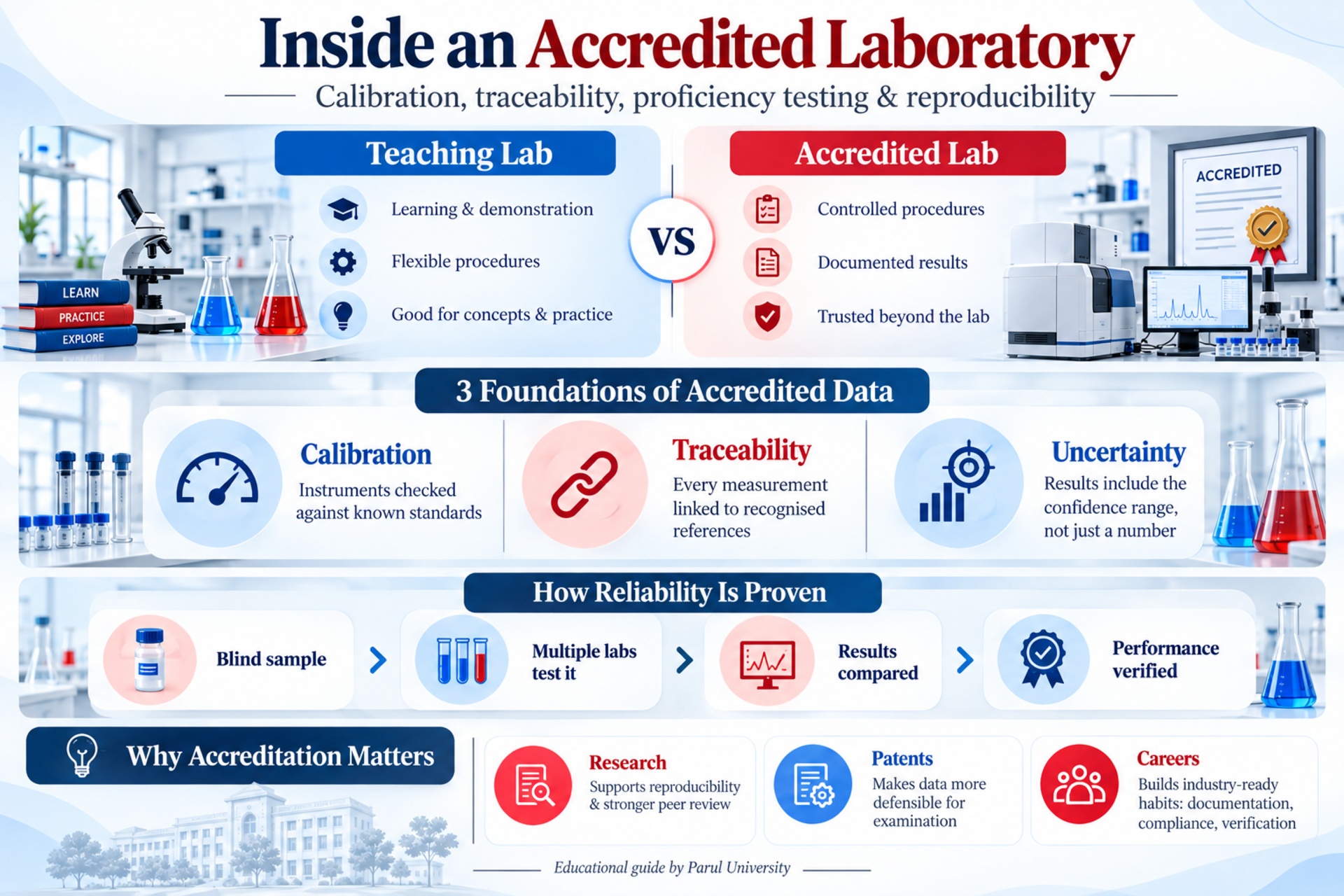
A teaching laboratory is designed for demonstration and learning, and a degree of procedural flexibility is often useful for that purpose. An accredited laboratory works under a completely different logic. There, every instrument must be calibrated on a fixed schedule and traceable to a recognised national measurement standard; every result must carry a documented uncertainty figure rather than a single unqualified number; and every procedure must be locked into a written, auditable protocol that an outside assessor can review and verify. Turning a research or academic laboratory into an accreditation-ready one therefore means rebuilding habits from the instrument level up, not just buying newer equipment.
The Three Foundations: Calibration, Traceability, Uncertainty
Three ideas sit at the heart of accredited work:
- Calibration, regularly checking instruments against a known standard so their readings can be trusted.
- Traceability, an unbroken chain linking every measurement back to a recognised national or international reference, so anyone can see how a number was arrived at.
- Measurement uncertainty, stating not just a result but how confident we are in it, because no measurement is perfectly exact.
Together, these turn a number into a defensible piece of evidence.
Proving Reliability: Proficiency Testing
How does a laboratory prove its data is reliable, not just claim it? Through proficiency testing and inter-laboratory comparison. In these schemes, an external body sends identical blind samples to several laboratories and compares each one’s results against a verified reference value. Because no participant knows the correct answer in advance, consistent performance across these blind trials is one of the few genuinely objective ways to show a laboratory’s data can be trusted, and passing them over time is what allows a laboratory to keep its accredited status. For students and faculty, taking part builds a discipline of verification that mirrors real industry and research settings.
Why It Matters for Research: The Reproducibility Question
Perhaps the most consequential benefit is quiet but profound. Science faces a reproducibility challenge: published results sometimes cannot be independently verified because the original work relied on uncalibrated instruments or undocumented procedures. Data generated inside an accredited system is traceable at every step, which instrument was used, when it was last calibrated, and the uncertainty of each result, exactly what reviewers, journals, and patent examiners look for. For research centres working on diagnostics, micro- and nano-technologies, or engineered materials, that traceability can shorten the time it takes to defend findings during peer review or clear a patent examination, building a defence against delays before they occur.
From Data to Patents and Careers
This credibility carries into the commercial world. Data generated by a university on an equipment that has not been verified is a major concern for any corporate and pharmaceutical partner looking to license an academic IP, whereas data from a system that is accredited and audit-ready makes licensing more trustable and increases the university’s portfolio of technology licensed and start-up spin-offs. The benefit for the students is lifelong: industries like pharmaceutical manufacturing, medical devices, and advanced materials are compliance-regulated environments that most students experience only in their careers. Accreditation-grade practice while pursuing a degree shortens that path to building an attitude and habit of documentation and verification that will carry over to any other workplace, academic or industrial.
Frequently Asked Questions
What is the difference between a teaching lab and an accredited lab?
A teaching laboratory is designed for demonstration and learning, with some procedural flexibility. An accredited lab holds authentic value. The lab has rules and regulations to follow. They are strict guidelines. Here the instruments are calibrated on fixed schedules and traceable to recognised standards. The results carry documented measurement uncertainty. Here every process has a written, auditable protocol than an external assessor can verify. Main thing that hold is the difference in accountability, trustworthiness and defensibility of the data produced.
What is proficiency testing?
Proficiency testing (and inter-laboratory comparison) is a scheme in which an external body sends identical blind samples to several laboratories and compares each one’s results against a verified reference value. Because participants do not know the correct answer in advance, consistent performance is an objective way to demonstrate that a laboratory’s data is reliable, and it is required to maintain accredited status.
Does laboratory accreditation matter for research?
Yes, the accreditation of laboratories matters so that the data holds accountability. The data gained hold validity globally too. It ensures data traceability and defensibility. It shows which instrument was used, when it was calibrated and the uncertainty of each measurement. This directly tackles the reproducibility issue in science and is something that journals, reviewers and patent examiners are looking for, allowing researchers to defend their findings and pass patent examinations faster.