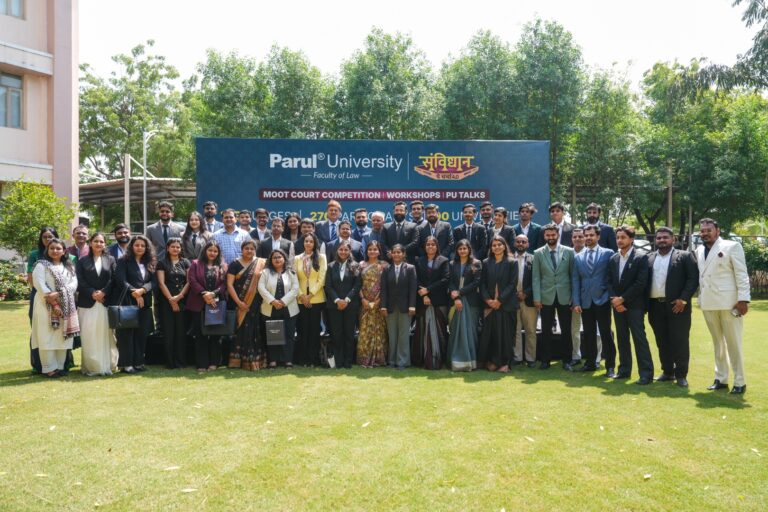
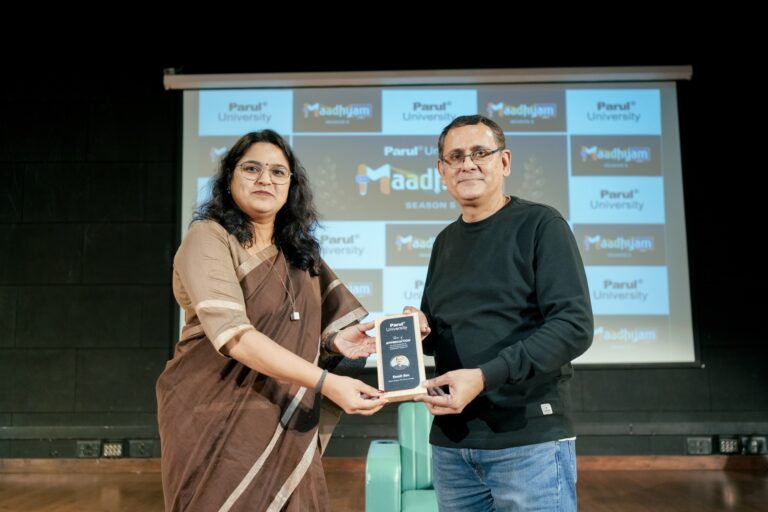
Inaugural Ceremony of Samvidhan Pe Charcha 4.0 at Parul University!
Bench, Bar, and Parul University!
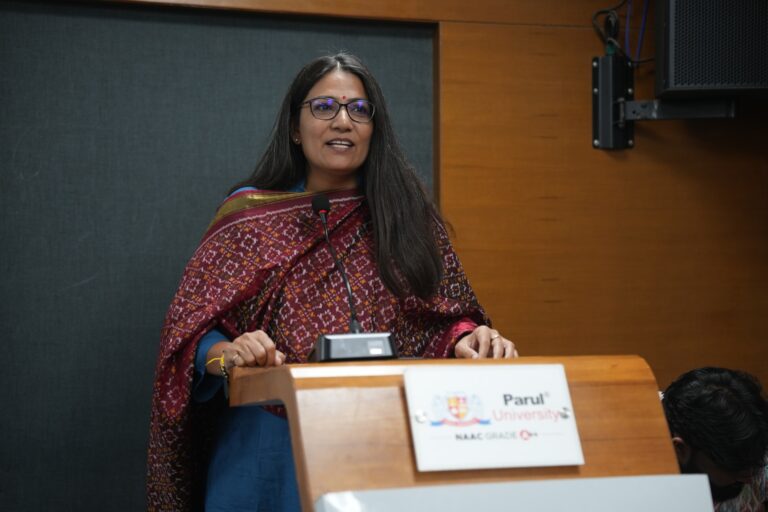
The inaugural event began with the lighting of the lamp and Saraswati Vandana, followed by Dr. R. I. Parikh, Dean of the Faculty of Law, who welcomed the students and stated that “the power of a legal argument resides not only in the volume of your voice but also in the clarity of your listening and strength of your constitutional understanding.” Supreme Court Judge Justice Vipul M. Pancholi, Gujarat High Court Judge Justice D. N. Ray, Justice N. S. Sanjay Gowda of the Gujarat High Court, Senior Advocates Gaurav Bhatia and Mahalakshmi Pavani, and the university leadership comprising President Dr. Devanshu Patel and CEO Mr. Dhruvil Shah were present on the dais.
Constitution as a living document!
The Constitution is a living document and is to be interpreted by Justice D. N. Ray. Hon’ble Justice D. N. Ray, Judge of the High Court of Gujarat, drew parallels between constitutionalism beginning with Aristotle and the Magna Carta; then it was continued with the Government of India Act 1935 and eventually culminated in the Constituent Assembly, which was likened to a building having its structure intact even as its interior continued to change. He said the Constitution is “a living institution unto itself” that can be changed by amendment while it has been preserved in its fundamental essence.
Justice N. S. Sanjay Gowda: Then, now, and tomorrow
Hon’ble Justice N. S. Sanjay Gowda, Judge of the High Court of Gujarat, spoke on “The Indian Constitution: Then, Now and Tomorrow.” Using the analogy of a family that needs written rules only as it grows, he explained why a nation as vast and diverse as India needed a common framework and said simply, “It is this document, the Constitution, which really constituted us.”
He urged students not to read the Constitution as an abstract text but to understand why it was created and then look forward, asking whether a framework written decades ago can answer a generation facing the internet and artificial intelligence. That, he said, is not a criticism of the framers but the responsibility of the present generation, whom he asked to “look at the past to learn the future.”
Presidential Address: Dr. Devanshu Patel
In his presidential address, Dr. Devanshu Patel, President of Parul University, distinguished the heart of the event: “Today is not simply about the Constitution. Today we are going to talk about the Constitution, and there is a big difference in that.” Questions, he said, make democracy strong, and dialogue helps a society move along. Subsequently, he connected constitutional values to the digital lives students are actually leading. Freedom of speech comes with a sheer responsibility, the holistic access to information comes with a duty to verify and fact-check, and the right to disagree comes with the duty of respecting and listening before forming any positive/negative opinion. In the presence of judges and senior advocates at Parul University, he firmly said that law is not distant from young people, and it eventually helps constitutional values lead a culture. He ended it with the story of Lord Hanuman sitting aside his own Ramayana out of devotion instead of recognition; he even urged students to value and approach their work with love, passion, and commitment!