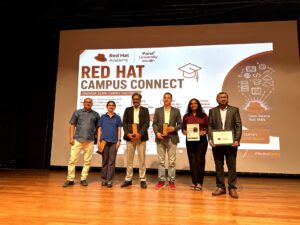
Viksit Bharat 2047, the Government of India’s ambition of becoming a developed nation by the centenary of Independence, is no exception. Almost every Indian university now claims alignment with the vision in marketing material, prospectus copy, and the standard sentence that gets appended to convocation speeches. The fact is, the rarest have the physical infrastructure, specifically designed to execute the vision of Lakshya 2047. Parul University takes sheer pride in executing the operational implementation at all levels. Lakshya 2047 – Centre for Future Skills was officially inaugurated by Dr Jitendra Singh, Union Minister of State for Science & Technology, Earth Sciences, & MoS in the Prime Minister’s Office for personnel, public grievances, atomic energy, pensions and space. He called Lakshya 2047 “not only contemporary but also very futuristic” and tied the centre directly to the Viksit Bharat 2047 framework under Prime Minister Shree Narendra Modi Ji. The detailed inauguration coverage, ministerial speech extracts, and complete lab inventory are in ihe Lakshya 2047 anchor hub article.
Core demands of Viksit Bharat 2047.
Viksit Bharat is not just a single aspiration; the solid vision identifies India as a fully fledged developed country by 2047. As the very same year marks the 100th anniversary of Indian Independence, the ideation, planning and execution are around multiple pillars. When we speak of growth at the holistic levels, it must cover economic, social, environmental, infrastructural, appropriate governance, technology and skilling & upskilling capacities. No amount of policies can play a role when the execution lacks, and hence, to mark all the pillars, Parul University has already started contributing tremendously.
Here are the 3 operational requirements that any institution must achieve to contribute substantially –
- Future technology – India needs millions of talents & workers who are massively trained in cloud computing, AI, cybersecurity, semiconductor design, manufacturing automation, quantum computing, and cognitive sciences for nearly 2 decades.
- Multi-sectoral training – A successful semiconductor domain needs material engineers, technicians, packaging specialists, marketing & management capacity as well, and not just chip designers. Single skills are good, but cross-functional exposure will lead to the future!
- Government & domain-approved alignment – The logic is simple – no university or organisation can deliver this alone. They all need to collaborate at many levels to ensure industry-perfect partnerships & academic standards as well. These are the operational tests against which any university’s claim of Viksit Bharat 2047 alignment can be evaluated.
The implementation gap in Indian higher education
Walk through any Indian university website in 2026, and you will find some version of “committed to Viksit Bharat 2047” inside the first three clicks. Walk into the actual labs, and the picture is different.
A small number of premier institutions, mostly the IITs, IISc, and a handful of central universities, have credible infrastructure for cutting-edge research and training. Beyond that cohort, the typical Indian university lab houses equipment that is anywhere from five to fifteen years out of date relative to industry. The mismatch is not always due to a lack of will. It is structural. Industrial automation panels cost crores. Semiconductor design software requires expensive licensing. Cloud computing credits require active subscriptions. Setting up a single Microsoft-certified training programme requires negotiating partnership terms with Microsoft, training instructors to Microsoft-defined standards, and aligning curriculum to Microsoft’s certification examination structure. Most institutions do not have the resources or institutional bandwidth to do this for one vendor, let alone for twenty.
The cumulative effect is what could be called the implementation gap. Universities support Viksit Bharat 2047 in their marketing material, but the students graduating from those universities are not actually being trained on infrastructure that prepares them for the industries the vision is built on. The gap matters because Viksit Bharat 2047 outcomes depend on the workforce, and the workforce depends on what students actually learned at university, not what the university said it taught. Parul University has positioned Lakshya 2047 explicitly as a response to this implementation gap.
How Lakshya 2047 closes the gap: four operational mechanisms
The centre closes the implementation gap through four specific operational mechanisms, each addressing a distinct dimension of the gap:
- Viksit Bharat 2047 priorities – Cloud computing (Microsoft, AWS), AI and GPU computing (NVIDIA), cybersecurity and networking (Cisco), software development (Apple), industrial automation (PLC and SCADA, Industrial Drives, Home Automation, ABB Robotics), design and engineering simulation (Autodesk, Adobe, ANSYS), immersive technologies (AR/VR), semiconductor and materials engineering (VLSI, Material Synthesis Zone), and cognitive sciences plus drones plus prototyping (Mind Lab, Drone ecosystem, AICTE IDEA Lab). Nine future-technology domains, twenty-plus labs, each named to a global industry partner. Domain coverage that maps directly to what the vision identifies as priority areas.
- Vendor-issued certifications – 25+ certifications are recognised through the centre, including Microsoft Azure AZ-900 and AZ-204, AWS Academy, NVIDIA Deep Learning Institute, Cisco, Siemens certifications, Schneider EcoXpert, ABB, Autodesk certified experts, Meta AR developer, and many others. The main part is that each certifying body in each case is the company itself, not the university.
- NSDC partnership for national skill alignment. The National Skill Development Corporation is the central government’s principal vehicle for the Skill India Mission. Its involvement in Lakshya 2047 connects the centre’s certification programmes to national skill frameworks, ensuring that students do not just earn vendor credentials but also earn credentials that carry weight inside India’s national workforce development architecture.
- Cross-faculty integration by structural design. The labs are not departmental property. Engineering, Computer Science, Design, Architecture, Medicine, Nursing, Applied Sciences, and Management students all access the same infrastructure for different purposes. A Mechanical Engineering student designing a prototype, a Computer Science student building an AI model, a Design student rendering an immersive environment, and a Medical student training on cognitive instrumentation can all be inside Lakshya 2047 on the same day. This is what cross-sectoral skilling looks like when it is structural rather than aspirational.
These four mechanisms together address what the implementation gap leaves open. The detailed mapping of how each Lakshya 2047 lab connects to specific Parul University programmes is in the dedicated course-to-lab mapping article, and the breakdown of what each of the 25-plus certifications qualifies a student for is covered in the certifications article.
Mapping Viksit Bharat 2047 pillars to Lakshya 2047 infrastructure
The mapping between vision pillars and physical infrastructure is where rhetorical alignment usually breaks down. Lakshya 2047 makes the mapping explicit.
- Technology and innovation pillar: The NVIDIA Lab supports the IndiaAI Mission compute and skilling layer. The VLSI Lab supports the India Semiconductor Mission talent pipeline. The Material Synthesis Zone supports nanotechnology and sensor research priorities. The Microsoft, AWS, and Cisco labs collectively cover the cloud and cybersecurity workforce capacity that the digital economy depends on.
- Manufacturing pillar: The PLC and SCADA Lab, Industrial Drives and Control Lab, Home Automation Lab, and ABB Lab together train students in industrial automation, factory floor control, and smart manufacturing. This is the Make in India workforce capacity at the university level.
- Design and creative economy pillar: The Autodesk Lab, Adobe Creative Design Studio, AR/VR Lab, and ANSYS Lab collectively support the design, simulation, and immersive content industries that the modern creative economy runs on. The combination supports both engineering design and creative content production.
- Healthcare and cognitive sciences pillar: The Mind Lab, with EEG, fNIRS, polysomnography, eye-tracking, and VR rehabilitation infrastructure, supports research and training in cognitive health, sleep medicine, and Brain-Computer Interfaces. Combined with the Cadaveric Centre and Advanced Medical Simulation facilities inaugurated the same day, this gives Parul University a healthcare-capacity contribution to the Viksit Bharat 2047 healthcare pillar.
- Drone and aerospace pillar: The Drone Technique Lab, Drone Battery System Repair Lab, and Remote Pilot Training Operation (RPTO) Setup Lab align with India’s Drone Rules 2021 and the national drone policy framework that positions UAV technology as a strategic capability.
- Entrepreneurship pillar: The Prototyping Zone, recognised under the AICTE IDEA Lab scheme, feeds directly into the Parul Innovation and Entrepreneurship Research Centre (PIERC) startup pipeline, where students turn lab work into commercial ventures.
The 8 May 2026 inauguration as an institutional credential
Operational alignment with a national vision is harder to claim than to verify, which is why the Lakshya 2047 inauguration matters. The choice of who inaugurates a building tells you what the institution is positioning itself as, and what the central government is willing to associate itself with. Dr. Jitendra Singh’s portfolio at the time of the 8 May 2026 inauguration spanned Science and Technology, Earth Sciences, the Prime Minister’s Office responsibilities for Personnel, Public Grievances, Pensions, Atomic Energy, and Space. A minister with this portfolio personally inaugurating a private university centre is the institutional signal that the central government views the centre as substantive enough to warrant ministerial association.
The minister’s speech reinforced this. He referenced India’s progress under the National Quantum Mission (1,000 kilometres of secure quantum communication achieved within three years), the IndiaAI Mission launched in 2024, the Anusandhan National Research Foundation, India’s ranking as the third-largest startup ecosystem globally, the milestone of crossing one lakh patents, and the demographic reality that nearly 70 per cent of India’s population is below the age of 40 years. He positioned Lakshya 2047 as part of the national infrastructure being built to capture this demographic dividend before it ages out. “The year 2047 will belong to the present generation of young Indians, who will be at the peak of their energy, careers, and capabilities when the country completes 100 years of Independence,” the minister said. Lakshya 2047 was built for those students. The naming was deliberate.
Beyond Lakshya 2047: Parul University's other Viksit Bharat alignments
Lakshya 2047 is the most visible piece of Parul University’s Viksit Bharat 2047 contribution, but it is not the only piece. Three parallel institutional assets extend the centre’s reach:
- PIERC (Parul Innovation and Entrepreneurship Research Centre): 254 startups incubated, more than Rs 20 crore in funding deployed, more than Rs 40 crore in startup revenue generated. The Startup India alignment that the Viksit Bharat 2047 entrepreneurship pillar depends on.
- MNRDC (Micro-Nano Research and Development Center): Parallel research infrastructure for nano-scale materials, microbial biotechnology, and sensor engineering that complements the Lakshya 2047 Material Synthesis Zone with deeper research-grade capability.
- CIRR (Centre for International Relations and Research): Hosts more than 6,000 international students through tailor-made academic programmes that increasingly include time inside Lakshya 2047 labs. Brings the Viksit Bharat 2047 vision’s international engagement requirement into operational reality.
- Research scale: More than Rs 58.31 crore in government-funded research across 315 funded projects, with seven faculty members in the Stanford-Elsevier global top 2 per cent of scientists. The research absorption capacity that Anusandhan National Research Foundation funding depends on having somewhere credible to land.
These four assets, combined with Lakshya 2047, give Parul University one of the broader institutional Viksit Bharat 2047 footprints among private Indian universities, covering skilling, entrepreneurship, research, and international engagement simultaneously.
Why operational implementation matters more than policy alignment statements
Indian higher education has reached a point where almost every institution can write a policy alignment statement. The supply of such statements vastly exceeds the supply of institutions that have built the infrastructure to deliver against the policies. The Viksit Bharat 2047 vision is national in scope and centennial in horizon, which means it depends on universities not for endorsement but for execution. Endorsement is cheap. Execution requires capital expenditure, partnership negotiation, institutional commitment across multiple academic cycles, and the willingness to make the centre’s success measurable in graduate outcomes rather than in admissions brochures.
The test for any university claiming Viksit Bharat 2047 alignment is whether the institution has built infrastructure students can demonstrably use, whether the outcomes (certifications, placements, startup launches, research publications) are verifiable, and whether the structural design of the alignment cuts across faculties rather than being confined to one department’s marketing effort. Lakshya 2047 passes all three tests. The infrastructure is physical and operational. The outcomes are certifications issued by global vendors that can be independently verified. The cross-faculty design is built into the architecture of the centre.
This is what the implementation gap looks like when it is closed. Operationalising Viksit Bharat 2047 at the university level is not impossible. It is hard. It requires sustained institutional commitment, real capital investment, and the willingness to be measured against industry-recognised credentials rather than university-issued certificates. The AICTE IDEA Lab, Make in India, and NEP 2020 multi-mission alignment article extends this analysis to the broader policy ecosystem Lakshya 2047 engages, beyond Viksit Bharat 2047 alone.
FAQs
What does it mean for a university to operationalise Viksit Bharat 2047?
Operationalising Viksit Bharat 2047 means moving beyond policy alignment statements to building physical infrastructure, training programmes, and credentialing pathways that demonstrably contribute to the vision's outcomes. Most universities support the vision rhetorically through prospectus copy and mission statements. Operational implementation means infrastructure students can use, certifications they can earn, and graduate outcomes that can be independently verified. Lakshya 2047 of Parul University is an executional facility, divided across 9-future technologies, 25+ globally revered certificate programmes, and partnerships with NDSC, Ethnotech, and Cambridge University Press & Assessment!
Define the pillars of Viksit Bharat 2047?
To be precise, Lakshya 2047 - Parul University is designed in a way to progress the core vision of Viksit Bharat 2047. NVIDIA & VLSI labs are there to support technology and innovation pillars via IndiaAI & Semiconductor Mission Alignment. PLC & SCADA, industrial drives, home automation, and ABB labs are solidly supporting the manufacturing pillars through Make in India’s capacity. Subsequently, Autodesk, Adobe, AR/VR & ANSYS labs are supporting the design and creative pillar. Then, the Mind Lab is designed to empower the healthcare & cognitive sciences pillar. Drone technique & RPTO labs are even empowering drone and aerospace pillars, and the AICTE IDEA Lab Prototyping Zone is designed to support the entrepreneurship pillar. Technically, each lab is designed to amp the vision of Viksit Bharat 2047!
What are his views on Lakshya 2047’s vision?
On the 8th May 2026, Dr Jitendra Singh proudly inaugurated Lakshya 2047 and shared his views on how this centre will become the epicentre for Viksit Bharat’s Vision for 2047. He added the National Quantum Mission’s epic achievement of 1000 kms of communication within the timeframe of 3 years, the IndiaAI mission’s launch in 2024, the ANRF’s mission, and how India’s 3rd place in startup ecosystems will empower India’s youth at all levels. He even spoke on the milestone of crossing one lakh patents by Indian residents.
Which Parul University programmes contribute to Viksit Bharat 2047 through Lakshya 2047?
Multiple programmes across multiple faculties contribute through Lakshya 2047 access. Engineering programmes (Computer Science Engineering, Information Technology, Artificial Intelligence and Machine Learning, Electronics and Communication, Electrical Engineering, Mechanical Engineering, Mechatronics, Aeronautical, Cybersecurity, Robotics and Automation) use the relevant lab clusters. Design programmes use the Adobe Creative Design Studio and AR/VR Lab. Architecture programmes use Autodesk and Home Automation. Medical, Nursing, and Public Health programmes use the Mind Lab. Applied Sciences (Physics, Chemistry, Biotechnology) use the Material Synthesis Zone. Diploma, undergraduate, postgraduate, and PhD students all have access at appropriate levels of complexity, which is the cross-faculty structural design that the vision requires.