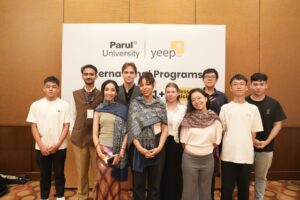
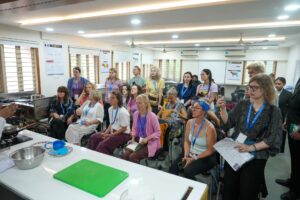
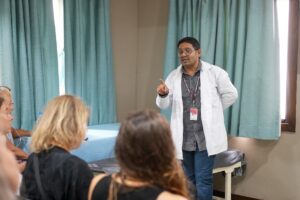
The Parul Institute of Architecture Delhi Tour from 24 to 27 March 2026 took students across eleven sessions representing the operational range of the architecture profession in India. Every session corresponds to a specific kind of career, which in turn corresponds to a specific academic pathway at Parul University. This article maps each tour session to the relevant Parul Institute of Architecture programme and explains what each programme actually prepares students to do.
The intent of the mapping is practical. A first-year B.Arch student who attended the tour and found one particular session compelling can use this article to understand what specialisation pathway leads toward that kind of work. A prospective student considering Parul University for architecture education can use the mapping to understand which programme corresponds to which professional outcome. Parents of prospective students can use the mapping to ground a discussion about career trajectories in specific programme structures rather than in abstract aspirations.
The Parul Institute of Architecture programme portfolio
Parul Institute of Architecture offers a complete vertical programme structure across architecture, planning, urban design, and interior design. The portfolio is anchored on the COA-approved five-year Bachelor of Architecture, with master’s-level specialisations and adjacent undergraduate pathways.
Bachelor of Architecture (B.Arch): the five-year COA-approved foundational programme. Admission through the National Aptitude Test in Architecture (NATA). Full programme details are documented in the B.Arch course page.
Master of Planning (M.Plan): the two-year postgraduate program building on the B.Arch foundation. The course has topics related to sustainable design, how to apply them, how to do conservation, professional practice, and building systems. Full program details are given on the M.Plan page.
Master of Design in Interior Design: the postgraduate specialisation in urban-scale design practice, integrating architecture with the planning and design of streets, neighborhoods, and city districts. Full program details are documented on the course page.
Bachelor of Interior Design (B.Interior Design): the four-year undergraduate programme in interior design, with parallel competencies in spatial design, materials, and the product-design intersection that firms like Studio Lotus operate in. Full programme details are documented in the B.Interior Design course page.
Session-by-session mapping
Each of the eleven Delhi Tour sessions corresponds to one or more Parul Institute of Architecture programmes. The mapping below pairs each session with the programme that most directly prepares students for the career represented.
Session 1: Mr. Gurmeet Singh Chauhan at Design Forum International (DFI)
The session on sketching, environmental psychology, the master plan of New Delhi, and voids and shadows maps to the design studio core of the B.Arch programme. The deeper themes of cultural identity in design and the integration of heritage context with contemporary architecture extend into the M.Plan programme. Full session content is in the dedicated deep-dive article on Mr. Chauhan.
Read More: Mr. Gurmeet Singh Chauhan at Parul Institute of Architecture’s Delhi Tour 2026!
Session 2: Ar. Rajesh Satish at the Center of Science and Excellence (CSE)
The session on passive architecture, the American Embassy case study, mechanical-engineering integration, and the Tajara campus maps to the building services, climate-responsive design, and sustainable architecture modules in the B.Arch programme. The deeper specialisation into resource conservation and green-building certification (LEED, IGBC, ECBC) is available through the M.Arch programme. Full session content is in the dedicated deep-dive article on Ar. Rajesh Satish.
Read More: AR. Rajesh Satish at Parul Institute of Architecture’s Delhi Tour 2026!
Session 3: Dr. Ajit Pai at the Delhi Urban Art Commission (DUAC)
The session on aesthetics as cultural framework, urban density, Transit-Oriented Development, and the politics of Indian urban governance maps to the urban-scale practice prepared by the Master of Architecture in Urban Design and the Bachelor of Planning. Students drawn to policy and governance careers find these programmes the relevant academic pathways. Full session content is in the dedicated deep-dive article on Dr. Pai.
Read More: Dr. Ajit Pai at Parul Institute of Architecture’s Delhi Tour 2026!
Session 4: Mr. Deepak Kumar at the Council of Architecture (COA)
The session on the regulatory framework of Indian architecture, the Chartered Architect designation, and the laws every architect should know maps to the professional-practice modules in the B.Arch programme itself. The COA-recognised B.Arch programme at Parul Institute of Architecture is the prerequisite for COA registration after graduation.
Session 5: Ms. Amita Goel at Studio Lotus
The session on 300+ projects with zero design repetition, the role of cultural identity, and the integration of product and interior design with architecture maps to the design studio core of the B.Arch programme and the parallel Bachelor of Interior Design. Students drawn to hospitality, retail, and cultural-identity-driven practice find these programmes the relevant pathways.
Session 6: Mr. Ashok Singh at the New Delhi Municipal Corporation (NDMC)
The session on urban management, the Lutyens’ Bungalow Zone, public space improvement, and the Smart Cities initiative maps to the Bachelor of Planning for students interested in municipal practice, and the Master of Architecture in Urban Design for students interested in the architectural-design side of urban management.
Session 7: Mr. Madhav Raman at Anagram Architects
The session on climate-culture integration, the Gurgaon Farmhouse, NASA scientific visualization, and 12 designs across 120 sites maps to the climate-responsive design and research modules in the B.Arch programme, with specialisation pathways through the M.Arch programme for students drawn to research-led practice.
Session 8: Ms. Shivi and Ms. Pooja at Morphogenesis
The session on the SOUL framework, sustainable architecture at scale, and the software stack for large-firm practice maps to the building-services, BIM, and parametric-design modules in the B.Arch programme and the professional-practice and large-firm-management modules in the M.Arch programme. Students interested in scale, system, and sustainability find these the relevant pathways.
Session 9: Ms. Vijaya Amujure at INTACH
The session on thirty years of heritage restoration, materials analysis across historical timelines, and water-bank heritage maps to the architectural conservation specialisation in the M.Arch programme. The B.Arch foundation in history of architecture, materials, and structures is the prerequisite for the M.Arch specialisation. Students drawn to heritage practice find this the relevant pathway. Full session content is in the INTACH and AFCONS deep-dive article.
Read More: Inside Indian Architecture Governance
Session 10: Dr. Ravikanth Shukla at AFCONS Infrastructure
The session on Delhi Metro alignment, the Chenab Bridge, large-span structures, and MEP integration maps to the construction technology, building services, and project-management modules in the B.Arch programme, with infrastructure-specific extension through the Bachelor of Design. Students drawn to infrastructure construction and project management find these the relevant pathways.
Session 11: Dr. Virendra Paul at SPA Delhi
The session on how architecture is educated in India, the studio model, RIBA framework, and the NASA and NOSPLAN student bodies maps to the academic foundation of the B.Arch programme. The studios at the Parul Institute of Architecture are made on the same principles that SPA Delhi follows that is design as an interactive practice, peer review, and critique from faculty and progress through increasing project complexity across the five-year program.
Career outcomes by programme
- Arch graduates: B.Arch graduates can take up practices in private firms like Studio Lotus, Morphogenesis, Anagram, and others. Public sector practices include working with state architecture departments and municipal corporations, government bodies (DUAC, COA, NDMC), infrastructure construction firms (AFCONS, L&T, Tata Projects), and heritage-preserving organizations (INTACH and regional chapters).
- Arch graduates: These graduates can get senior roles in private firms and specialist consultancy in sustainable development, conservation, building services, and can also take up doctoral research programmes in architecture and faculty roles.
- Arch Urban Design graduates: These master’s students and graduates can practice in urban design at private firms, municipal corporations, planning consultancies, positions that have development authorities, and international consultancy work on Indian Urban Projects.
- Plan graduates: They get to work with municipal corporations (including NDMC-equivalent bodies in other cities), state planning departments, infrastructural development authorities, consultancies that are specialised in planning, and policy research organizations.
- B. Interior Design graduates: These graduates get to practice interior design for residential, commercial, hospitality, and retail sectors. Apart from this they work for product design, furniture design, brand space practice integrated with retail design and brand identity.
Admission and institutional standing
Admission to the B.Arch programme at Parul Institute of Architecture is through the National Aptitude Test in Architecture (NATA), the national entrance test for architectural education in India. Admission to the M.Arch programme requires a recognised B.Arch degree from a COA-approved institution. Parul University holds NAAC A++ accreditation at a 3.55 CGPA and is a Category 1 University with Grant of Graded Autonomy. Full institutional history is documented in the Foundation Day account of Dr. Parul Patel and the NAAC A++ trajectory.
Students drawn to entrepreneurial practice can access the Parul Innovation and Entrepreneurship Research Centre (PIERC), which has incubated 254 startups, extended ₹20 crore plus in funding, and supported ₹40 crore plus in revenue generation across the start-up portfolio. PIERC includes student-led architecture and design ventures alongside other technology and product start-ups.
Read More: Startup Journey Of Parul University Students.
FAQs
What courses should one take to become an architect?
Parul University offers programs like B.Arch at Parul Institute of Architecture, which is a five-year program. This is an entry pathway to becoming a chartered architect in India. The entrance to get into course is the National Aptitude Test in Architecture (NATA). The program is approved by the Council of Architecture (COA). The university has M.Arch program, a two year masters program. The course has specialisations in sustainable design, conservation, or building systems or the Master of Architecture in Urban Design for urban-scale practice.
What is the course structure of the B.Arch program at Parul University?
The B.Arch program at Parul Institute of Architecture at Parul University is five years. The program is COA-approved. The course covers topics like the history of architecture and building materials. structures, building services, climate-responsive design, sustainable architecture, urban design, and professional practice under the framework of Indian architectural practice, and the course integrates a design studio. The studio model is inspired by frameworks that SPA Delhi follows, and final-year students have a thesis project.
What is the difference between B.Arch and B.Plan at Parul University?
The difference between the two programs is that B.Arch is a five-year COA-approved program, while B.Plan is a four-year program that offers urban and regional planning practice, focused on planning of cities, regions, infrastructure systems, and policy frameworks. B.Arch graduates can register as Chartered Architects after the prescribed training period. B.Plan graduates typically work in municipal corporations, planning departments, infrastructure-development authorities, and planning consultancies.
Does Parul University offer specialisation in heritage conservation?
Yes. The Master of Architecture (M.Arch) programme at Parul Institute of Architecture includes specialisation modules in architectural conservation that prepare students for heritage practice with organisations like INTACH (Indian Trust for Art and Cultural Heritage). The specialisation covers materials analysis across historical timelines, traditional craftsmanship preservation, conservation theory, and the documentation methodology required for professional heritage work. The B.Arch foundation in history of architecture, materials, and structures is the prerequisite for the M.Arch conservation specialisation.
What admission test is required for B.Arch at Parul University?
Admission to the Bachelor of Architecture (B.Arch) programme at Parul Institute of Architecture requires a valid score in the National Aptitude Test in Architecture (NATA), the national entrance test conducted by the Council of Architecture. NATA assesses candidates on aesthetic sensitivity, drawing skills, and architectural awareness. Eligibility for NATA requires 10+2 with Mathematics as a compulsory subject. Parul University Class XII academic eligibility requirements and admission process details are documented in the official admissions information.