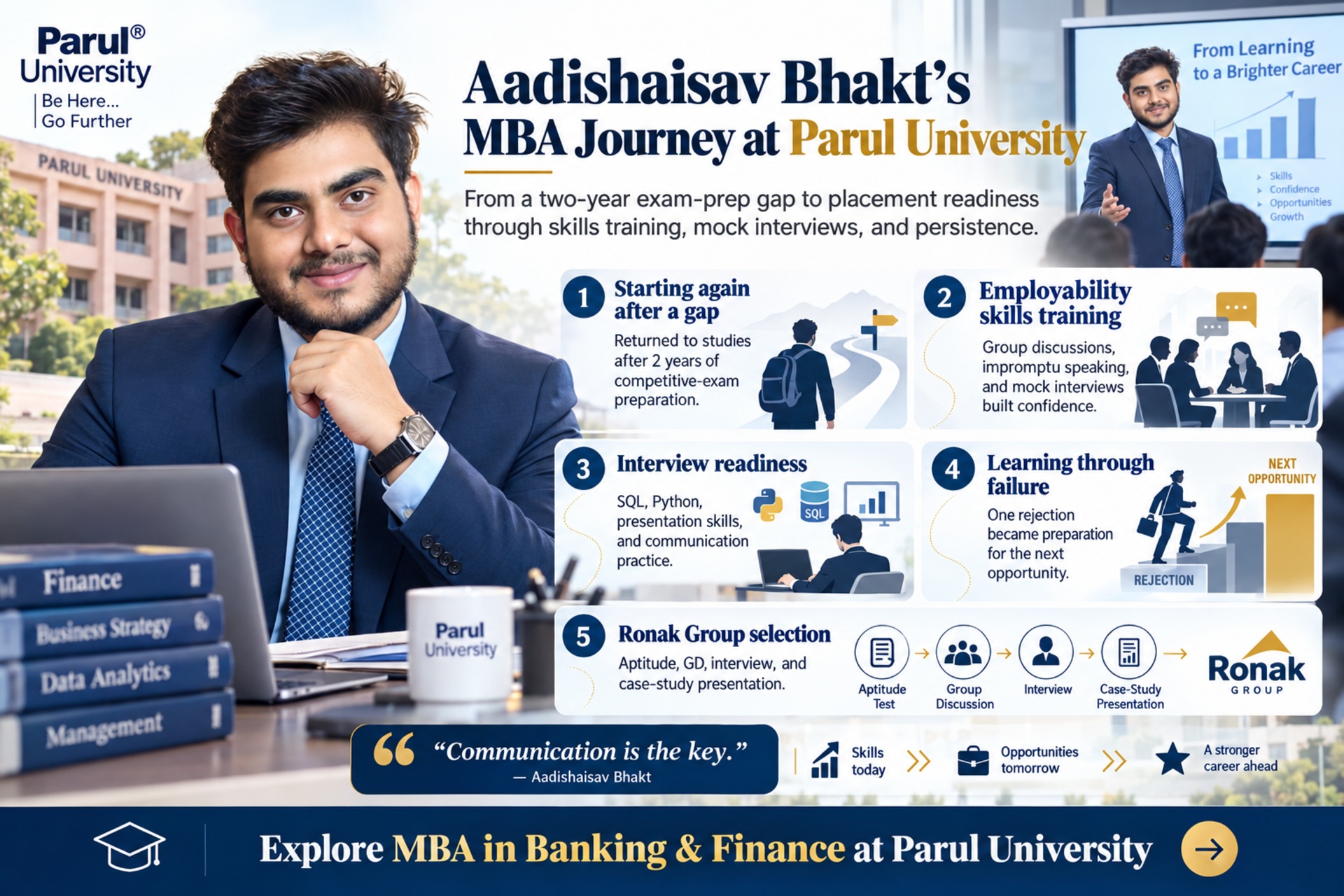
Most placement stories start at the offer letter. Aadishaisav Bhakt‘s starts about two years earlier, in the quieter and less flattering period after his graduation when he stepped away from formal study to prepare for competitive examinations. By the time he enrolled in the MBA in Banking & Finance at Parul University, he was not a fresh graduate carrying momentum. He was someone who was restarting an academic routine he had left behind and rebuilding the confidence that comes with it. The placement that eventually secured Ronak Group is the result of this rebuild.
“I did not want to limit myself to one particular area. Banking and finance give the chance to be in many roles: accounting, banking, or any other finance role.”
The real challenge: starting again after a gap
Aadishaisav is candid that his biggest obstacle was not a subject or an exam. It was the gap itself. Two years of preparation for the exams had distanced him from his previous educational base, which placed him at a disadvantage from the beginning of the MBA, something the rest of his classmates did not have to face. He had to retrain in accounting, do more than others to practice, and relearn the study process itself. He did not see this as an obstacle or an unfair advantage over others; he saw the first challenge to overcome in the MBA and accepted it as part of the learning process. This is essential information, as the fear of returning to education after some time away discourages many from returning when they should reconsider their careers.
Learning to speak: employability skills training
The change Aadishaisav credits most is not a finance subject. It is the university’s employability skills training, which forced him to do the one thing the gap had made hardest: stand in front of people and speak. He admits he was not comfortable doing this at first, even on simple soft-skills topics. The sessions chipped away at that discomfort through repetition, impromptu speaking on assigned themes, sharing opinions, group discussions, and mock interviews.
“Speaking on random topics, being part of group discussions and taking part in mock interviews made me move out of my comfort zone.”
For someone who had always found public speaking uncomfortable and who had just spent two years largely out of such settings, they were the actual training. So when he reached the final stage, he was all prepared and confident!
Training that built interview readiness
TAlongside the soft-skills work, Aadishaisav points to more targeted preparation. He received training in areas such as SQL and Python, which broadened his technical understanding, and separate presentation training that taught him how to structure an argument, present to a larger audience, and read his own strengths and weaknesses. He is clear that presentation training was not about making slides. It was about communicating an idea with confidence, a skill that became directly relevant when his selection process required a case-study presentation in front of senior representatives.
Learning through failure: the OLA interview
One piece of advice that stayed with him was given by his professor;
“Failing is the first step to getting success.”
The point was simple: one unsuccessful interview is not a reason to stop. He came to see that a rejection can be the preparation for the opportunity that follows, which is exactly how it played out. This is the honest spine of his story, and the part most prospective students actually need to hear.
The Ronak Group selection process
The opportunity with Ronak Group ran through several stages, each testing something different. Aadishaisav drew on different parts of his MBA at each one:
- Aptitude and subject knowledge: An assessment covering accounting, cost accounting, sales and marketing, and finance concepts, requiring him to apply what he had studied rather than only recall it.
- Group discussion and interview: Stages focused on communication and personality, where his employability-skills training did its work.
- Case study and presentation: Analyzing a business situation and presenting it to senior representatives, which combined his finance knowledge and marketing skills!
The case-study stage is the clearest example of his MBA translating into a practical advantage. His academic knowledge framed the business and finance angle, and his marketing learning shaped the product and market. His presentation training let him communicate it. Classroom learning and a real recruitment situation met in the same room. He called his parents immediately. His father celebrated by distributing sweets.
A practical obstacle: the passport
He did not have a passport at the moment, which was problematic given the nature of the position. Instead of rescinding the offer, the company allowed him time to get his passport and documents in order, assuring that the paperwork would be handled on their end. It was a gesture that he would always remember, and it is an example of how an appropriate opportunity can allow an applicant to rectify a potentially negative experience.
The influence behind the confidence: his father!
Aadishaisav is unusually direct about where his steadiness came from. His father works with Tata Steel as a site manager, handling logistics, distribution, and operational responsibilities. But what Aadishaisav admires is not the position. It is the temperament: patience under pressure and the fact that his father never discouraged him after a setback. The message his father gave him was about ownership.
“It’s your life. You have to make your career yourself.”
Before the final interview, that advice took a specific form: stop measuring yourself against the other candidates in the room and focus entirely on your own preparation. Aadishaisav believes that mindset carried him through the final selection. His own distilled lesson from it is one most students recognise but rarely act on: competition is real, but comparison becomes a distraction.
His future directions!
Asked how students should prepare, Aadishaisav does not lead with technical knowledge. He leads with conduct and communication: listen to the interviewer and let them finish before answering, arrive early, avoid overconfidence, and above all, communicate clearly. His one-line version is blunt.
“Communication is the key.”
His reasoning is that companies are not looking for people who can simply quote marks. They are looking for people who can understand a situation and explain their thinking, which is exactly the gap that trips up academically strong but under-prepared candidates. Looking to the future, Aadishaisav wants to complete his professional tenure, gain experience, and build a career in finance, including opportunities such as NBFCs, before finally returning to India. His closing message to students is personal: idealise someone whose discipline and approach you can learn from. For him, that person is his father.
FAQs
Can you get an MBA placement after a gap for competitive exams?
Aadishaisav Bhakt took a gap of approximately two years after graduation to prepare for competitive examinations, and he did his MBA in Banking & Finance from Parul University and got placed in Ronak Group. The gap between studies set a challenge for him to get back to studies, but by getting good employability training, he picked up the momentum and regained the lost confidence.
What is the MBA in Banking & Finance at Parul University like for placements?
Aadishaisav Bhakt's experience suggests that the program matches the syllabus of subjects like accounting, finance, cost accounting, marketing, etc., with the preparation needed for placements. Employability skills sessions, mock interviews, GDs, presentation skills, exposure to tools like SQL and Python, and the hand-holding by the faculty members and the Training and Placement cell helped him prepare for the selection process, which involved an aptitude test, a group discussion, an interview, and a case study presentation.