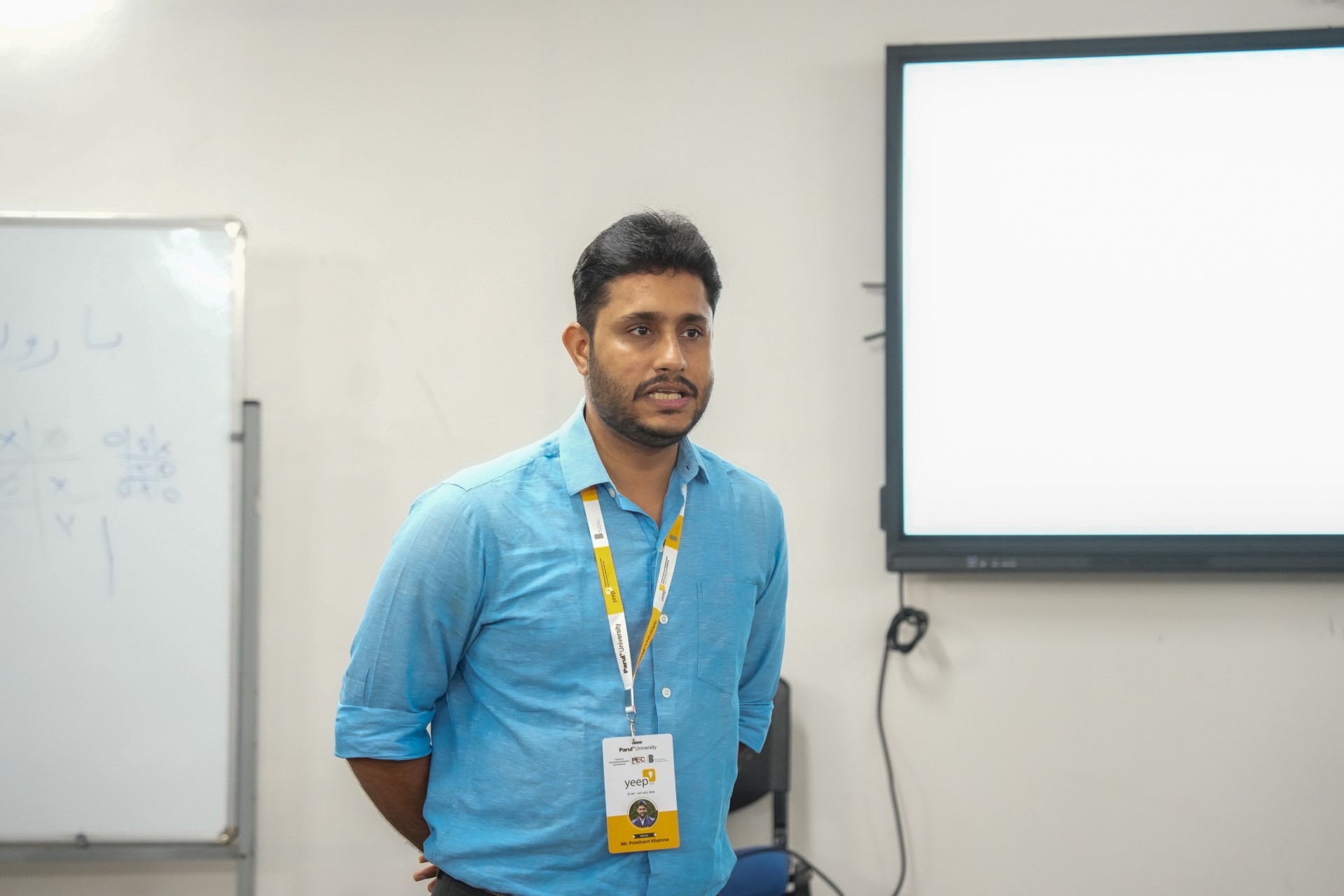
Most failed products share one flaw: they were built around an assumption instead of a person. Design thinking exists to fix that. It’s a human-centred approach so the innovation keeps a real customer at all the decisions. This was the central theme of a foundational session at YEEP – Young Entrepreneur Exchange Program 2026 at Parul University, led by Mr. Prashant Khanna.
The Core Idea - Human Thinking at the Centre
Failure to put the customer at the centre of your attention means you cannot develop a successful product.
– Prashant Khanna, at YEEP 2026
At its heart, design thinking is a systematic way to innovate by understanding a real person’s needs first, not assuming them, and not designing from personal preference. Its whole purpose is to bridge the gap between a founder’s assumptions and what customers actually require, the same gap that causes most startups to fail. By nurturing innovation, design thinking turns assumptions into a repeatable process.
Say Bonjour to 5 Stages of Design Thinking
This is the most trending model, as popularised by the Stanford d.school. Let’s explore each and master how to turn an idea into a solution –
- Empathy – Understand deeply for whom you’re designing for. Learn their needs, behaviours, weaknesses, frustrations via conversation instead of doing random guesswork!
- Define – Learn what needs to be solved & draft a focused problem statement.
- Ideate – Capture & generate a range of solutions without having a judgement. It should even favour quantity and multiple variations of ideas.
- Prototype – Ideate and build a low-cost version of your promising ideas so they can be seen, held, validated and tested.
- Test – Test prototypes with real users and not just closed ones. Learn from their reactions, questions and then figure out whether design thinking is iterative!
#YEEPEntrepreneurship2026 – Your idea is cool. Can it actually become a business?
The Real Difference between Innovation vs Invention!
Primarily, design thinking is majorly about innovation and it helps in what it means. As illustrated with a light bulb by Mr. Prashant Khanna; Thomas Edison is credited with inventing it, but we hardly say he innovated it. Hence, invention is creating something that didn’t exist before, wherein, innovation is applying that something to meet the expectation of a human. That’s when elevating an invention is useful. Innovation is about using the existing/available resources to serve the needs of people and hence, design thinking is built to do the same.
Why Should Entrepreneurs Care?
For a founder, design thinking is insurance against the most expensive mistake in business, building something nobody wants. By empathising before ideating and prototyping before scaling, entrepreneurs test their riskiest assumptions cheaply and early. It is why the method underpins so much of modern entrepreneurship education, and why it pairs naturally with idea validation and the Business Model Canvas.
Design Thinking at Parul University
Parul University applies design thinking across disciplines, from the Parul Institute of Design, where human-centred design is core to the studio method, to management and entrepreneurship programs and the PIERC startup ecosystem, where founders use it to shape products around genuine demand. Besides this, you can even explore business-focused programs such as BBA in Marketing, BBA in Financial Management, BBA in Digital Marketing, and BBA in International Business and build a successful career in entrepreneurship. And wherein for mastering graphics & visual communications for a creative career, discover (B.Des) in Communication Design and M.Design in Design Management and Communication Strategy.
Through PIERC, which has supported 300+ startups, and programmes like YEEP, students do not just learn design thinking as theory; they apply it to real problems, prototype solutions, and test them with real users on a campus of 70,500+ students.
FAQ
What is design thinking & what are its core 5 stages?
Design thinking is a human-centred approach to innovation that solves problems by first understanding the real needs of the people you are designing for, then ideating, prototyping, and testing solutions. It keeps the customer at the centre and treats innovation as a systematic, repeatable process rather than a flash of inspiration. The 5 stages are - Empathise, define, ideate, prototype and test. This process can be iterated and it refines the problem and solution in a straight line.
Define the difference between invention & innovation?
Invention is creating something new and innovation is applying that new something to meet the needs of a human. To execute that invention into something useful, Thomas Edison is credited with the invention of the light bulb, as followed by making it useful and it was globally adopted!
How to apply design thinking for startups?
Execute the 5 stages of design thinking - empathising with customers, find the real problem, work on prototyping and move to testing before scaling. At Parul University, student founders can apply it via PIERC & programs like YEEP for designing ventures around demand!