When a granted Indian patent lists its inventors, you expect senior scientists. On Parul University and IIT Palakkad’s e-waste copper MOF patent, one of those names is Muskan Memon, who began not as a seasoned researcher but as a dissertation student. Her story is one of the most encouraging things about the whole project and a lesson for any student who thinks real research is out of reach.
A Research Interest That Grew
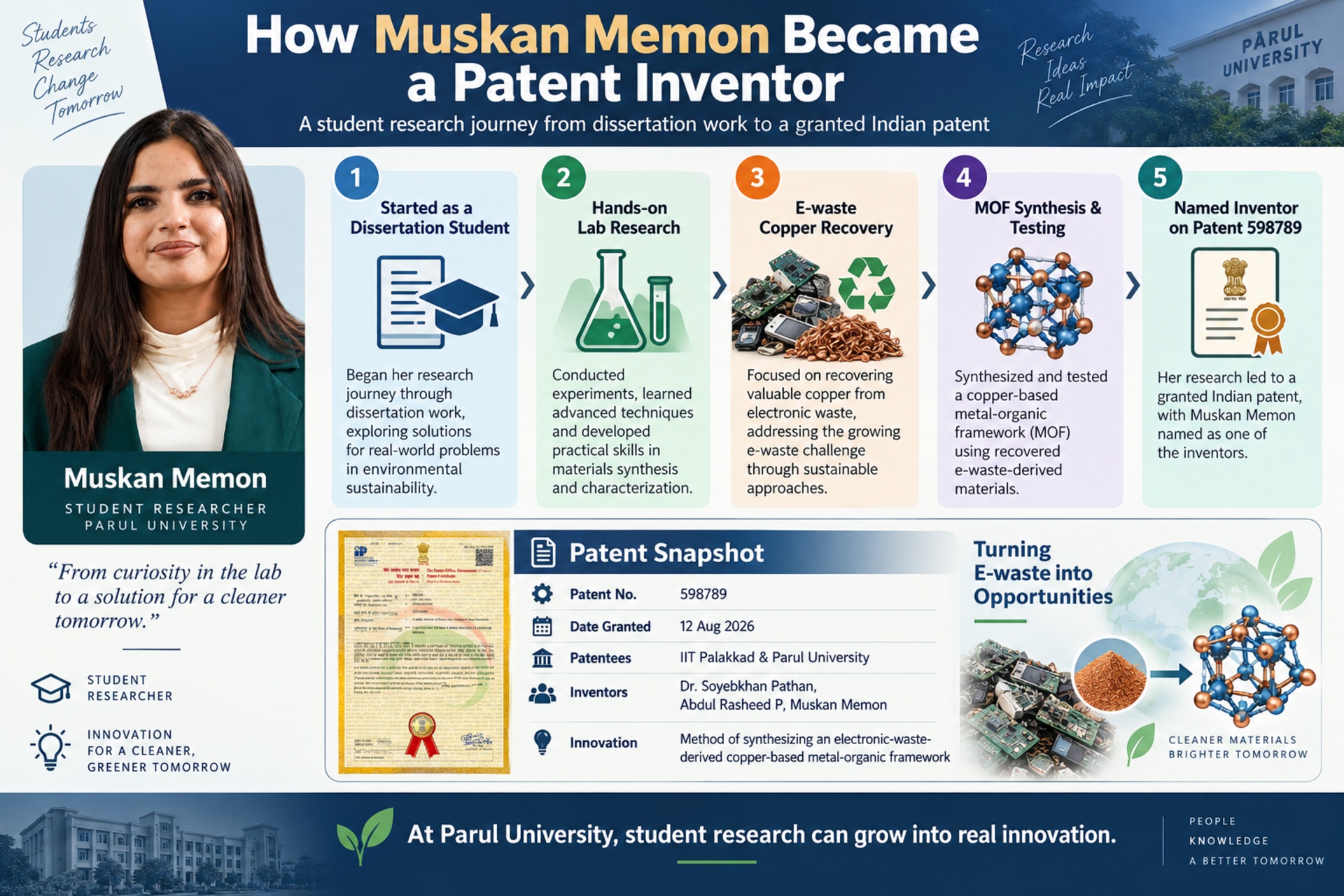
Muskan Memon did not walk into university with a fixed plan to become a researcher. Her interest developed gradually, the way it does for many. She got her first real taste of research while working as a dissertation student, and through regular laboratory work and interaction with other researchers, that taste became genuine curiosity. As the interest developed, so did her involvement and passion for research. She eventually joined as a junior research fellow under the guidance of Dr. Soyeb Khan. Her journey is an inspiration for many researchers out there: Keep going, and that’s how you will win your desired result!
Doing the Real Work
Muskan’s contribution was not peripheral; it was the hands-on heart of the project. She was involved in collecting and processing the electronic-waste-derived material and in synthesising the copper-based metal-organic framework itself, carrying out laboratory reactions, following exacting procedures, adjusting experimental conditions when needed, and checking whether the desired material had formed correctly. This mattered enormously, because a research idea is only a proposal until it is proven in the lab. It was not enough to suggest using e-waste as a material source; someone had to actually synthesise the MOF and show the process worked consistently. Muskan was central to making that happen.
The Hardest Part: Recovering the Copper
Both Muskan and Dr. Khan agree that battery dismantling and copper recovery were among the most difficult parts of the entire project. Discarded lithium-ion batteries must be handled with real care, because they contain reactive materials, and opening them safely involves genuine risk, requiring careful handling and expert support. For Muskan, this was a formative lesson: research is often very different from how simple it looks in theory.
Extracting the copper was challenging, especially because opening the batteries involved safety risks.
– Muskan Memon
In the laboratory, she learned that researchers must contend with safety, the availability of materials and equipment, repeatability, and proper process control; the unglamorous realities that separate a good idea from a working result.
Why Her Story Matters
Muskan’s journey, from a young researcher learning laboratory techniques to a named inventor on a granted Indian patent, demonstrates what becomes possible when students receive meaningful research exposure. It did not happen in isolation: it took mentorship from an experienced researcher, access to proper research infrastructure and instruments, a Junior Research Fellowship, and the support of the university’s Research and Development Cell, which she also credits.
For any student or researcher wondering whether they can ever contribute to innovation, her answer is super clear, go all in with your curiosity, experience, and the right support; a dissertation can become a patent at any point in time!
FAQs
Can students be named as inventors on a patent?
Yes, Muskan Memon, who began as a dissertation student at Parul University and became a junior research fellow, is named as an inventor on a granted Indian patent. Being named on a patent depends on genuine contribution to the invention, not seniority, so students who do real, substantive research work can absolutely be inventors.
How can a student get involved in research?
Research interest often grows through hands-on experience. Getting involved typically starts with dissertation or laboratory work, then deepens through regular lab practice and interaction with researchers. Opportunities like Junior Research Fellowships, mentorship from experienced faculty, and access to research facilities, as at Parul University, allow committed students to contribute to real projects.
What is a Junior Research Fellow (JRF)?
A junior research fellow is a student or early-career researcher who works on research projects under the guidance of a senior researcher, often while pursuing further study. It is a common entry point into serious research, giving hands-on experience with real experiments, as it did for Muskan Memon on the e-waste copper MOF project.