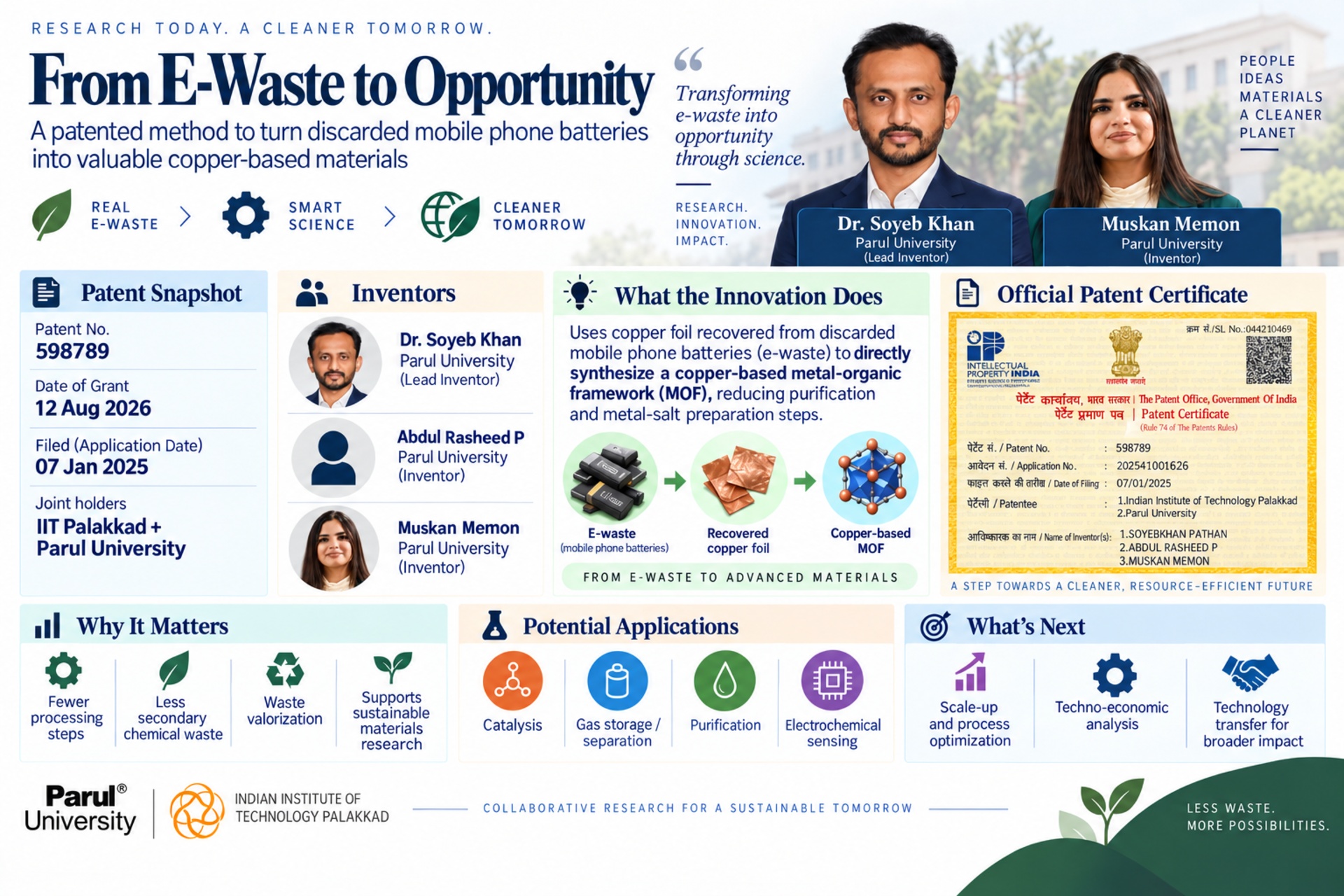
On a global level, electronic waste is one of the fastest-growing problems. Be it phones, batteries, circuit boards, or electronic devices, the opportunity is massive for sure if we could recover and reuse them cleanly. A research team at Parul University figured out that gap with the Indian Institute of Technology Palakkad, has figured out a solution and has championed an Indian patent for it!
The Patent
On 12th August 2026, the Patent Office, Government of India, granted Patent Number 598789, titled A Method of Synthesizing Electronic Waste Derived Copper-Based Metal-Organic Framework. As filed on 7th January 2025, this patent is jointly held by IIT Palakkad and Parul University. Dr. Soyeb Khan, Abdul Rasheed P, and Muskan Memon are the real inventors of this granted patent, as it’s among the most tremendous and verifiable forms of research milestones.
The Innovation: A Shorter, Cleaner Route
The heart of the invention is elegant. Copper recovered from waste normally has to travel a long road before it becomes something useful: electronic waste, then copper recovery, then purification, then conversion into a metal salt, then finally synthesis of the target material. Each step consumes resources and can generate its own chemical waste, an environmental contradiction where treating waste creates more waste. This team took an alternative route. With the usage of exact copper foil, they used mobile phones and batteries to build a copper-driven MOF, skipping the salt and purification stages altogether!
Reducing these extra purification and precursor preparation steps was one of the main innovative parts of the research.
– Dr. Soyeb Khan
In short, the route turns electronic waste into a source of copper to direct MOF synthesis. Fewer steps, less processing, and a genuinely sustainable use of a discarded material.
Two Problems Solved at Once
What makes the work notable is that it addresses two challenges simultaneously. It offers an alternative pathway for managing electronic waste, and it produces a useful functional material, a metal-organic framework with real applications. This is the principle of “waste valorization”: not just disposing of waste, but transforming it into something of scientific and economic value.
Why Copper?
Much recycling research chases the most expensive metals: gold, silver, platinum, and palladium. This team deliberately focused on copper. Copper is abundant, has excellent electrical conductivity, is used extensively in electronics, and still holds real commercial value even as scrap. Crucially, copper recovered specifically from discarded mobile-phone batteries had been far less explored than copper from sources like printed circuit boards, and the battery copper foil provided a direct metallic source once safely separated. The team chose copper not because it was the priciest metal, but because it was widely useful, recyclable, and scientifically under-explored, a smart research bet.
What Can the Material Do?
The e-waste-derived MOF is not a curiosity; it has potential across several important fields, including catalysis, gas separation, gas storage, purification, and biomedical research. The team took the biomedical angle further, developing the material for electrochemical sensing, detecting substances like bilirubin (whose abnormal levels can indicate conditions such as jaundice) and serotonin (linked to functions such as mood and stress). This sensing work was published in a peer-reviewed scientific journal, the Chemical Engineering Journal, and recognised by the university as high-impact research.
The Collaboration & Ecosystem!
The patent reflects a genuine collaboration with IIT Palakkad, one that also led to broader interaction between the institutions and, later, a memorandum of understanding, while a major part of the experimental work was carried out using Parul University’s own facilities. That capability did not appear overnight. Dr. Khan, who joined Parul University in 2021 amid an institutional push to expand research in chemistry, material science, and life sciences, credits the university’s investment: an estimated more than 1.5 crore rupees in research instruments and facilities, around 25 lakh rupees in seed funding for his projects, and the support of the Research and Development Cell, led by figures including Dr. M. R. Yadav and Dr. Anand Joshi, which he says created an environment focused on quality research.
Beyond infrastructure and financial support, Dr. Khan also particularly appreciated the guidance and encouragement he received from Dr. Geetika Madan Patel. He recalled that she would listen to him patiently and carefully, giving him the space to discuss his ideas, concerns, and requirements related to his research. Her patience and willingness to listen left a strong impression on him, and he expressed that developing the same quality of patience is something he hopes to carry into his own professional journey.
He believes that her encouragement and support were also important to the growth of the RDC, adding that without her contribution, he feels the center would not have grown to the scale it has reached today. For Dr. Khan, therefore, the university’s research support has been about more than laboratories, instruments, and funding; it has also been about having people who listen, encourage, and help researchers move their ideas forward.
What’s Next?
TThe researchers are clear that this patent is a milestone and not a finish line. A comparison suggested that lab-scale copper from waste batteries can be cheaper than purity-based commercial copper, but a holistic techno-economic analysis hasn’t been executed yet. Hence, no such commercial claim can be made as of now. The next challenges are scaling from laboratory synthesis towards kilogram-scale production, followed by large-scale systems, completing a techno-economic study, and eventually following the technology transfer. The vision of modern research is simple—create value from waste, reduce the usage of resources, and allow researchers to turn their ideas into intellectual property!
FAQS
Who are the founders of this patented technology?
Patent Number 598789 is jointly owned by IIT Palakkad and Parul University. They developed a method of synthesising an electronic-waste-derived copper-driven metal-organic framework. They executed this by skipping purification processes and then turning e-waste management into an advanced material!
What’s the significance of this patent?
It solves two problems at once: managing electronic waste and producing a valuable functional material. By using recovered copper directly, it shortens the process and reduces secondary chemical waste. As a granted, formally examined patent jointly held with IIT Palakkad, it is a rigorous, verifiable marker of Parul University’s research capability.
What can the e-waste-derived MOF be used for?
The material has potential applications in catalysis, gas storage and separation, purification, and biomedical research. The team specifically developed it for electrochemical sensing of substances like bilirubin and serotonin; the work was published in a peer-reviewed journal, showing that a material made from electronic waste can serve advanced scientific and medical sensing purposes.


