At a recent state-level debate at Parul University, the guest of honour made a striking point: anyone can prepare arguments in advance (many now use AI to do it), but the real test comes when you are cross-questioned on the spot. That is where debates are won and lost. Here is how to master it.
First, Understand the Structure
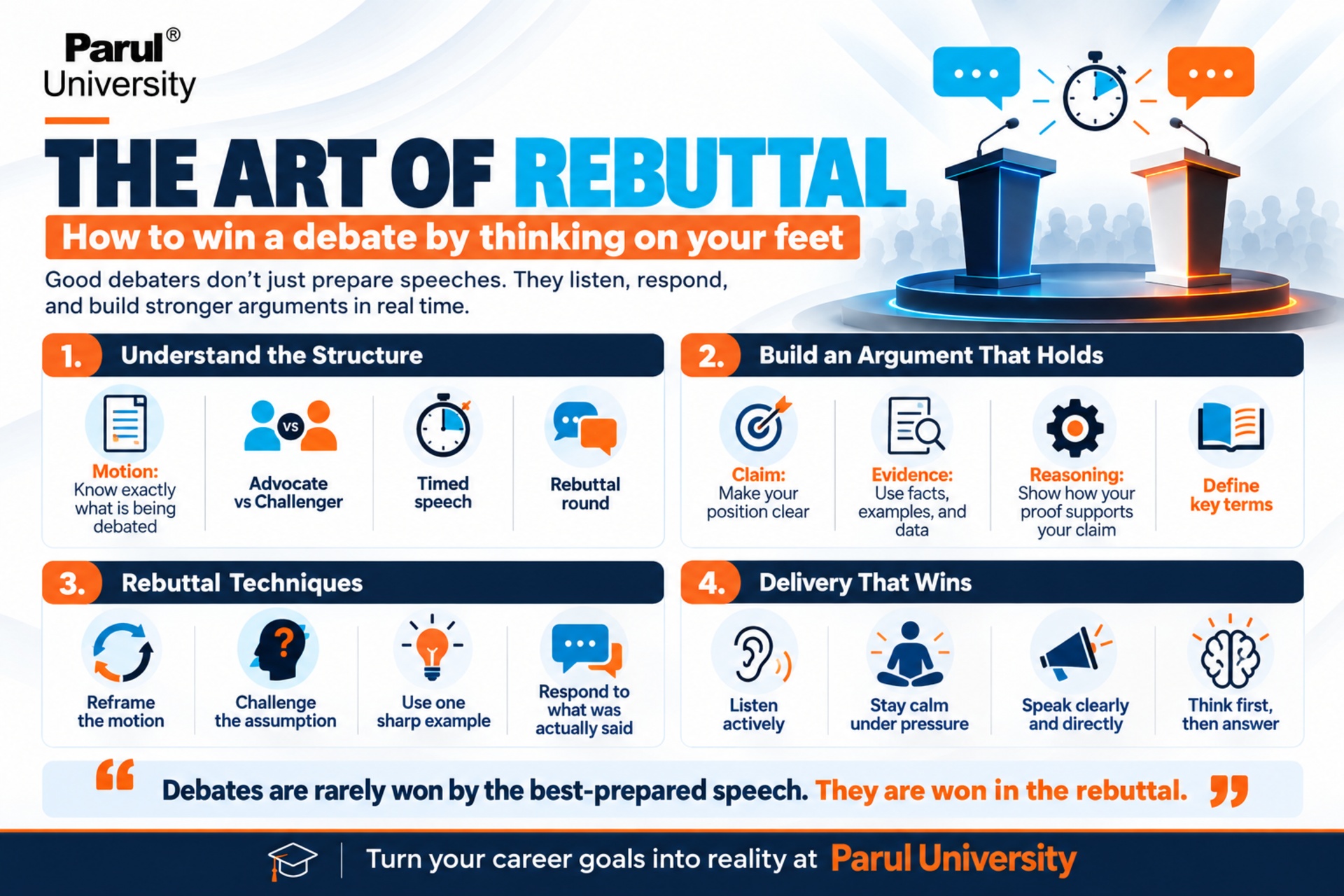
Each team is assigned a motion, a statement to debate, and each team is split into two sides: the “advocate” will present a motion in favour, and the “challenger” will present a motion opposing. Each delivers a timed speech followed by the crucial moment: the rebuttal, a period of direct rebuttal with each side attacking the other’s arguments. It’s important to know what this shape is because this will help you know where to invest your energy, when you speak, but also when you’re listening to someone else.
Build an Argument That Holds
A strong argument has three parts: a clear claim, solid evidence (facts, examples, and data), and the reasoning that links them. Two habits separate good cases from weak ones. First, define your terms. Many debates turn on a single word; in one Parul University round, an entire case hinged on what “precedence” actually means. Whoever controls the definition often controls the debate. Second, anticipate the other side. The strongest speakers build their case already knowing how it will be attacked and quietly answer those objections before they are raised.
The Rebuttal: How to Think on Your Feet
This is the skill that wins debates and the one you cannot fully prepare. When the other side speaks, do not simply wait to deliver your next pre-written point. Listen actively for the weak link in their argument: an unsupported claim, a shaky assumption, or a definition you can challenge. Then respond to what they actually said, not the speech you rehearsed. A few techniques help:
- Reframe the motion; shift the debate to the ground where your case is strongest.
- Attack the assumption; find the unproven belief the other side’s argument depends on.
- Use a sharp example; one vivid, concrete instance can outweigh a page of abstract claims.
- Stay calm; the composed speaker almost always sounds more convincing than the flustered one.
Thinking on your feet is not magic; it is a trainable skill, built by practising and by showing up to argue even when you feel unready.
Winning the Argument vs. Becoming a Communicator.
Lastly, have the bigger goal in mind. To win one argument is good; to be a real communicator is better. To be a real communicator who is able to get across a point clearly, able to listen well, and able to convince with reason and not noise is the master prize. This skill will carry you far beyond the trophy stage in interviews, meetings, and leadership. In the end, debating is not about defeating an opponent; it is about learning to think and talk brilliantly, capturing the attention of those who listen. Practice is the key to skills, just like all true skills, and that’s why platforms to present and speak are important. Your next chapter starts here. Explore programs at Parul University, find what matches your interests and career goals, and take the first step towards turning your plans into reality. From storytelling and journalism to digital media and communication, take your passion further with Parul University’s Bachelor of Arts in Journalism and Mass Communication and Master of Arts in Journalism and Mass Communication. Explore the programs and take your next step in the world of media.
FAQs
How to prevail in a debate?
A debate is not a matter of the opening speech; rather, it is winning the debate by responding to the challenge. Make arguments that contain a clear claim, solid evidence, and sound reasoning; identify key terms (debates often focus on a single term); recognise the “other side” and respond to what they actually said in a calm and specific manner; and listen for the weak point in the other side's argument and respond accordingly in the rebuttal.
What is a rebuttal in a debate?
Each side of a debate rebuts the arguments of the other side, instead of just presenting their own. It's commonly the turn of the conversation, as it cannot be scripted; it requires you to think on your feet, find the point in your opponent's line of reasoning where they are going wrong, and counter that on the spot.
What ways can I improve on my ability to think on my feet?
You can develop the ability to think on your feet with practice. Debate and speak frequently, even if not prepared; listen actively to identify weaknesses, not just to hear what one wants to hear; remain calm and unflappable under pressure; have a few tools to use: view a question in a different way, challenge assumptions, and use well-chosen examples. The more you do it, the more natural it will feel to you.