

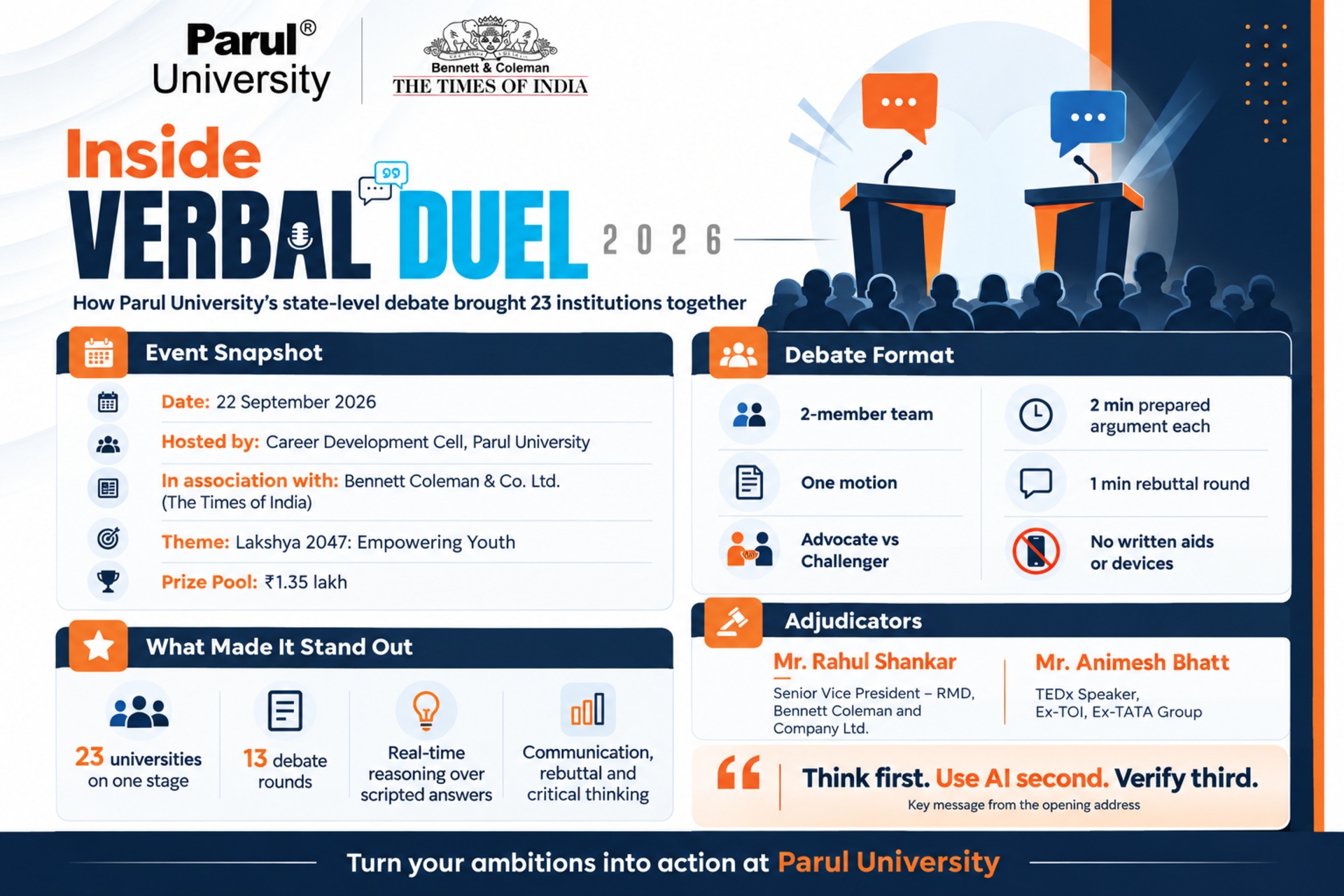
On 22 September 2026, Parul University’s central auditorium became an arena of ideas. Verbal Duel 2026, a state-level inter-university debate run by the university’s Career Development Cell in association with Bennett Coleman & Co. Ltd. (The Times of India), drew two-member teams from twenty-three institutions across Gujarat, competing for a Rs 135,000 prize pool. The theme, “Lakshya 2047: Empowering Youth,” framed the day as a contribution to the national Viksit Bharat 2047 vision.
An Address on Thinking for Yourself
Dr. Kunjal Sinha, Pro Vice-Chancellor of Parul University, opened the event with an address that set its intellectual tone. Drawing on nearly a decade of integrating AI into higher education, she offered a pointed caution: people are increasingly outsourcing not just tasks but the act of thinking itself to machines, accepting an AI tool’s first output uncritically and acting on it without reflection. She extended the warning to the debaters directly, noting, without judgement, that most had likely sourced their prepared points from some tool. The real test, she said, would come in the rebuttal round, when a debater is questioned on something they did not anticipate and must respond using nothing but their own mind. Her advice was a hybrid posture toward AI: think first, use AI second, and verify third round. She closed on the purpose of debate itself: the lasting skill is not winning an argument for a day, but learning to communicate.
Winning an argument for a day is a game. The more enduring skill worth cultivating is the ability to communicate, to become a communicator, not merely a debater.
– Dr. Kunjal Sinha, Pro Vice-Chancellor, Parul University
The Format: Where the Real Test Is the Rebuttal
The rules were built to reward genuine thinking. Each two-member team was assigned a single motion, with one member arguing as the advocate (for) and the other as the challenger (against). Each debater had two minutes to present, followed by a shared one-minute rebuttal round in which the speakers cross-questioned each other directly. Written aids and electronic devices were barred, as was any unparliamentary language targeting a region, religion, caste, sex, or political affiliation. The adjudicators’ decisions were final.
The Adjudicators
Two industry leaders judged the day. Mr. Rahul Shankar, Senior Vice President for Research and Market Development at Bennett Coleman & Co. Ltd., brought close to three decades of experience across the FMCG and media industries, with an electrical engineering degree from NIT Rourkela and a postgraduate diploma from XLRI Jamshedpur. Mr. Animesh Bhatt, a digital growth and monetisation strategist, TEDx speaker, and former member of the Times of India Group, brought over two decades in the field and a focus on human behaviour and communication. He set a generous tone, telling participants to relax and enjoy the experience rather than treat it purely as a contest to win or lose.
The Debates: A Nation’s Questions, Argued by Its Youth
Across thirteen rounds, students argued the questions India is genuinely wrestling with, each side making its case, with figures cited as part of the debaters’ own arguments. A representative sample shows the range:
- The use and misuse of AI (Central University of Gujarat), where one debater argued AI is a safe tool if we refuse to outsource our thinking, while the other countered that people will always choose the easiest path.
- Skill-based versus degree-centric education (debated by several teams), turning on whether India should prioritise practical skills or the foundational knowledge that produces future innovators, with the word “precedence” itself becoming the battleground.
- Digital versus physical infrastructure ( D. College of Engineering and others), which produced the memorable line that “you cannot upload a highway or download a bridge.”
- Regenerative versus conventional farming (Narayan Business School and others), weighing long-term soil health against the near-term food security of vulnerable farming households.
Other rounds tackled social media and student well-being, electric-mobility policy, and the balance between ease of doing business and welfare, each argued on its merits by students from across the state.
Why Events Like This Matter
It is worth stepping back to see what a day like this represents. Convening twenty-three universities, in partnership with one of India’s largest media houses, for a rigorous, rules-based contest of ideas is not a small undertaking, and it reflects an institution that takes intellectual life seriously. For the students, the value runs deeper than a prize. In an age when it is easy to let a machine think, they were rewarded for exactly the opposite: for listening closely, reasoning in real time, and defending an idea under pressure with nothing but their own minds. That is a form of education no tool can provide, and it is the clearest answer to what a university is for, giving young people the stage and the challenge to become genuine thinkers and communicators. Your media career starts with the right foundation. Discover Parul University’s Bachelor of Arts in Journalism and Mass Communication and Master of Arts in Journalism and Mass Communication to develop industry-relevant skills and prepare for exciting opportunities across journalism, media, and communication.
FAQs
What was Verbal Duel 2026?
Verbal Duel 2026 was a state-level inter-university debate competition hosted by Parul University’s Career Development Cell in association with Bennett Coleman & Co. Ltd. (The Times of India) on 22 September 2026. It featured two-member teams from 23 institutions across Gujarat competing for a Rs 135,000 prize pool, on the theme “Lakshya 2047: Empowering Youth.”
What was the debate format?
Each two-member team was assigned one motion, with one member arguing for (advocate) and one against (challenger). Each debater had two minutes to present, followed by a shared one-minute rebuttal round of direct cross-questioning. Written and electronic aids were prohibited, as was unparliamentary language, and the adjudicators’ decisions were final.
What topics were debated?
Movements spanned the questions shaping India’s future, including the use and misuse of AI, skill-based versus degree-centric education, digital versus physical infrastructure, electric-mobility policy, regenerative versus conventional farming, ease of doing business versus welfare schemes, and social media’s role in student well-being, all framed around the Viksit Bharat 2047 vision.


