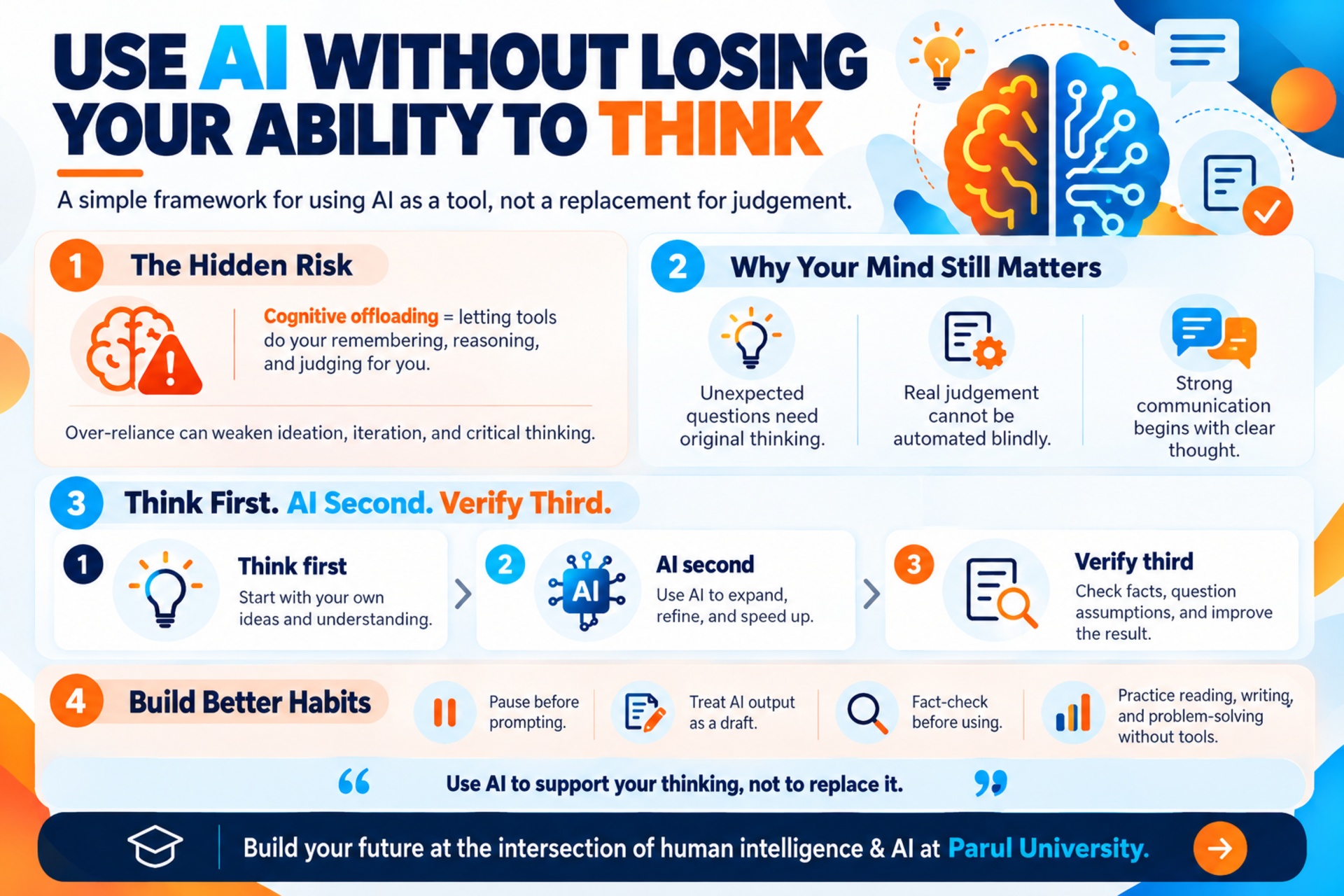
Opening a state-level debate at Parul University, Pro Vice-Chancellor Dr. Kunjal Sinha issued a warning worth everyone’s attention: increasingly, she said, people are outsourcing not just their tasks but their thinking to machines. It is a quiet risk and a real one. Here is how to avoid it.
Why Your Own Mind Still Matters
Here is the catch: AI is brilliant at answering questions you expected, but life constantly asks the ones you did not. Dr. Kunjal Sinha illustrated this with a debate. A student can have every argument prepared in advance, perhaps with AI’s help, but the moment they are cross-questioned on something unanticipated, no preparation helps. They must respond with nothing but their own reasoning. That moment (the unexpected question, the problem no tool has pre-solved) is where real thinking lives, and it is a capacity you keep only by using it. An education, a career, and a life are full of such moments.
The Rule: Think First, AI Second, Verify Third
The solution isn’t to turn off AI; that’s impossible and unnecessary. It’s to use it in the correct sequence. Dr. Kunjal Sinha has a very simple and powerful rule:
- Plan and develop ideas or understanding before engaging an AI tool. This keeps your mind on the author and the AI on the assistant.
- Edit, check, or speed up what you’ve already made.
- Check; do not take anything an AI says at face value. Ask questions, look it up, and verify that it is correct (AI can be as confident as it is incorrect).
These proven activities will enable you to harness AI’s speed and power without losing control of your own judgment.
Building the Habit
Using AI well is a series of small disciplines: pausing to think before prompting; treating every AI answer as a draft to be verified, not blindly followed; using AI as a tool to generate ideas and then deciding for yourself; and regularly engaging in hard mental work, reading, writing, arguing, and problem-solving without a tool to keep the skill polished.
The objective is to be a collaborator, not a competitor: AI should augment your thought rather than taking it over. When used in this way, AI is a powerful thinking tool for the powerful thinker. When not used properly, it can be a luxury that not everyone can afford. The power of thinking & communication seems even more important in the age of AI, which is now ubiquitous in all aspects of life. It is the priciest possession you own. Explore Parul University’s Bachelor of Arts in Journalism and Mass Communication and Master of Arts in Journalism and Mass Communication to build your skills in journalism, media, communication, and the evolving world of digital storytelling. Start your journey towards a dynamic career in media and communication today.
FAQs
How to leverage AI without depending on it?
Use AI correctly: think first, and go to AI tools in the second phase of creation and verify. Ask constant questions, fact-check the information, and that’s how you’re leveraging organic thinking in sync with AI!
What is cognitive offloading?
Cognitive offloading is when you use something outside the head to remember things or perform calculations, e.g., a notebook for memory or a calculator for arithmetic. With AI, the risk is not only of passing off memory but also of passing off reasoning, judgment, and creativity. The very essence of thinking can be damaged if you depend on AI instead of your own thinking.
Should the use of AI be decried as a threat to critical thinking?
Not in and of itself; it depends on how you use it. If students rely on the initial answer provided by AI without critically processing it, it can become a bad habit. However, employing AI after personal thinking and always checking what it produces can improve your work. The secret is to let your own logic drive the thinking process and use AI as a tool, not a replacement.