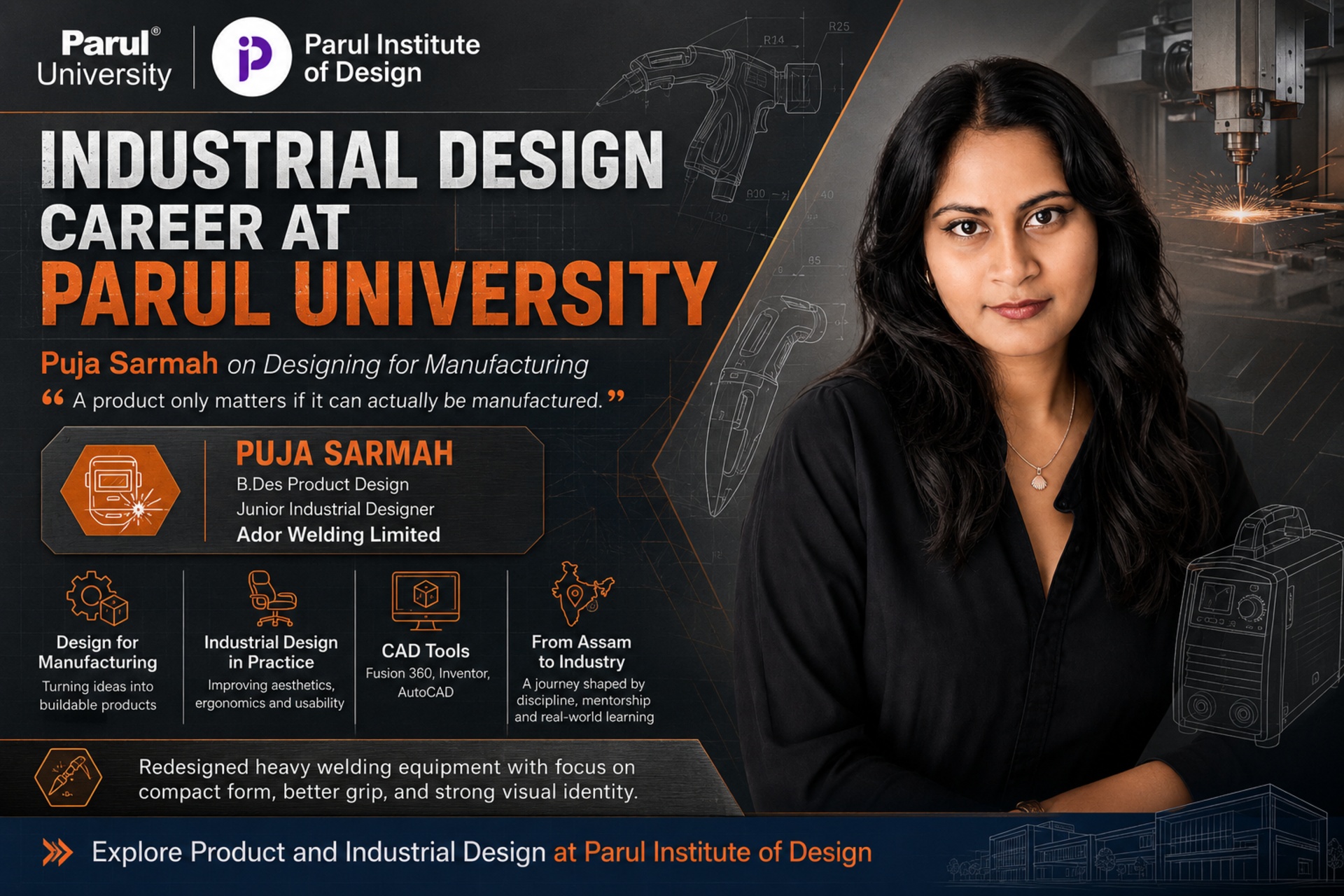
There is a lesson most design students only learn once they reach a real factory floor: a brilliant design that cannot be manufactured is not a good design. Puja Sarmah, a Bachelor of Design graduate in Product Design from Parul Institute of Design, learned it working as a Junior Industrial Designer at Ador Welding Limited, a long-established Indian company in welding and industrial equipment. Her path there, and what it taught her, is a clear window into what an industrial design career actually demands.
From Nagaon to a Design Studio
Puja’s route into industrial design was anything but linear, and it began far from any studio, in Nagaon, in the north-eastern state of Assam. She grew up in a close-knit family of three, in a home she describes as a mix of strict routine and deep tradition: her father is an ex-army man, whose military background gave her an early sense of discipline, and her mother, who runs the home, she describes as someone full of culture. Surrounded by Assam’s landscapes, she took nature as her biggest inspiration, a theme that would run through her academic projects for years. After appearing for the NIFT and NID design entrance exams, she found her way to Parul University through a personal recommendation, a school senior connected to her cousin, who told her about its design programme.
An Introvert’s Difficult Start
Puja is candid that she is a complete introvert, and the scale of a new campus frightened her enough that she very nearly did not begin. The course started in June; she joined the university in August and preferred staying in her room, avoiding college completely initially.
This changed with a small act of care: her faculty noticed that she was not attending the classes; even after joining the university, they called her directly to share that she should start coming to classes now. That one call gave her courage to walk in the next day and finally start her college life. A reminder of how much a nervous student can be shaped by a teacher who simply reaches out.
The Switch from Fashion to Product Design
She did not begin in product design at all. Puja spent her entire first year in fashion design and felt genuinely lost in it, with no clear sense of what she was meant to do. Rather than let her switch on impulse, a teacher gave her patient advice: sit through the fashion classes for another three or four days, observe, and be sure. She did, confirmed she had no interest, and made the considered decision to move to Product Design.
The switch brought its own wave of self-doubt, joining a new set of classmates already settled in the stream and wondering whether she could cope, but it proved to be the moment her real path began.
The Mentors Who Built Her Foundation
Getting through that transition was possible, she says, because of her teachers, and she credits three by name. Samir sir took her right back to basics, teaching her how to approach sketching and how to start and execute a project from scratch.
Gopal sir gave her the structural side, the established methods of design and how to follow them properly through a live project. And Manas sir supported her throughout her time at the institute.
The combined patience of all three is what helped her find her footing in a department she had entered full of doubt.
Finding Her Niche, and a Design Philosophy
As she felt settled, she started enjoying the work, working on ergonomics, consumer electronics, packaging design, and, her clear favourite, nature-inspired design, a natural extension of her Assam childhood.
She felt that with these subjects, she could explore her capabilities, which she didn’t know existed within her. This changed her perception of the profession.
Design, she realised, is not about making something merely look good; a functional design has to meet a real user need. The true job of a designer, in her words, is to find a good, easy solution to a genuine problem, exactly the mindset her later work at Ador Welding would demand.
The Discipline of Re-dos
Design school was rigorous in a way she does not romanticise. The practical workload was heavy and relentless, and the hardest part was the constant cycle of redos, work sent back by strict faculty to be done again until it was right.
The pressure before a jury was intense, with a lingering panic over whether a physical model would even be finished in time to present to external examiners. Yet she is clear that the re-dos, punishing as they were, are what produced the best work.
That resilience was tested further in her seventh semester, when a serious illness struck close to a major deadline; she credits her friends and faculty with rallying to help her through it, a mark of the support around her.
A Portfolio Built by Hand
In product design, the portfolio is everything, and much of it is physical. From her second year onwards, Puja built a steady series of tangible models: a simple product to begin with, then a detailed packaging project, then a more mechanical challenge in the form of a vacuum cleaner, and, around her sixth and seventh semesters, a sleek pair of earbuds, a body of work weighted heavily toward consumer electronics.
She also stepped beyond coursework to compete in an innovation event called Toyathon. This habit of building, rather than only sketching, is what prepared her for the manufacturing realities of industry.
What Does an Industrial Designer Do?
Industrial design is the discipline of designing manufactured products, everything from consumer electronics to heavy machinery, balancing how a product looks, how well it works, and how comfortable it is to use.
At Ador Welding, Puja was assigned to redesign an existing heavy welding machine: improving its visual appearance and its ergonomics, making a bulky machine more compact, redesigning the handles for better grip, and reworking the external shell, all while staying within the company’s established design language.
That combination – aesthetics, ergonomics, and consistency with a brand – is the core of industrial design work. She entered the company through an internship that was extended into a role, secured through a personal reference rather than campus placement, and is today its junior industrial designer.
The Real Difference: Design for Manufacturing
A product can look amazing from the outside. It is only from the inside that you realise how important the internal mechanical rules and constraints are.
– Puja Sarmah
The single biggest shift Puja describes is the move from imagination to manufacturability, the discipline known as design for manufacturing.
In college, she explains, a student thinks of a striking idea, gets it approved, and builds a small mock-up on a lab 3D printer, with no real material limits or constraints. Industry is the opposite. Every design decision needs a solid engineering reason, and a designer must constantly ask whether a design can actually be built with real materials and whether it is commercially viable enough to sell.
A design that cannot be manufactured, however beautiful, is simply not usable. Learning to design within those hard constraints is what separates a student from a professional industrial designer.
The Software Behind the Work
Industrial design at this level is highly technical, requiring precise 3D modelling and engineering-grade tools. Puja works daily in Fusion 360, Inventor, and AutoCAD to model and draft complex products such as the external shell of a heavy welding machine. This is a different toolkit from the software used in graphic or interface design, and it reflects the field’s closeness to engineering. Building genuine proficiency in these tools during study is what makes an industrial designer employable from day one.
From Employee to Entrepreneur: What Comes Next
Puja’s scale of work jumped dramatically from college to industry, from small everyday consumer products to heavy, complex welding machines with many variations, and she found that the fundamentals held across that range: understand the user, respect the constraints, and solve a real problem. Her plan from here is deliberate. She wants to spend the next four to five years building solid, practical experience in a good job, and then to strike out on her own, starting an independent business and building her own brand in the market. Her advice to juniors reflects the same self-driven spirit: build your professional network actively and start giving interviews early, rather than waiting for opportunities to arrive.
Also Read : How to make a career in UX/UI designing ?
Frequently Asked Questions
What does an industrial designer do?
An industrial designer designs manufactured products, balancing appearance, function, and ergonomics while ensuring the product can actually be built and sold. Work ranges from consumer electronics to heavy machinery and includes 3D modelling, refining aesthetics and usability, and designing within real material and manufacturing constraints, using tools such as Fusion 360, Inventor, and AutoCAD.
What is design for manufacturing?
Design for manufacturing is the practice of designing products so they can actually be produced efficiently with real materials and processes. It means every design decision has an engineering rationale, and a designer must constantly check whether a concept is physically buildable and commercially viable, not just visually appealing. It is one of the biggest differences between student projects and professional industrial design.
What is the difference between product design and industrial design?
The terms overlap heavily and are often used interchangeably. Product design broadly covers designing products for people to use, while industrial design particularly emphasises products that are mass-manufactured, giving strong weight to manufacturability, ergonomics, and engineering constraints. In practice, an industrial designer is a product designer who works closely with how things are actually made.
What software do industrial designers use?
Industrial designers rely on 3D modelling and computer-aided design (CAD) software such as Fusion 360, Autodesk Inventor, and AutoCAD, among others, to model products precisely and prepare them for manufacturing. This engineering-orientated toolkit differs from the software used in graphic or interface design and reflects industrial design’s close relationship with engineering.