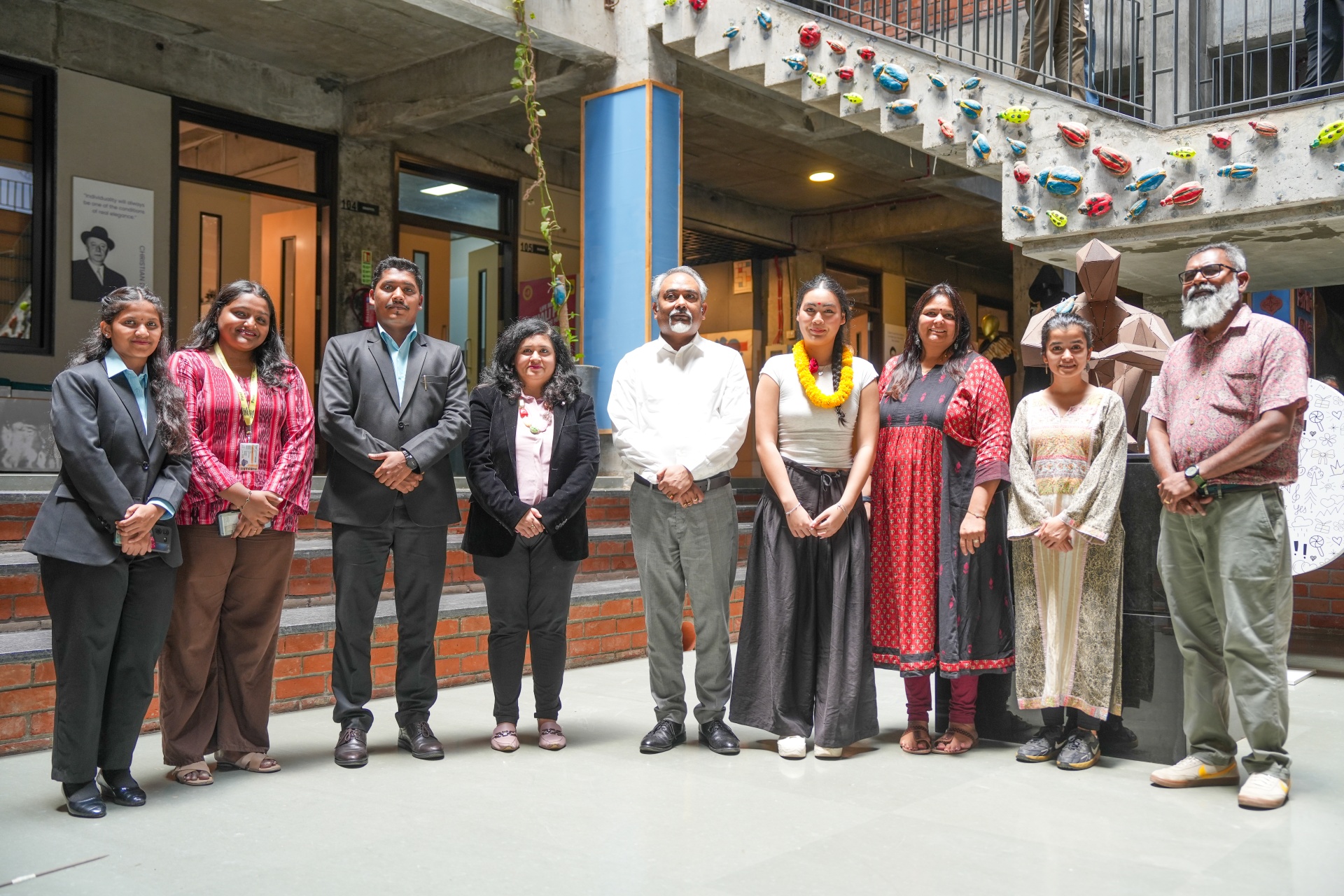
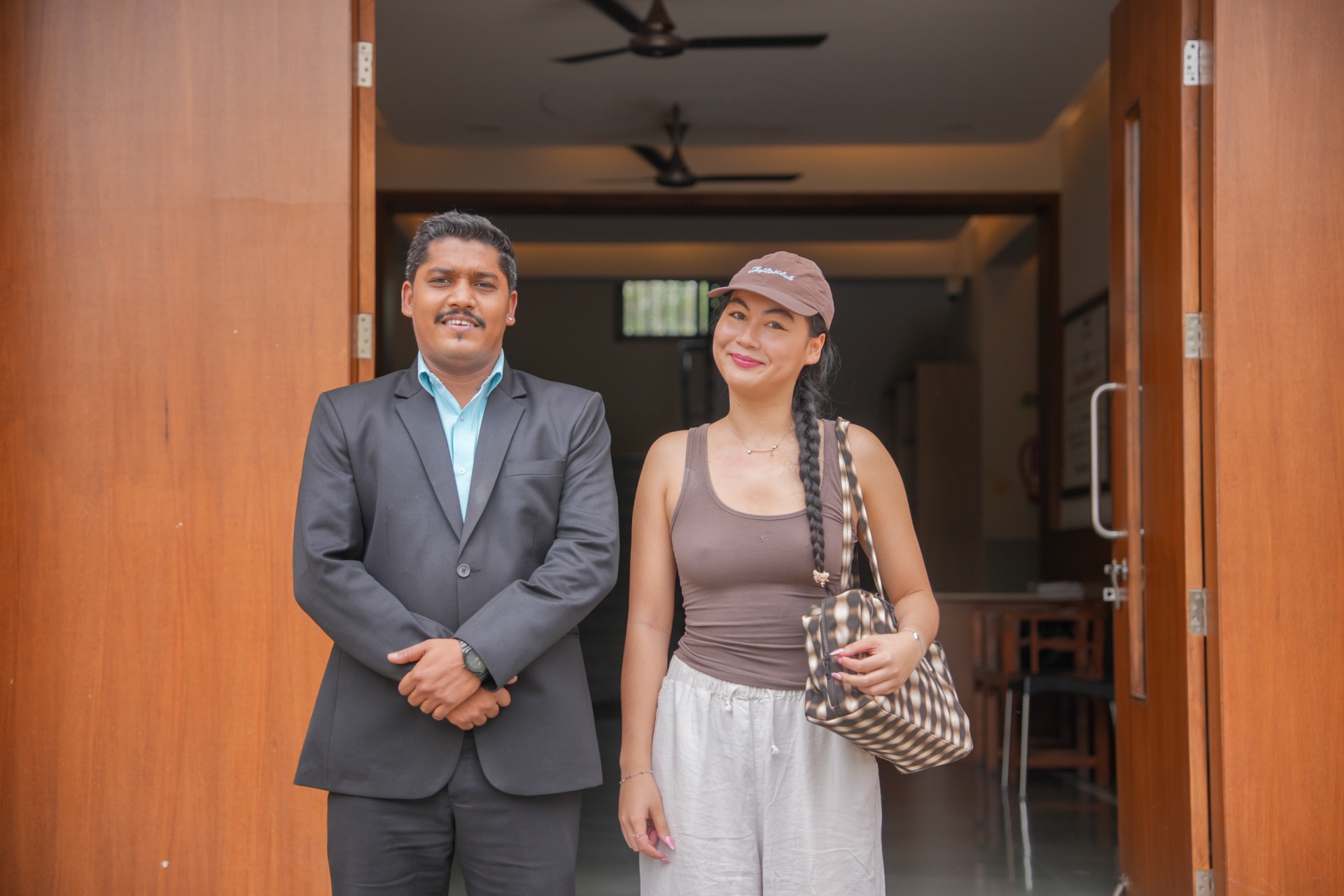
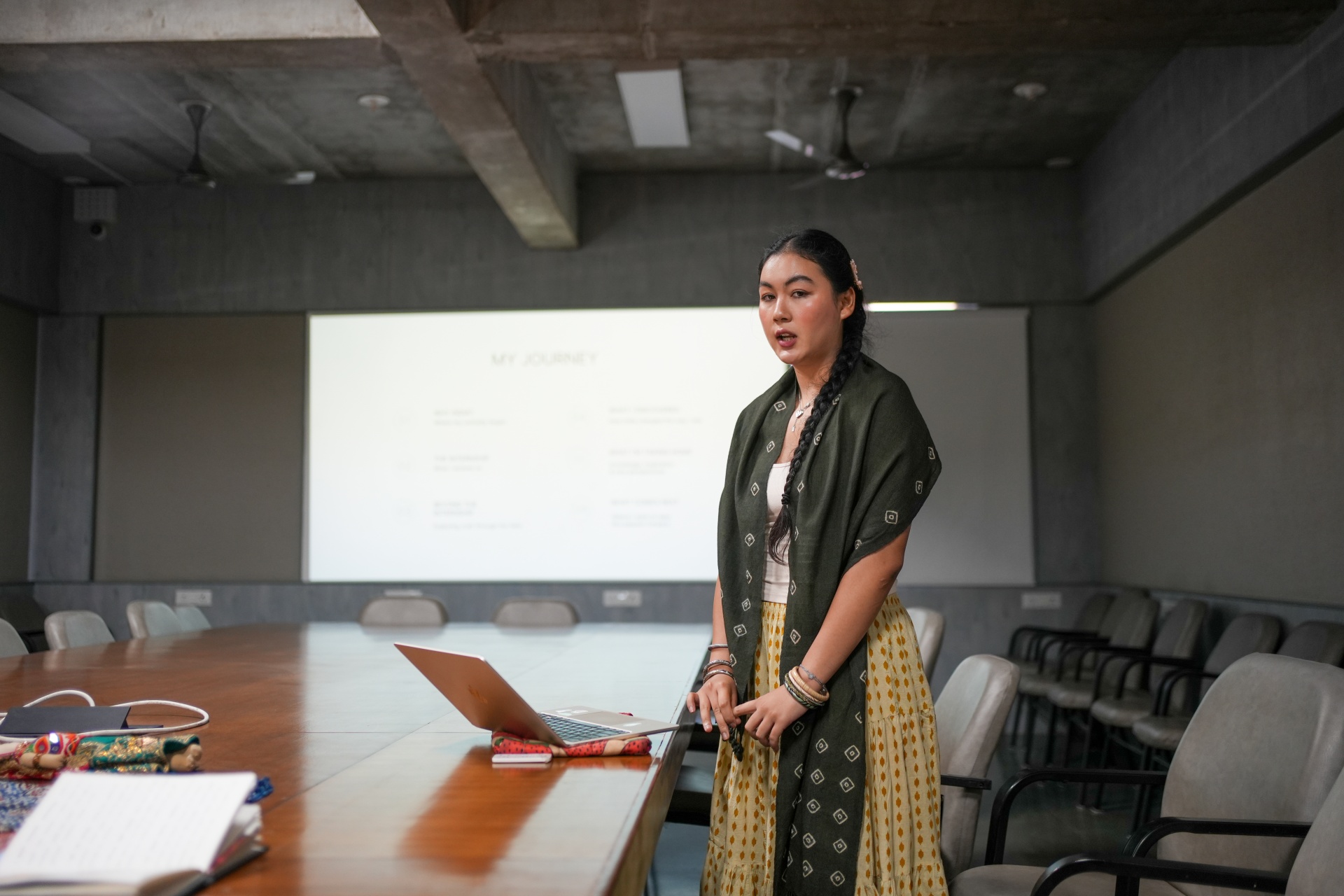
Pappim Semthapphra’s Craft & Textile Journey at Parul Institute of Design!
A student who came for passion!
Pappim Semthapphra is a third-year communication design student at King Mongkut’s University of Technology Thonburi (KMUTT) in Thailand, and she came to India with a clear purpose. Her internship ran at the Parul Institute of Design, Parul University, from 19 June to 30 September 2026, arranged through the collaboration between Parul University and KMUTT. Unlike many of her friends at home, who chose conventional company placements, she wanted something different, and she built her internship around a country and its crafts rather than a single organisation.
“I came here for passion. I really love, and I’m deeply fascinated by Indian arts and culture.”
At KMUTT, communication design is broader than the name suggests, spanning marketing, website building, photography, and cinematography alongside hands-on work in crafts. Pappim describes herself less by software and more by a way of seeing, and her strongest pull has always been to work by hand. Her largest project at KMUTT, a set of six tie-dye pieces totalling ten metres of fabric, took her five months to complete, made slowly and by her own hands. That preference shaped how she approached India: she came looking not for a project to finish but for material to learn from.
Research-based internship in the classroom of India.
For Pappim, the internship was a research experience: it was to study crafts and textiles, learn them at the source, and document them. Parul Institute of Design provided her with a foundation, a group of mentors and her circle of friends, and the campus from where she started planning her travels, and India was her classroom. All her activity within and outside the university was devoted to that purpose.
The Kutch journey: a goldmine of living crafts
One chapter of her life with India is Kutch, which she had also planned when she first stepped onto Indian soil. It is the most unforgettable trip she has ever made, and for that reason, she selected the region.
“It’s a goldmine.”
Kutch, in her account, holds a craft community for almost every kind of traditional work a design student could hope to study, from block printing and tie-dye to embroidery and painting, in a largely rural area that few foreign visitors reach. There she tried Rogan art, the intricate painting tradition of Kutch, and explored Ajrakh block printing, which she is especially drawn to. She visited the Shrujan organisation, known for its work in Kutchi embroidery, the Living and Learning Design Centre (LLDC) museum, and the craft organisation Khamir. What made it meaningful, she says, was not only seeing the crafts but speaking with the artisans themselves. She credits a friend from Parul University, Himanshu Raj, who accompanied her and helped her navigate the region and speak with the artisans, as essential to the access and the conversations the trip made possible. Turn your creativity into a career with B.Des in Communication Design and B.Des in UX & Interaction Design with AI. Explore design, technology, and branding to shape the future of creative industries!
Beyond Kutch: Jaipur, Ahmedabad, and more
Kutch was the centrepiece, but not the only stop. In Jaipur, Pappim attended a block printing workshop and a workshop on blue pottery, a craft closely associated with the city. In Ahmedabad, she took part in a workshop on Mata ni Pachedi, the traditional temple textile art of Gujarat, which she describes as one of the rarest crafts in India, practised today, she says, by only two families in the city. She also tried Gond art, the tribal painting form of central India, through a workshop. She is modest about her results and clear about her intent: she is not trying to master every tradition but to meet each one honestly, understand its history, and carry that understanding with her.
“I expect to collect and experience as many types of art as possible. I just want to experience everything new to me, because everything here is new to me and so beautiful.”
How she documents: the process learning book!
One of the most distinctive parts of Pappim’s work is how she records what she learns. She has a book that she calls her process learning book, a travelogue of photos, handwritten notes, and scrapbook materials that captures all of her experiences and learning in India, for her university in Thailand, but also as her own sort of creative diary. She has a straightforward approach, and her local friend assists her with the questions; she asks them how long they have been doing the craft, its history, and what is behind it and then writes it down in the book. It is a document that has no reason to be rushed, and it is ideal for a student who likes to use a paper and pen instead of a laptop. Her research falls under a theme that she has set herself, Learning Through Craft, Culture, and Community, which truly reflects what she has been doing: learning from the craft traditions, understanding the culture in which they are embedded, and listening to the communities that support these traditions.
The person beyond the portfolio
Pappim’s interests reach beyond design. She has practiced yoga for six years and hopes to open her own yoga studio and wellness centre, and she imagines a space that also makes room for pole dance. Alongside it, she wants to launch a clothing brand, a line of activewear including yoga and pole wear, inspired by Indian fabrics, which is part of why her study of textiles in India matters so personally to her. Her family runs a tourism business in Thailand that also hosts art workshops, and her interest in block printing is partly a wish to open a block printing workshop there herself. Her five-year vision brings these together: her own studio and wellness centre, support for her family’s business, and a small clothing brand of her own.
Mentors, friends, and what she takes back
Throughout her stay, Pappim speaks warmly about the people she met at Parul University, above all her mentor at the Parul Institute of Design, whom she refers to as Yasmin ma’am, and whose support, she says, meant a great deal to her. She is equally warm about the friends who were willing to help her travel with her and translate where needed, which for an international student far from home mattered as much as any academic opportunity. Asked what she is taking back to Thailand, she speaks of everything she has learned and her wish to share with her community there how rich India’s craft traditions are.
“I love India so much. I still love India.”
Go on, she says – concentrate on what you want to do. It is an apt note at the end of an internship of many little, purposeful bits, a trip to Kutch arranged before the arrival, workshops located in three cities, a process learning book slowly filled with photographs and handwriting, and of an international internship that is, when it’s done by sincere curiosity.