When Parul University researchers set out to study stress using a wearable patch, two of the signals they focused on were cortisol and Galvanic Skin Response. To understand why, it helps to understand the fascinating science of how the body reacts to stress. This is an educational overview, not medical advice.
What Is Cortisol?
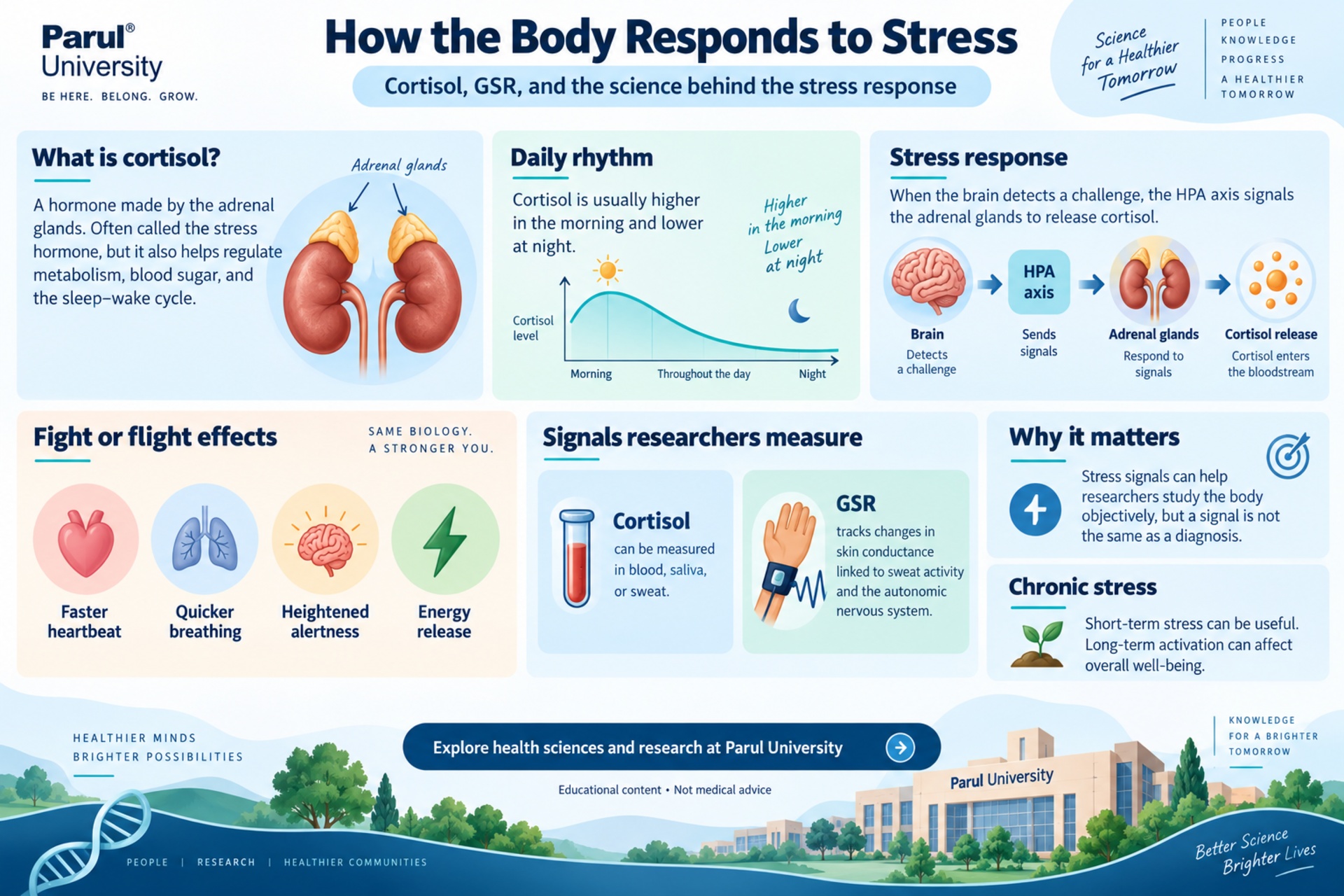
Cortisol is a hormone produced by the adrenal glands, small glands that sit on top of the kidneys. It is often called the “stress hormone” because the body releases more of it in response to stress, but cortisol is not a villain. It plays essential everyday roles: helping regulate metabolism and blood sugar, supporting the sleep-wake cycle, and helping the body respond to challenges. Cortisol naturally follows a daily rhythm, typically higher in the morning to help you wake and get going, and lower at night. In short, cortisol is a normal, necessary hormone, its release during stress is a feature, not a fault.
Responses to Stress
Stress can be good but harmful too. There are two types of responses to stress. One is fight; the other is flight. It gets activated when brain perceives a challenge or threat; it triggers the body’s stress response. There is a coordinated system (known as the HPA axis, it links brain and the adrenal gland). It releases stress hormones, including cortisol. Usually, the result is set of physical changes that the body goes through. It is designed to help you respond. The responses can be a faster heartbeat, quicker breathing, heightened alertness, and the release of energy.
This response is ancient and useful; it prepares the body to act. It is meant to be temporary, switching on when needed and off when the challenge passes.
Signs That Stress Shows Up
Because the stress response produces measurable physical changes, stress can, to some degree, be observed through the body’s signals. Two are especially informative:
- Cortisol levels: as a biochemical marker of the stress response, cortisol can be measured, in blood, saliva, or even sweat, offering information about how the body is responding.
- Galvanic Skin Response (GSR): when the stress response activates, tiny changes occur in the skin’s sweat activity, altering its electrical conductance. GSR measures this, reflecting activity in the autonomic nervous system, the part that operates automatically, outside conscious control.
Together, these give a window into the body’s physiological state, which is precisely why researchers, including at Parul University, study them to understand stress objectively.
Why Measuring Stress Matters
We often cannot tell, even in ourselves, how much stress our body is carrying. Objective physiological signals can add useful information alongside how a person feels and what a clinician observes. This is the promise behind emerging wearable health technologies: the ability to observe the body’s stress-related signals continuously and non-invasively. It is important to be clear, though, that measuring a signal like cortisol is not the same as diagnosing a condition; such measurements are one piece of information, most meaningful when interpreted by professionals within proper clinical research.
When Stress Becomes Chronic
The stress response is healthy in short bursts. Stress can become chronic. There are indications. The concern becomes serious when stress is present constantly. The response that should help stays on. When you have stress for a long period it can affect the overall well-being. And it is important to understand and recognise it. All this leads to taking science in the picture. Here science meets self-care and professional support. When it comes to managing well being it is more than any single hormone.
Anyone who is experiencing stress, anxiety or low mood for long time, please reach out to a qualified healthcare professional.
FAQs
What is cortisol and what does it do?
The human body has many hormones. They influence the moods, physical and mental health. Cortisol is one of such hormone. It is a hormone is produced by the adrenal glands. It is usually known as "stress hormone". It is called the stress hormone because the body releases more of it when under stress. It is not harmful, it actually helps to regulate metabolism and blood sugar. It supports the sleep cycle and it helps the body to respond to challenges. Following a natural daily rhythm that is higher in the morning and lower at night.
How to explain the stress response of the body?
Stress usually leads to different issues. There are two types of responses "fight or flight". The response is through brain that is released by the adrenal glands (HPA axis), releasing hormones like cortisol. When stress hormones are released, it leads to fast heartbeats, quick breathing, and heightened senses and energy release, meant to help the body respond, and to melts down when the situation passes.
What is Galvanic Skin Response (GSR)?
Galvanic Skin Response measures small changes in the skin’s electrical conductance caused by sweat activity when the stress response is active. It reflects activity in the autonomic nervous system, the part that works automatically. Because it responds to arousal and stress, GSR is used in research as one objective signal of the body’s physiological state.


