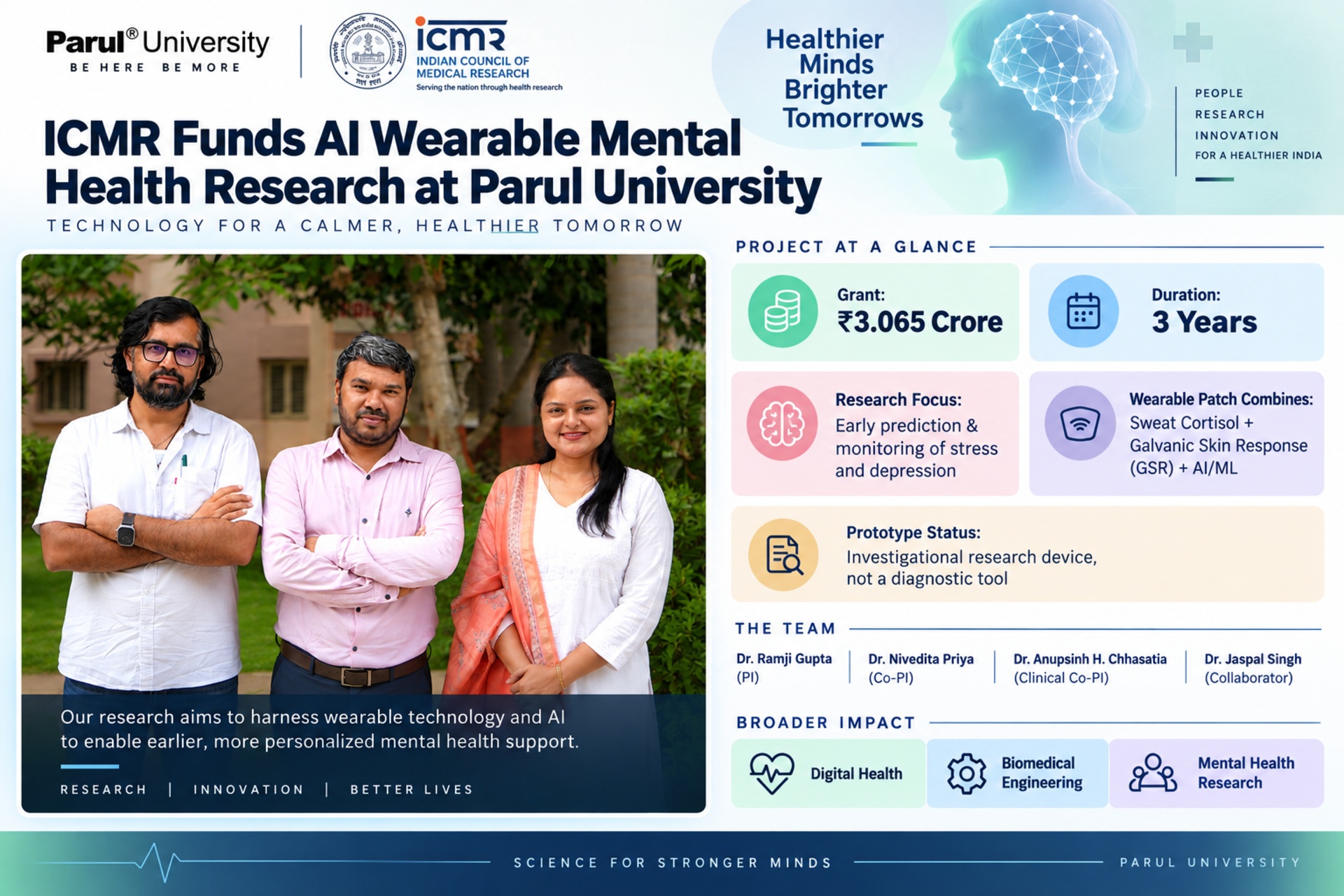
Mental health can change super quickly, and so those shifts in the body are quite hard to notice. One of the most promising question arises is how can a technology recognise physiological changes? Backed by an impeccable and significant national grant, a team of researchers is proactively working on it!
The Grant and the Project
Dr. Ramji Gupta, Assistant Professor, Department of Electronics and Communication Engineering at Parul Institute of Engineering and Technology, received Rs 3.065 crore from the Indian Council of Medical Research (ICMR) for a three-year project. The project is looking to create an AI-powered wearable patch that integrates sweat cortisol, Galvanic Skin Response (GSR), and artificial intelligence to predict and monitor stress and depression early on. It brings together advanced computing researchers, health science and medical researchers, and psychiatrists around one question.
How the Project Was Born
The idea did not appear from nowhere. It grew out of Dr. Gupta’s earlier research, the Seizure Sentry project, an AI-enabled wearable cap designed to identify physiological signals that may precede a seizure and provide an early warning. That work gave the team experience in continuous biomedical signal acquisition, wearable systems and AI-based physiological data analysis. It opened a new line of thinking: if technology can study physiological signals linked to one medical condition, could similar principles help researchers understand the physiological changes associated with stress, anxiety, and depression? There was a human motivation too. The team recognized how stress has become part of everyday life across all age groups and wanted to explore whether meaningful changes could be recognized earlier.
Understanding the body’s signals more closely may help technology provide useful information at the right time.
– The research philosophy behind the project
An Interdisciplinary Team
A project like this needs expertise well beyond electronics, and its strength lies in the people behind it:
- Ramji Gupta (Principal Investigator), providing the technical foundation in VLSI, embedded systems, biomedical signal processing, AI, and machine learning.
- Nivedita Priya (Co-Principal Investigator, Parul Institute of Allied and Health Sciences), bringing expertise in biomarkers and health sciences.
- Anupsinh H. Chhasatia (Clinical Co-Principal Investigator; Professor and Head of Psychiatry, Parul Sevashram Hospital), providing the clinical psychiatry foundation.
- Jaspal Singh (Scientist F and Technology Director, C-DAC Mohali), the external collaborator strengthening the AI and advanced-computing dimensions.
The Science: Two Signals, Better Together
At the heart of the proposed patch are two types of signals. Cortisol is a biochemical marker associated with the body’s stress response, and sweat offers a non-invasive way to explore cortisol-related information. Galvanic skin response measures changes in skin conductance, reflecting activity in the autonomic nervous system. Rather than studying one signal in isolation, the project’s distinctive multimodal approach brings biochemical and physiological information together, using AI and machine learning to examine patterns across the combined data within a small, wearable, non-invasive patch.
A Rigorous Research Methodology
The research is structured for credibility. The team plans to study approximately 200 participants, using standardised screening (PHQ-9 and GAD-7) followed, where appropriate, by psychiatrist-led clinical assessment (using DSM-5 criteria and HAM-D/HAM-A assessments). Sweat-cortisol measurements from the wearable sensor will be validated against established laboratory methods (ELISA/CLIA). This combination of wearable sensing, laboratory validation, and clinical assessment gives the project a solid foundation for evaluating the technology. (These clinical tools are part of the research process and are administered by qualified professionals, not self-assessment tools.)
A Research Prototype, Not a Diagnosis
The team is careful and clear about an important distinction. The wearable at this point is an investigational research prototype that is in development and clinical validation; it is NOT a clinical diagnostic or treatment device. It is designed to explore meaningful early patterns that emerge from the combination of sweat cortisol, GSR, and AI, as well as to offer objective supplemental data that could potentially be used one day in early screening and monitoring in conjunction (not in place of) existing clinical assessment methods. The research will be able to tell if it can or not. If experiencing stress or poor mental well-being, please contact a health care provider or a trusted person, as help is available.
Strengthening Research at Parul University
For Parul University, the ICMR grant is a significant milestone, expanding research capabilities in AI, wearable biosensors, biomedical technology, and digital health, and creating opportunities for interdisciplinary student training, doctoral research, publications, and patents. It lets engineering students work alongside health-science professionals, psychiatrists, and technology experts on a real healthcare question. It also supports India’s broader priorities, contributing to indigenous capability in wearable healthcare technology in line with Make in India, Digital India, and Atmanirbhar Bharat, and adds to the university’s growing research record, alongside achievements like its recent jointly-held patent. Dr. Gupta shared the milestone in a LinkedIn post.
FAQs
What is the name of the ICMR-funded project on which Parul University is working?
It is a three-year research project funded by an Rs 3.065 crore ICMR Intermediate Grant to study the early prediction and monitoring of stress and depression through the use of a wearable patch that measures sweat cortisol, galvanic skin response (GSR), and artificial intelligence (AI). It is headed by Dr. Ramji Gupta and has an interdisciplinary team.
How does the proposed wearable work?
The proposed patch is a small wearable device that collects two signals, one biochemical (sweat cortisol, which is a biological indicator of the stress response) and one related to the autonomic nervous system (Galvanic Skin Response). Patterns are then analysed using AI and machine learning in this combined, multimodal data. It is not a diagnostic device yet; it is still an investigational research prototype.
Is the device a diagnostic tool for depression?
No. The team is explicit that it is an investigational research prototype undergoing development and clinical validation, not a clinical diagnostic or treatment device. Its research aim is to explore whether combining cortisol, GSR, and AI can identify early patterns that might, in future and after validation, provide additional objective information to support, not replace, clinical assessment.


