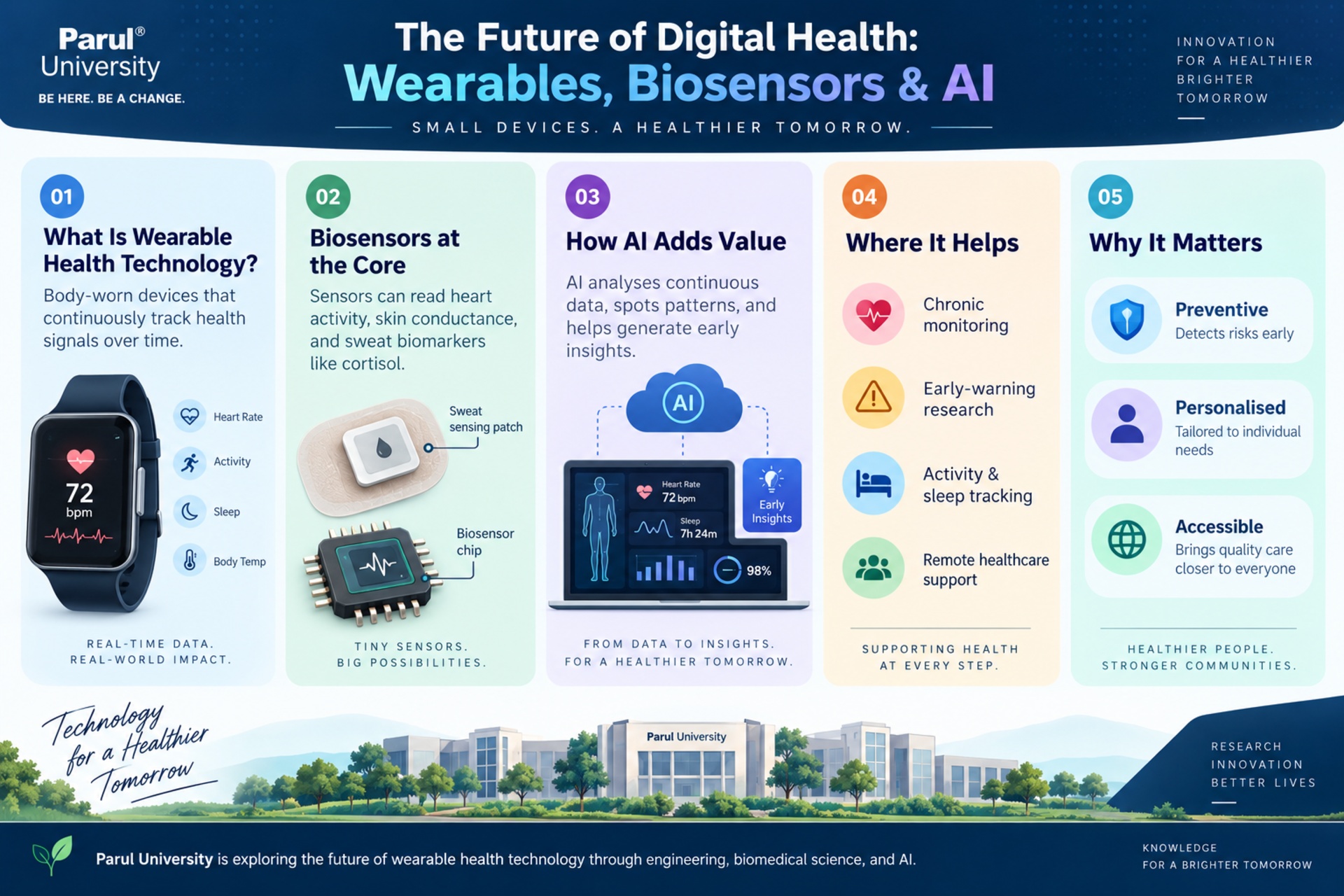
Healthcare is moving out of the clinic and onto the body. At Parul University, researchers are building wearable devices that read the body’s signals, from an AI cap that studies signals that may precede a seizure to a patch that explores the physiology of stress. These projects are part of one of the most exciting frontiers in modern medicine: wearable health technology.
What is Wearable Health Technology?
Wearable health technologies are electronic devices that continuously monitor and record information related to health, worn on the body, the wrist, the head, or attached to the skin. A wearable can record the activity of the body over time, as it happens in everyday life and situations, whereas a one-off test in the clinic can only be taken at a single moment. The possibilities range from fitness wristbands tracking heart rate and sleep patterns to more sophisticated medical monitoring of specific physiological signals.
Biosensors: Heart of It:
The key element of a health wearable is the biosensor, which is able to sense a biological or physiological signal and translate it into data. Biosensors can detect a wide variety of signals, including electrical activity such as a heartbeat or galvanic skin response (skin conductance) or even biochemical signals from fluids like sweat, such as cortisol. One of the main objectives in the field is to be able to measure meaningful parameters non-invasively, without the use of needles or discomfort. This is why sweat-based sensing is an interesting research field. Wearables can listen to more from our bodies thanks to improved biosensors.
How is AI being used in wearables?
This is just half the job because it is not enough to collect the data; it is important to interpret the information. This is where AI revolutionises wearables. It is too much of a burden for humans to interpret the physiological data continuously in a stream. AI and machine learning can analyse that information, detect patterns, and indicate changes that might be significant, thereby picking up on early indications that need attention. More and more, the most powerful wearables are multimodal; that is, they measure multiple signals (e.g., biochemical plus electrical), or they measure a single signal, and then AI decodes it as a combination of multiple signals.
What Wearables Can Do?
The uses are expanding every day:
- Continuous monitoring of chronic conditions to allow patients and physicians to monitor health over time.
- Research on early warning, including signal detection research that seeks to identify signals that may accompany a medical event.
- Health, activity tracking, sleep, and recovery.
- There is a need for remote and at-a-distance health care in order to monitor health in locations where specialized services are scarce.
Most significantly, in serious medical applications, wearables in research are still experimental devices that complement, rather than supplant, expert clinical evaluations.
The Future: Preventive, Personalised, Accessible
Wearable health technology points toward a profound shift in medicine, from reactive to preventive. Instead of waiting for a problem to become serious, continuous monitoring may help identify meaningful signals earlier, when there is more that can be done. It also promises more personalised care (based on an individual’s own data over time) and more accessible care (bringing monitoring to underserved settings). For India, developing these technologies domestically connects directly to national goals like Digital India and Make in India, and it is why research groups at institutions like Parul University, working across engineering, biomedical science, and AI, are investing in this field. The devices that will shape the future of healthcare are being built now.
FAQs
What is wearable health technology?
Wearable health technology refers to electronic devices worn on the body, on the wrist, on the head, or as a skin patch that continuously sense and record health-related information. Unlike a single clinical test, wearables monitor the body over time in daily life, using biosensors to capture signals and, increasingly, AI to interpret them.
What is a biosensor?
A biosensor is a component that detects a biological or physiological signal and converts it into data. Biosensors can measure electrical signals (such as heart rhythm or skin conductance) and biochemical markers in fluids like sweat (such as cortisol). Non-invasive biosensors, which gather information without needles, are a major focus of current research.
How to execute AI in wearable devices?
AI & ML are filling the gaps by analysing large sets of data that wearables are producing every day and are recognising patterns, and deriving solutions for meaningful changes. AI is basically valuable in wearables, which will eventually combine signals at once and will allow AI to interpret for richer outputs!