If a laboratory anywhere in India wants its results to carry formal national credibility, one body can grant it: NABL. When Parul University signed a partnership with NABL, it connected its laboratories to this system. Here is what it means
NABL is one of the most respected bodies of India. NABL is the National Accreditation Board for Testing and Calibration Laboratories.
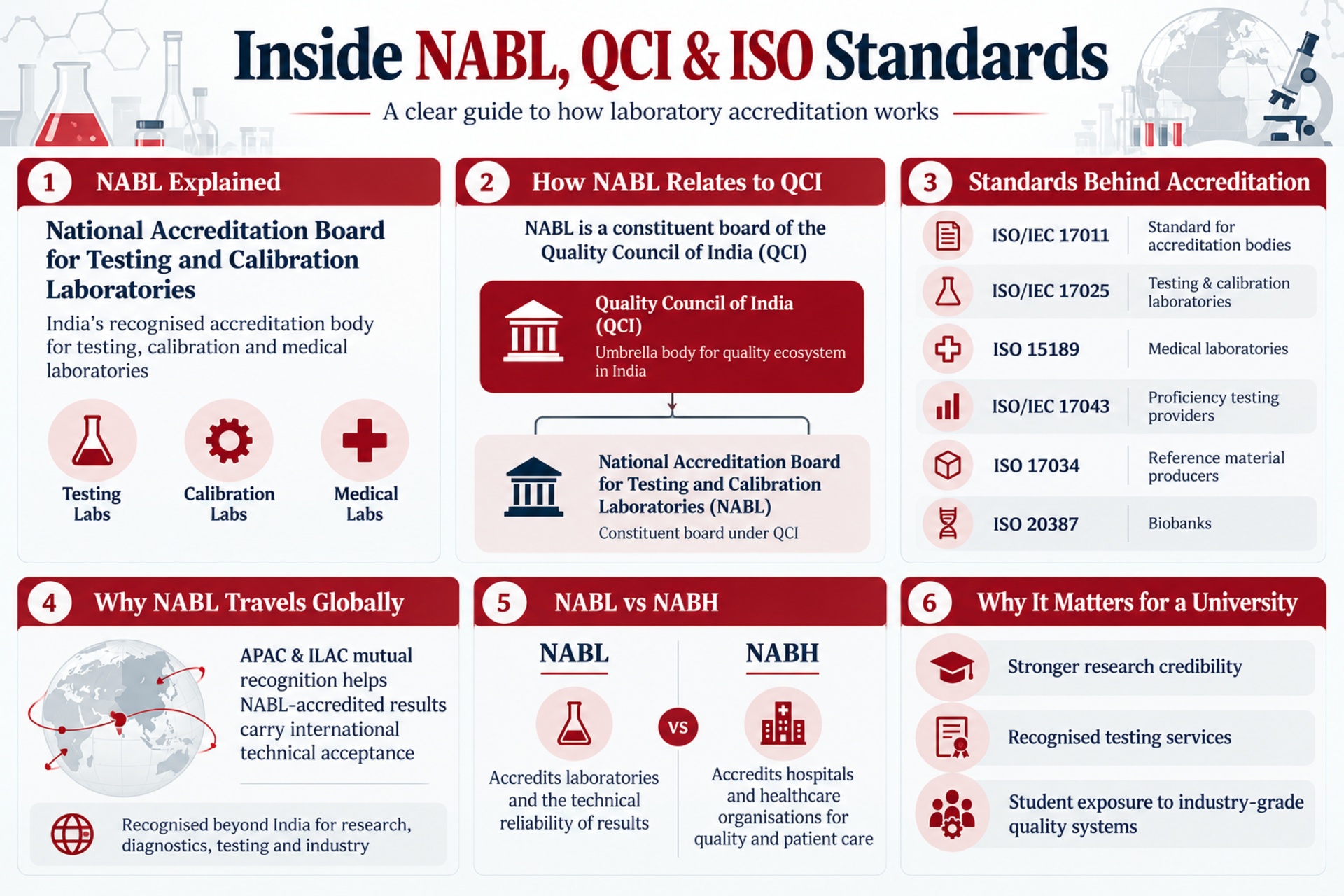
It is India’s sole recognised body for accrediting testing and calibration laboratories across scientific and engineering fields. In simple terms, NABL is the authority that can certify that a laboratory’s results are technically sound and trustworthy. It is voluntary. It has a wide coverage from testing, calibration laboratories and medical labs. It also covers proficiency-testing providers, reference-material producers and biobanks. This will help students gain insights from labs at the Parul University.
How NABL Relates to QCI
NABL does not stand alone. It is a constituent board of the Quality Council of India (QCI), the autonomous apex body that builds and monitors the country’s quality infrastructure. Formed through a public-private partnership model and working under the Department for Promotion of Industry and Internal Trade, QCI’s remit spans healthcare, manufacturing, governance, vocational training, and education. NABL is the part of that structure responsible specifically for laboratories.
The Standards Behind Accreditation
Accreditation is not a single yardstick; each type of laboratory is checked against its own international standard. NABL itself operates under ISO/IEC 17011, the standard that governs how accreditation bodies must work to stay credible. It then accredits laboratories against the relevant standard for their work:
- ISO/IEC 17025 for testing and calibration laboratories.
- ISO 15189 for medical laboratories.
- ISO/IEC 17043, ISO 17034 and ISO 20387 for proficiency testing, reference materials, and biobanking.
This range is exactly why a university partnership with NABL matters: it can reach across many kinds of laboratory and discipline, not just one.
From National to Global: Why NABL Travels
An NABL-accredited report is not a purely local document. NABL has signed a Mutual Recognition Arrangement with the International Accreditation Cooperation (ILAC) (formerly known as Global Accreditation Cooperation (GAC) and the Asia Pacific Accreditation Cooperation (APAC). This makes a test result from an NABL-accredited laboratory in Vadodara as technically as sound as a test result from any other accredited laboratory in Germany, Singapore or the USA. With research data, testing services, or diagnostics, that cross-border recognition allows the results to be accepted by international collaborators, journals, and regulators without additional scrutiny, which can be important when it comes to patenting, licensing or commercial partnerships, where the reliability of the data is looked at closely.
NABL vs NABH: A Common Confusion
Although the two can be confused, they accredit different things. NABL accredits laboratories, testing laboratories, calibration laboratories, medical laboratories with emphasis on the technical reliability of the results obtained. Hospitals and healthcare organisations are accredited by the National Accreditation Board for Hospitals and Healthcare Providers (NABH) with emphasis on the quality and safety of patient care. Both are constituent boards of Quality Council of India and a health-sciences institute, such as Parul University with recognitions by both, operates with each board to serve their particular purpose.
Why It Matters for a University
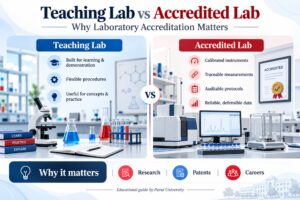
It matters to universities. When the university receives accreditation from NABL, it acts like an authentication. It transforms laboratories from academic spaces into areas or facilties that have data which can withstand scutiny, nationally and globally.
It strengthens research credibility, enables laboratories to offer recognised testing services, and gives students hands-on exposure to the quality standards they will meet in industry. In short, it sets a university’s laboratories on a global technical footing rather than a purely domestic one.
FAQS
How to Explain NABL?
NABL is National Accredition Board for Testing and Calibration Laboratories. It is the main body that regulates the accreditation of testing, calibration and medical laboratories. It is also a constituent body of board of the Quality Council of India (QCI).
What is the difference between NABL and NABH?
They might sound similar but are different. NABL functions to test, calibrate and overseeing medical labs. The focus is on the technical trust of their results. How authentic they are. NABH (the National Accreditation Board for Hospitals and Healthcare Providers) accredits hospitals and healthcare organisations, focusing on the quality and safety of patient care. Both are constituent boards of the Quality Council of India.
Is NABL accreditation recognised internationally?
Yes. NABL holds Mutual Recognition Arrangements with international bodies including the Asia Pacific Accreditation Cooperation and the Global Accreditation Cooperation (formerly ILAC). This means an NABL-accredited laboratory’s results carry the same technical standing internationally as those from accredited laboratories in countries such as Germany, Singapore, or the United States.