A partnership built on a simple idea
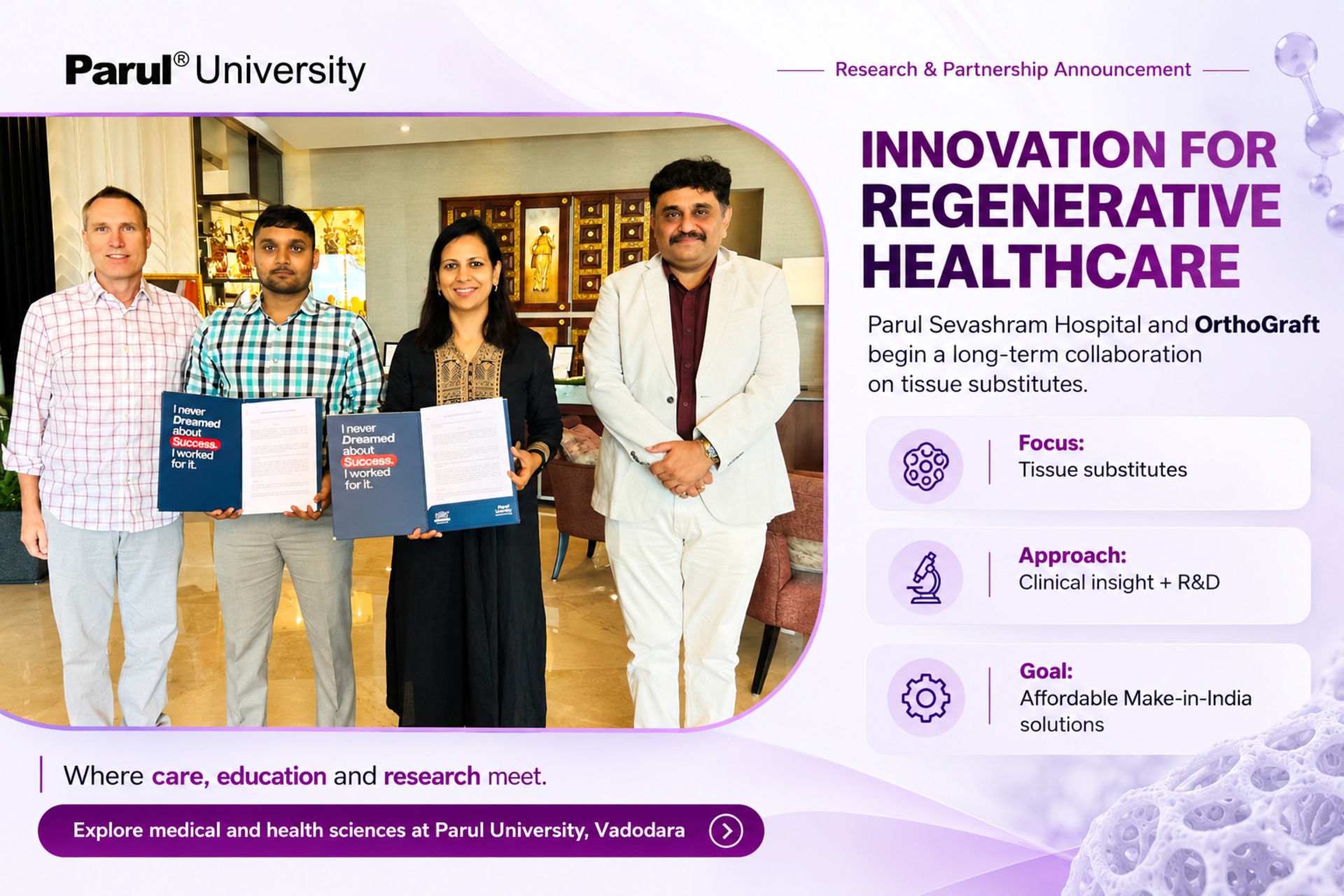
Parul University has a hospital named Parul Sevashram Hospital. It trains students with how hospitals actually work. Recently, they have signed an MOU with OrthoGraft Pvt. Ltd. It is based out in Vadodara. A Startup to work on research and development of tissue substitutes. The R&D is done for regenerative healthcare. Here, the idea is the people who treat patients know what is actually required to treat them and what is missing from today’s treatment options. Here is the thing that happened: a surgeon’s observation can get to a laboratory prototype and, once all is aligned, move forward. Once all safety approvals are in place, toward the patients who need it.
Parul Sevashram Hospital brings its clinical experience, its specialist surgeons and its role as a centre of medical education. OrthoGraft the startup aims to focus on tissue-based biomaterials and its drive to make them affordable. This partnership is planned in a way that it lasts for long. This is shaped by views from doctors and constant research, which is according to what patients actually need.
For Parul University, which has been steadily building its identity as a research-driven institution, it is another step in connecting classroom learning, hospital care and real-world innovation.
The need behind the partnership
Hospitals and healthcare have things missing that might make patients’ lives better. Every research in this field is done with an aim to take of the patient’s and treatment them well. Hospitals regularly get cases related to bones, tendons, cartilage or other tissues that have been damaged. The cases can be related to sports injuries, accidents, infections, tumours or age-related issues. And there are cases that can’t be repaired fully. Hence, the operators or surgeons need a solution that can bridge the gap. Earlier, these products were imported, which led to higher costs and dependency on countries outside. And for a patient, it would mean the treatment is out of reach or more costly than usual. On the other hand, for hospitals, it can mean planning surgeries based on the availability of a product made far away. By creating such products with tissue-based materials in India or closer to home. The partnership aims to make good-quality regenerative options that are easily accessible and affordable or available at a lower cost. These types of startups are supported by PIERC.
What are tissue substitutes and regenerative medicine?
Regenerative medicine is the branch of healthcare that is focused on the processes of healing and repairing tissue, rather than just managing the damage. The regenerative approach provides a structure for the body to accept and incorporate into its own tissue, rather than simply replacing the affected area. The tissue substitutes are central to the regenerative approach, with these materials being prepared from biological tissue or engineered to behave like it, used to support the repair in areas such as bone, joints and soft tissue. In a healing area they act like scaffolding on a building site, providing the body with a structure on which new tissue can grow, until the body’s own cells take over. They are used across orthopaedic surgery, reconstructive surgery and many other specialities where tissue needs to be rebuilt, and the field is growing worldwide, as new technologies and a better understanding of healing help researchers create materials that work more naturally with the human body. Explore medical programmes at Parul University.
The two partners
OrthoGraft Pvt. Ltd. is a research and development-based medical-devices start-up, recognised by the Government of India under the start-up framework and based in the city of Vadodara. It aims at developing and bring to market high-quality tissue-based biomaterials in India at lower cost, aligning with the ‘Make in India’ initiative, and in the development and clinically translate tissue-derived biomaterials for regenerative healthcare with a vision of becoming a global leader in cost-effective tissue-derived implants.
Parul Sevashram Hospital is a tertiary care multi-specialty hospital with advanced diagnostic facilities, specialized surgical care and medical education, clinical training and research centre under the aegis of Parul University providing the clinical services. It can offer an ideal environment for testing novel medical technologies and is an ideal location for studies that remain relevant to the clinical practice.It has a strong patient base with an emphasis to ethical and patient focused care, making it a natural setting for the evaluation of new medical technologies and research based on current clinical needs. Each partner will supply the other with what the other requires: a young company developing the technologies of a tissue-based product will find clinical guidance and access to doctors and a venue to test their ideas and make refinements to them, whereas a teaching hospital will find assistance in the development of technologies that its own patients may well use in the near future.
From bedside to laboratory: how the collaboration will work
The value of the partnership is reflected in the extent to which medicine and research are connected. In particular, the medical products’ life cycle is often too long and disconnected from the hospital practice; hence, the needs identified in the operating room are not always addressed adequately and in time. Through cooperation at the hospital, this gap is bridged, as surgeons and clinicians can communicate their requirements directly to the researchers. In particular, they can share what is lacking in the current practice, what materials are needed, how certain procedures can be improved in a specific situation, and what could ease the recovery process. This information guides the company’s research activities, ensuring that they address relevant issues. Moreover, the feedback can be provided at different stages, as prototypes can be demonstrated and evaluated by the clinicians and surgeons, thus incorporating their suggestions. At the same time, the company can educate the hospital professionals, demonstrating the technology’s capabilities and addressing potential concerns, thus establishing the trust required to introduce innovations in the field.
Affordable and Made in India
One of the most important aims of the collaboration is affordability, because a treatment that works but cannot be paid for helps very few people. By focusing on cost-effective, indigenously manufactured tissue substitutes, the partnership works toward making modern regenerative options available to a wider section of patients. Local development brings practical advantages: supply becomes more dependable when a product is made nearby rather than shipped from abroad, costs can be kept in check by reducing long-distance import and distribution, and products can be designed with Indian conditions in mind, the types of cases doctors here most often see and the budgets within which hospitals and families work. It also supports a larger national direction, as India encourages domestic manufacturing of medical devices to reduce import dependence and build skills and jobs at home. If the work succeeds, products developed in Vadodara could in time serve patients and clinicians well beyond the region.
Safety first: every step guided by approvals
Anything that may eventually be used in a patient’s body must meet high standards of safety, and the partnership treats that as a fixed principle. Materials developed through the collaboration will not be used in clinical care until the required approvals from the relevant statutory bodies are in place. The path from idea to patient is deliberately careful: a new material is first studied in the laboratory, then tested for safety and performance, then reviewed by the concerned authorities, and only after it passes every stage is it considered for clinical use. These steps take time, but they exist to protect patients. This is a research and development collaboration, and any technology developed will undergo the required testing and evaluation before being considered for clinical use, reaching the operating theatre only after it achieves the necessary safety and effectiveness and receives all required regulatory approvals.
Ethics and patient trust
Whenever a startup is related to healthcare, it is necessary to follow ethics, rules and regulations. When the research is related to getting a solution and it involves human tissue. Then the research carries a special responsibility. It carries special attention because the material comes from people. And the use of it must rest on trust. It is necessary that citizens, patients and families become aware about their rights. Apart from rights, they should know their dignity and consent will be respected throughout. The Sevashram Hospital follows rules and regulations, It also works with ethics. It is based on a patient-centred approach to care. It is a NABH-approved hospital. The same values guide its research, so proper consent, safe tissue handling, clear records and compliance with the law are treated as essential. It is necessary that in healthcare it shall have transparency. As it is used for regenerative medicines. Through this a trust is built for medical advances. Like this that is tissue based.
What it means for patients, students and the region
For patients, the benefits are likely to be felt over time: wider access as locally developed regenerative materials mature and receive approval, often at a more reasonable cost than imported alternatives; greater relevance, because the research is shaped by clinicians who treat these injuries every day; and more confidence, since a material developed within a patient’s own hospital, with familiar doctors and all required approvals, may raise fewer questions. For the academic community, the partnership gives doctors, residents and students a close view of how a clinical need becomes a research question, then a laboratory concept, then a product that must pass strict checks, and it opens translational-research opportunities, including publications and patents, that expand the university’s research footprint. The collaboration also commits to sharing knowledge through peer-reviewed publications and annual seminars and workshops on tissue substitutes and their clinical use. For Vadodara, a teaching hospital and a medical-devices start-up working together signals a city where new healthcare technologies can be conceived and developed, not only delivered, and for Parul University, which brings medicine, engineering and applied sciences onto one campus, biomaterials work naturally opens the door to wider interdisciplinary cooperation.