Parul University and Kaizen Switchgear Sign a One-Year Industry MoU for Management Students
- • Signed 7 September 2026 between Parul University's Faculty of Management Studies and Kaizen Switchgear, Vadodara.
- • What MBA and BBA students get: internships, factory visits and guest lectures, capped at five interns at a time and fifty per visit.
- • The two-way clause: Kaizen can also draw on the faculty to train its own managers.
- • What the MoU is not: a binding contract or a guarantee of placement.
7 Sep 2026
Date signed, one-year term
5 and 50
Max interns at a time; max students per factory visit
MBA and BBA
Students covered, across three FMS institutes
Industrial Partnership
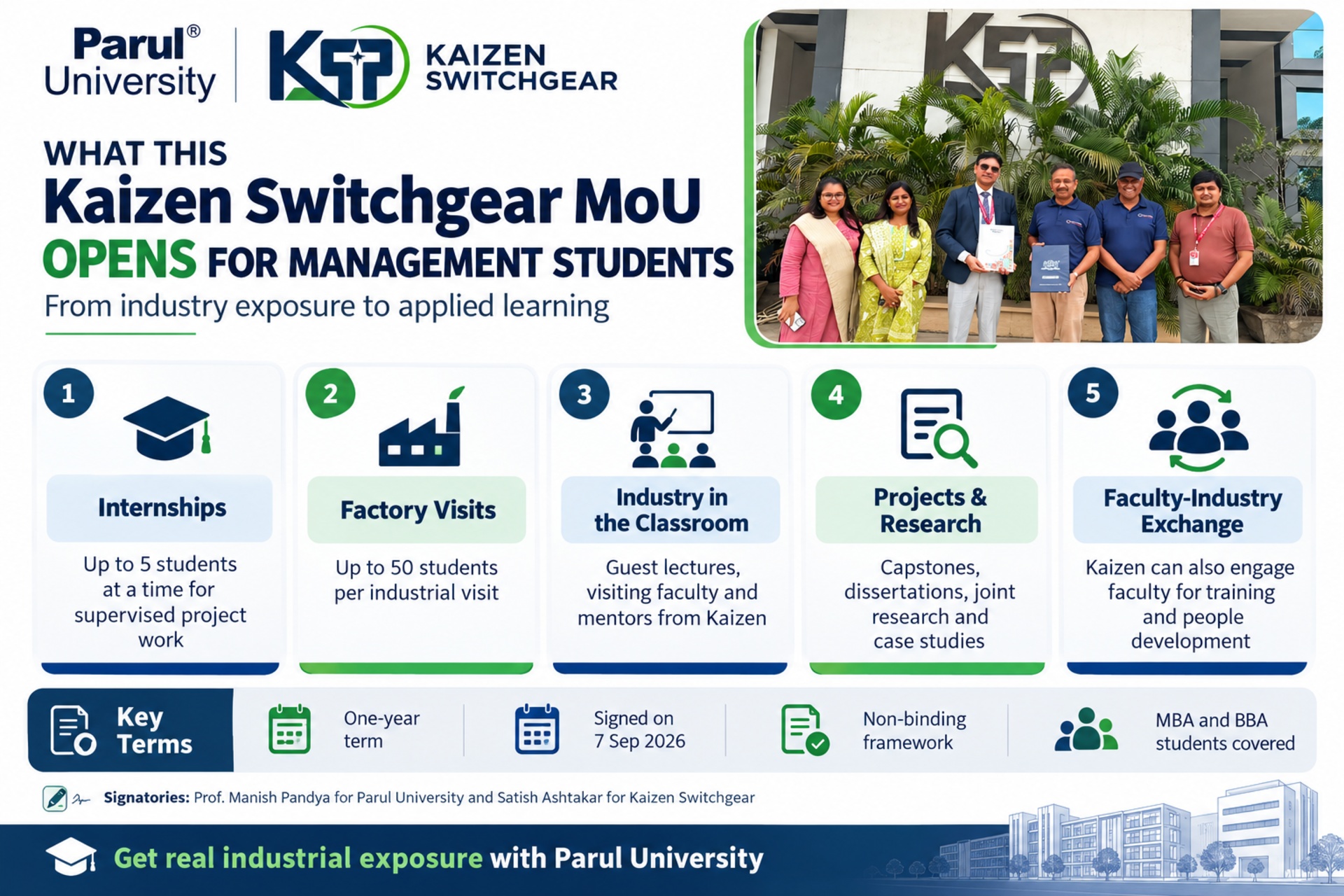
On 7 September 2026, Parul University’s Faculty of Management Studies signed a one-year agreement, titled an Industrial Academic Association, with , a Vadodara manufacturer. It opens internships, factory visits, guest lectures and joint research to the faculty’s MBA and BBA students. Two numbers set its reach: Kaizen will host up to five students at a time for project work, and up to fifty on a single industrial visit.
What the MoU gives students
Internships, industrial training, apprenticeships, dissertation and capstone projects, run either at Kaizen’s Vadodara plant or at its client sites. The caps are the part worth reading. Five students at any one time for supervised, project-based work. Fifty for a factory visit. A place is not automatic: students are selected, and the plant’s production schedule sets what runs and when.
That is a narrower promise than most university MoUs make, and it is the more credible for it. Five well-supervised interns is a commitment a working plant can actually keep. A blanket pledge to host students is not.
Who signed it
Prof. Manish Pandya, Registrar of Parul University, signed for the university. Satish Ashtakar, Kaizen’s COO and plant head, signed for the company, with senior HR manager Nilesh Shah as witness. From the Faculty of Management Studies, Dean Dr. Jitendra Sharma attended, with Dr. Amrita Singh, Principal of the Parul Institute of Business Administration, its academic head Dr. Shveeta Shah, and assistant professor Harsh Shah.
The faculty signs as one body covering three institutes: the Parul Institute of Business Administration, the Parul Institute of Management and Research, and the MBA stream at the Parul Institute of Engineering and Technology. Students across all three fall under the agreement.
What Kaizen gets back
The arrangement runs both ways, and the return side is where it stops being a simple access deal. Kaizen can send its own professionals onto the faculty as visiting faculty, guest speakers and industry mentors. It can also draw on what a management school knows: organisational development, behavioural and soft-skills training, HR consultancy, and leadership development for its own managers. A switchgear maker buying a management faculty’s people-development expertise is the quieter half of the deal, and the more unusual.
Areas of cooperation
The MoU lists ten areas of cooperation. The main ones:
| Area | What it covers |
|---|---|
| Joint events | Workshops, seminars, conferences, guest lectures, and faculty, management and executive development programmes |
| Practical learning | Internships, industrial training, visits, apprenticeships, dissertations and capstones (max 5 at a time, 50 per visit) |
| Industry in the classroom | Kaizen professionals as visiting faculty, guest speakers and industry mentors |
| Support for Kaizen | Academic guidance, consultancy, and people development: OD, behavioural and soft-skills training, HR, leadership |
| Research | Joint projects, case studies, publications, sponsored research, patents and consultancy |
| Curriculum inputs | Industry practices, emerging technology and skill requirements fed into the faculty’s programmes |
| Showcasing | Kaizen at faculty seminars, exhibitions, career fairs and placement drives |
| Shared resources | Library, labs, research support and faculty expertise; faculty and students visit Kaizen’s facilities |
Is it a binding contract?
No. The MoU is a framework, and it says so. It creates no financial obligation, and any activity that costs money is negotiated and signed separately. Every event under it depends on Kaizen’s approval, capacity and safety rules, with schedule, venue and numbers set by the company in consultation with the faculty. It runs for one year from signing and can be widened by written consent. Two things do bind both sides: they must keep shared information confidential, and any intellectual property question goes to its own separate agreement.
What to watch
The MoU names implementation officers on both sides, which is the one sign it is meant to be worked rather than filed. The year ahead is the test: whether the internships, visits and expert sessions it allows actually get scheduled. The document is a channel. The traffic through it is what will matter.
SOURCE AND CONTEXT. Based on the Parul University and Kaizen Switchgear MoU, signed 7 September 2026. The agreement is a non-binding framework for one year. Figures such as the five-intern and fifty-visitor caps are stated in the MoU. The signatory’s LinkedIn profile is linked with tracking parameters removed.
Explore the faculty and related partnerships
Faculty of Management Studies: paruluniversity.ac.in/faculty/management-studies
All programmes: paruluniversity.ac.in/all-programs
People and organisations
- Parul University, Faculty of Management Studies First party; MBA and BBA programmes
- Kaizen Switchgear Products Private Limited Vadodara manufacturer; second party
- Prof. Manish Pandya Registrar, Parul University; signatory
- Satish Ashtakar COO and Plant Head, Kaizen; signatory
- Dr. Jitendra Sharma Dean, Faculty of Management Studies