Advancing Sickle Cell Research: Parul University Secures Rs 1.04 Crore CCRAS Grant!
- → The grant
- → What will be the trial test?
- → Why adolescents, and why it matters?
- → Where and how it will run?
- → Who is behind it?
- → Frequently asked questions
Grant:
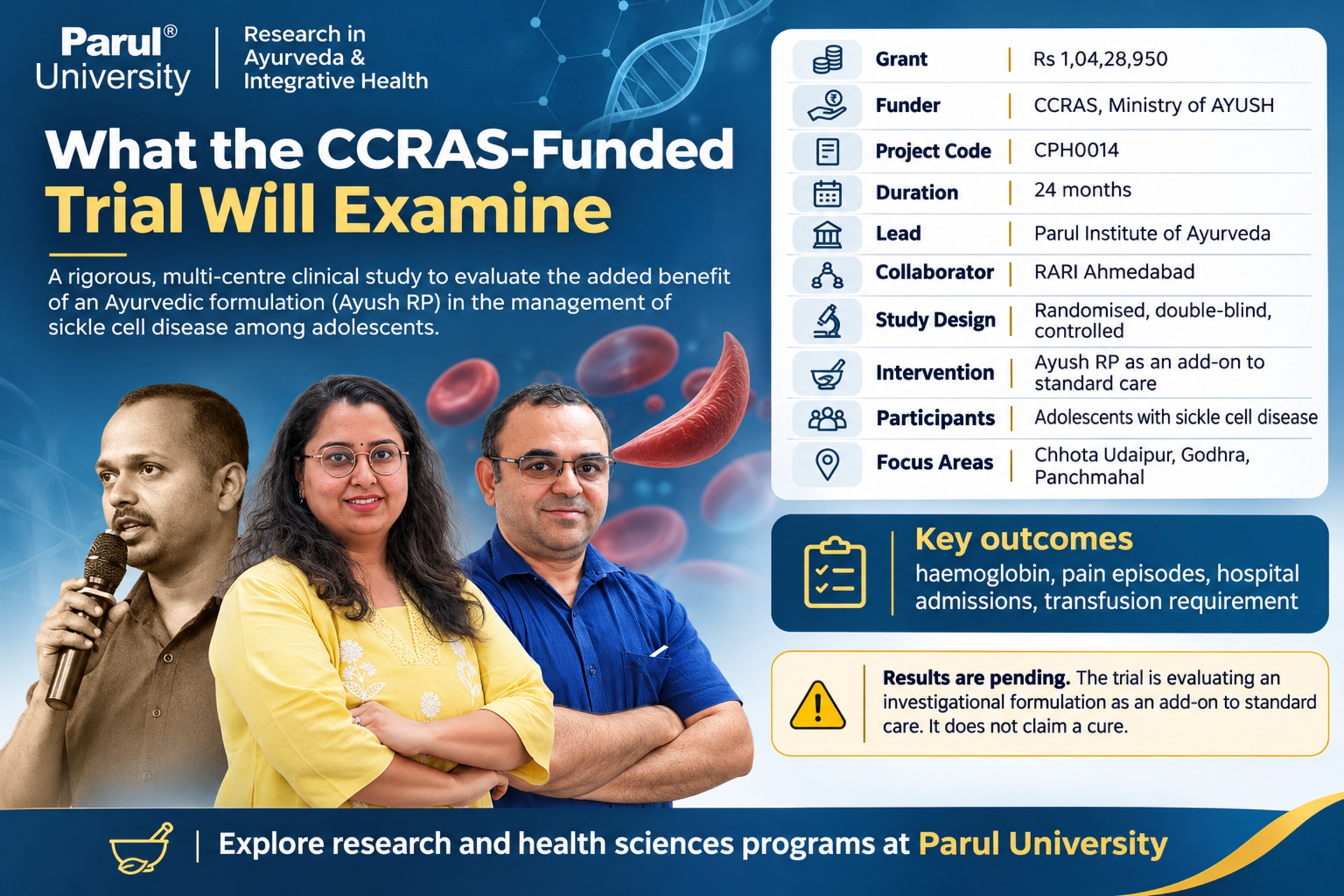
Rs 1,04,28,950 from CCRAS, Ministry of AYUSH
Project code:
CPH0014
Duration:
24 months
Lead institution:
Parul Institute of Ayurveda, Parul University
Collaborator:
Regional Ayurveda Research Institute (RARI), Ahmedabad
Design:
Randomised, double-blind, controlled trial; AYUSH RP as an add-on to standard care
Population:
Adolescents with sickle cell disease
The exclusive grant!
Parul University has received a research grant of Rs 1,04,28,950 from the Central Council for Research in Ayurvedic Sciences (CCRAS), the research body under the Ministry of Ayush, to run a clinical trial on the management of sickle cell disease in adolescents. The project, coded CPH0014, runs for 24 months and is led by Parul Institute of Ayurveda in collaboration with the Regional Ayurveda Research Institute (RARI) in Ahmedabad.
The study has a precise, deliberately narrow aim, and it is worth stating it carefully. It is titled Efficacy of Ayush RP as an Add-on to the Standard of Care in the Management of Sickle Cell Disease among Adolescents: A Randomized Double-Blind Controlled Trial. In plain terms, the trial sets out to test whether an Ayurvedic formulation, used alongside the standard medical care a patient already receives, makes a measurable difference under the kind of controlled conditions that let a result be trusted. It is an investigation, not a claim, and the point of the trial is to find out.
The principal investigator is Dr. Swapnil Raskar of Parul Institute of Ayurveda, supported by two co-investigators: Dr. Shaili Surti, Professor and Head of Preventive Medicine at Parul Institute of Public Health, and Dr. Prasad Muley, Professor and Head of Pediatrics at Parul Institute of Medical Sciences and Research. The sanctioned amount is split between the two institutions, with Rs 80,68,550 to Parul Institute of Ayurveda and Rs 2,360,400 to the Ahmedabad Institute.
| The grant at a glance | Detail |
|---|---|
| Funder | CCRAS, Ministry of Ayush, Government of India |
| Sanctioned amount | Rs 1,04,28,950 |
| Project code | CPH0014 |
| Duration | 24 months |
| Principal investigator | Dr. Swapnil Raskar, Parul Institute of Ayurveda |
| Co-investigators | Dr. Shaili Surti (Preventive Medicine); Dr. Prasad Muley (Pediatrics) |
| Institutional split | Rs 80,68,550 (Parul Institute of Ayurveda); Rs 23,60,400 (RARI Ahmedabad) |
Source: Parul Institute of Ayurveda; CCRAS sanction, Project CPH0014.
What will the trial test?
The formulation under study, Ayush RP, is a patented Ayurvedic preparation developed by the funding council itself, and its exact composition is confidential at this stage. What matters for anyone reading about the trial is the method, because that is what separates a clinical trial from an anecdote.
The study is built around an add-on model and a double-blind, randomised, controlled structure. Add-on means the formulation is given in addition to standard care, never in place of it, so the question being asked is narrow and honest: does adding it change outcomes that standard care alone would produce? Randomised and double-blind means participants are allocated to groups by computer, and, as far as the protocol allows, neither the participants nor those assessing them know who received what, which is how a trial guards against wishful reading of its own results. The outcomes it will track are concrete clinical measures, among them haemoglobin levels, the frequency of pain episodes, hospital admissions, and the need for blood transfusions.
| Trial design | Detail |
|---|---|
| Intervention evaluated | Ayush RP, a patented CCRAS Ayurvedic formulation, as an add-on |
| Role in care | Given alongside standard care, not as a replacement for it |
| Design | Randomised, double-blind, controlled; computer-based allocation |
| Participants | Adolescents with sickle cell disease |
| Outcomes measured | Haemoglobin, pain episodes, hospital admissions, transfusion requirement |
| Safety and lab work | CBC, kidney and liver function, electrolytes, HPLC, sickling tests, sonography |
| Status | Underway; results pending |
Source: Study protocol summary, Parul Institute of Ayurveda.
Why adolescents, and why it matters?
The choice of age group is itself part of the research design. By Dr. Raskar’s account, this is the second phase of a planned line of research on the formulation. An earlier phase considered it in adults in Maharashtra, and this project extends the work to adolescents, a step the team sees as the stage before any research in younger children.
Sickle cell disease gives that choice weight. It is a genetic blood disorder in which the red blood cells take on a rigid, crescent shape, break down faster than normal, and can block blood flow, producing the repeated pain episodes, hospital visits, and transfusions that define the condition. In adolescence, a period of physical growth, schooling, and social development, those interruptions land hard, pulling young patients out of class and routine. A study aimed at that group is aimed at the point where better day-to-day management could matter most.
The disease is also geographically concentrated. In India, it clusters in what is called the sickle belt, across parts of central and western India, including Madhya Pradesh, Chhattisgarh, Gujarat, and Maharashtra, and it falls most heavily on tribal and indigenous communities. In Gujarat, it runs through the eastern tribal belt known as the Purvi Patti, from Ambaji in the north to Ahwa in the south. Sickle cell disease is a recognised national health priority, and the Government of India runs a dedicated national mission to address it, so research based inside the affected region is part of how that priority gets met.
How will it run, and what location will it cover?
The trial will work in selected areas of Gujarat, with a focus on Chhota Udaipur, Godhra, and Panchmahal. It opens with roughly three months of screening across villages and locations in those districts to identify adolescents who meet the eligibility criteria, followed by enrollment and computer-based allocation into study groups, and then a one-year period of medication and observation during which the team records clinical investigations, health changes, pain episodes, and admissions. A final phase consolidates and analyses the data.
The clinical work is supported by the university’s own healthcare infrastructure, with Parul Ayurveda Hospital and Sevashram Hospital providing facilities for investigation, assessment, and care. The planned tests are standard hematology and safety work, including complete blood count, kidney and liver function tests, serum electrolytes, high-performance liquid chromatography, sickling tests and sonography where needed, and the budget provides for blood transfusion costs, patient transport and emergency medical management. Before fieldwork begins, the research team is to be trained, including in Basic Life Support, a detail that signals how the trial treats participant safety.
The dignitaries behind this mission!
On the national side, the project has drawn guidance from CCRAS in New Delhi, under Director General Dr. Rabinarayan Acharya, Deputy Director General Dr. Narayanam Srikanth and Research Nodal Officer Dr. Prashant Shinde. At the regional level, the collaboration with RARI Ahmedabad is supported by its Regional Director Dr. Kiran Kale, Principal Investigator Dr. Parth Dave and Co-investigator Dr. Suprabha, whose coordination links the university’s work to the council’s wider research program.