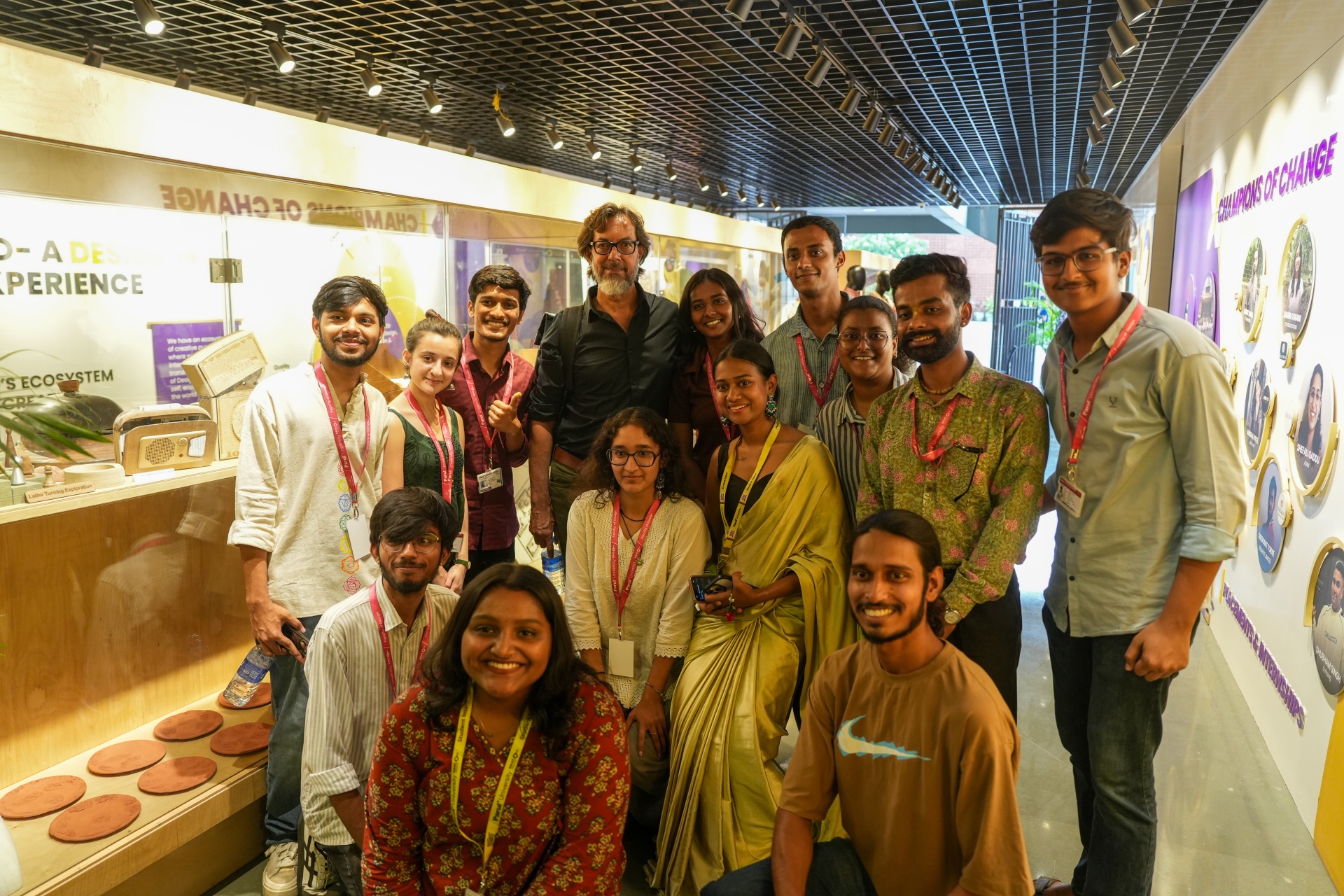
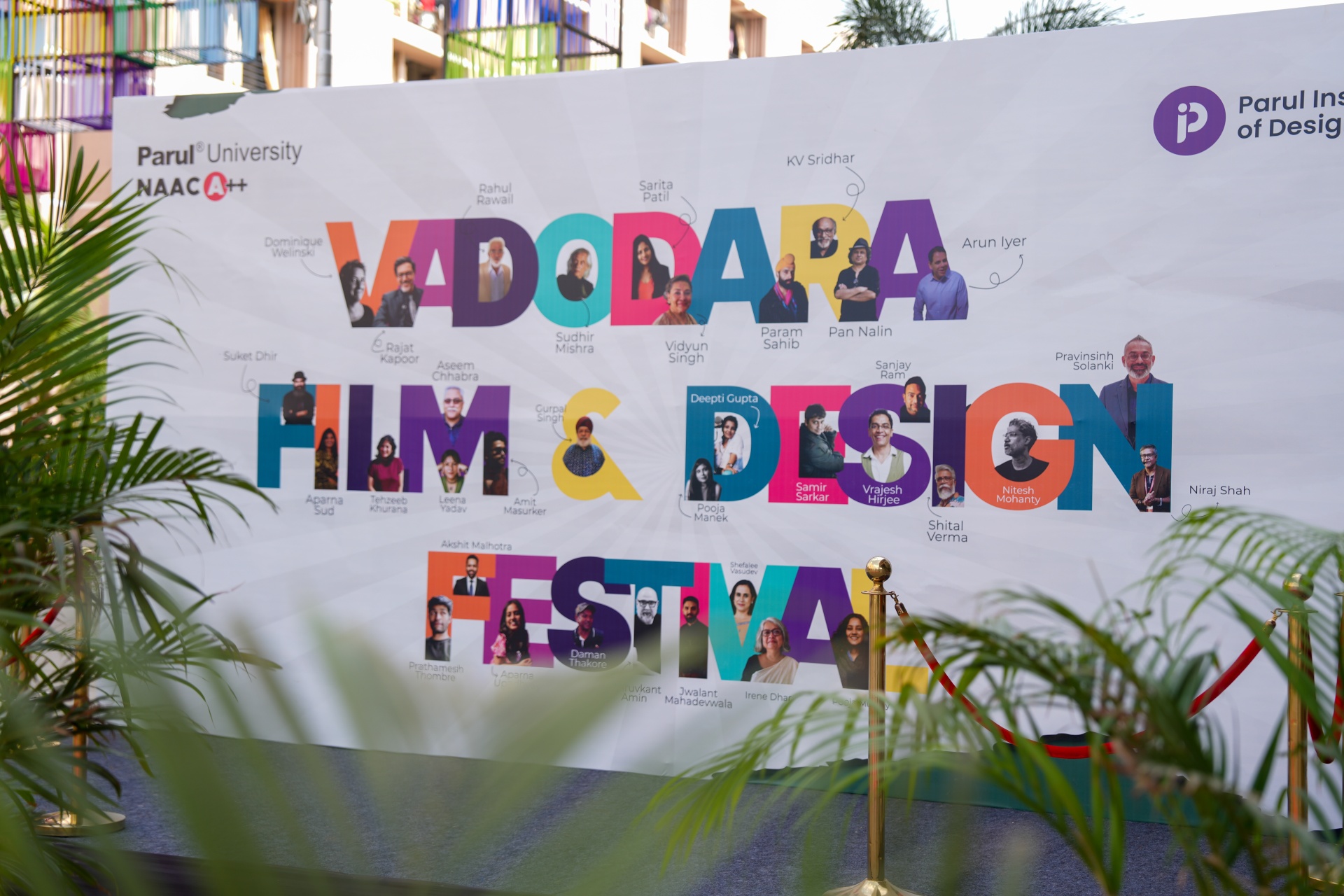
Between 8 and 11 April 2026, more than 30 filmmakers, designers, journalists, and practitioners worked inside Parul Institute of Design for four days straight. That is the mechanical description of the fourth Vadodara Film and Design Festival. The editorial description is sharper. VFDF 4.0 ran as a parallel design school. Working practitioners taught morning workshops while students ran afternoon stalls. Closed-door addas ran in the same building as PU Talks. And the student exhibition in the Design Building included a short film already selected for the Short Film Corner at the Festival de Cannes.
The festival opened with filmmaker Pan Nalin at the Central Auditorium. Four days later it closed with the felicitation of Shefalee Vasudev, editor-in-chief of The Voice of Fashion, at Oscar Hall. Everything meaningful happened between those two bookends.
The scale reads quickly in numbers:
- 4 days of programming held from 8 to 11th April 2026.
- 30 plus speakers across PU Talks, panel discussions, workshops, and closed-door addas
- 6 PID departments in the exhibition: Interior and Furniture Design, Product Design, Fashion Design and Technology, Communication Design, Animation and VFX, and Film and TV Production
- 1 short film from PID, The Fire Kept Its Promise, selected for the Festival de Cannes Short Film Corner
- 1 animated short, Aakhri Dor: The Last Thread, officially selected for CUIFF Film Festival 2025
- 15 plus student-run stalls operating as live businesses across all four days
Day 1: How Cinema, Fashion, and Narrative Got Framed
Day 1 opened with a filmmaker who sold his Mumbai house to finance the movie that became India’s Oscar entry. Pan Nalin directed Chhello Show (released internationally as Last Film Show), India’s official entry to the 95th Academy Awards. Moderator Sameer Sarkar walked him through a path that began in a Saurashtra village, ran through a year of Fine Arts at MSU Baroda, continued through graduation from NID Ahmedabad, and ended with the house sale. The line that anchored the session: the future belongs to storytellers, not to technology. If you’re passionate about having a career in Film, TV and Production, then enrol into B.Sc in Film & TV Production program of Parul University!
Five sessions anchored the day:
- Pan Nalin with Sameer Sarkar on Indian cinema through an international lens
- Dominique Welinski, French producer of Oblivion Verses and convener of the Cannes Factory program, running a three-hour narrative workshop
- Suket Dhir, winner of the 2015-16 International Woolmark Prize, with moderator Ankur
- Vrajesh Hirjee (Golmaal, Kaho Naa Pyaar Hai) on the many lives of a performer, with Gurpal Singh
- Rajat Kapoor (Dil Chahta Hai, Kadakh, Raghu Romeo) with Aseem Chhabra on the art of keep on keepin’ on
A separate closed-door adda with actor and commentator Gurpal Singh ran for senior film and animation students. Gurpal Singh’s survival advice was blunt. Before the meaningful work arrives, learn to cook. A rented kitchen in Mumbai is the difference between continuing and quitting.
Suket Dhir won the International Woolmark Prize in 2015-16 with a design philosophy that traces back to a single moment: his mother restitching a broken button on his shirt in red thread because white thread was not available. That one off-palette button became a framework. You do not need to change the system, change the detail.
Pan Nalin on why he sold his Mumbai house to make Chhello Show: full session
Day 2: Cinema That Refuses to Play Safe
Day 2 opened with the filmmaker most major Bollywood stars hesitate to work with.
Sudhir Mishra (Hazaaron Khwaishein Aisi, Is Raat Ki Subah Nahin, Afwaah) sat with Aseem Chhabra for a session titled Shades of Grey: Giving Liability to an Un-Hero. His protagonists are flawed, conflicted, and rarely conventionally masculine. Most A-list actors will not play them. Sudhir Mishra is fine with that. His grounding, he told the room, is 1970s street theatre in Delhi and Lucknow, not Bombay glamour.
The three-archetype structure at the centre of Hazaaron Khwaishein Aisi (the fixer, the leftist, and the woman navigating between both) came from watching people he actually knew in that period. If you too wish to master how these films are made and how the film-making works, enrol into Parul University’s Certificate Program in Photography and Cinematography!
Six sessions defined the day:
- Sudhir Mishra with Aseem Chhabra on un-heroes and the duplicity of the over-world
- Arun Iyer of Spring Marketing Capital on new-age brand building, using Wakefit’s scale-up from Rs 60 crore to Rs 1,000 crore
- Sarita Patil, co-founder of Matchbox Pictures, on producing Scoop and IC 814
- Aseem Chhabra with second-semester Film and TV Production students on writing about cinema without writing gossip
- A content-creation panel with Param Sahib, Akshit Malhotra (Senior Product Designer, Cars24), and Prathamesh Dhomre (Sole Store), moderated by Sanjay Ram
- Handmade Over Hype, a panel with Dhruvkant Amin (Tectona Grandis Furniture), Jwalant Mahadevwala (Black Design Studio), and bamboo designer Pravinsinh Solanki
Jwalant Mahadevwala’s contribution carried a lesson that applied across disciplines. Tasked with making an Islamic-art Muqarnas ceiling in India, importing the robotic fabrication methods he had learned at Zaha Hadid Architects in London would have cost over Rs 1 crore. Instead, his team broke the digital model into 30,000 pieces that local carpenters and miniature artists in Channapatna built by hand. The ceiling got built at a fraction of the cost. The grand idea had to adapt to the hands available.
Sudhir Mishra and Rajat Kapoor on why independent cinema still matters
Day 3: Gender, Memory, and the Ethics of the Frame
Day 3’s most discussed session did not frame the female gaze as a women-only conversation. Gender Jam, moderated by Aseem Chhabra, brought filmmaker Leena Yadav (Parched), cinematographer-director Dipti Gupta (founder member, Indian Women Cinematographers’ Collective), and National Award-winning editor Irene Dhar Malik onto one stage to argue that sensitivity is not a gendered quality. It is an editorial decision. Specifically: whether or not to include a shot of a young girl when that shot serves no purpose to the story.
The Writing Gem – Amit Masurkar at VFDF 4.0!
Seven sessions ran through the day:
- Gender Jam with Leena Yadav, Deepti Gupta, and Irene Dhar Malik, moderated by Aseem Chhabra
- Amit Masurkar (Newton, Sherni, Sulemani Keeda) with Chhabra on his first film
- Lal Pari: a 1950s car restored and driven 30,500 kilometres from Ahmedabad to London across 14 countries, with owner Daman Thakore
- Shital Verma (National Design Head, Navbharat Times) running a three-hour workshop on storyboard design combining hand drawing with AI
- Aparna Sud (Filmfare Award winner for Neerja) running a production-design workshop at PID’s Monalisa studio
- Nitesh Mohanty‘s Ways of Seeing session on his Blue Project exhibition
- Gender Vocabulary and Hygiene, a second closed-door panel with Yadav, Gupta, and Malik, moderated by Harshit Dave
Amit Masurkar’s session drew a straight line between persistence and output. For years he had sent unproduced scripts to UTV and Viacom before crowdfunding Sulemani Keeda on a Rs 5 to 6 lakh budget with his roommate Naveen Kasturia in the lead. His point to the students was not that struggle is romantic. His point was that the shape of the struggle changes over a career. It does not end. The current challenge for him is no longer finding money. It is finding the right story to be obsessed with for three years.
Parul Institute of Design Exhibition: 6 Departments, 300+ Student Projects
Day 4: Animation, AI, and the Business Reality of Fashion
Day 4 opened with an animation workshop on the paper that D-Mart prints its bills on. Tehzeeb Khurana, founder of Toon Club and juror at the Annecy International Animation Film Festival, had students drawing cameraless animation frame-by-frame on register rolls. Along the way, she walked them through animation history most textbooks skip: Lotte Reiniger‘s The Adventures of Prince Achmed (1926) predates Disney’s Snow White by nearly a decade and is widely considered the first animated feature film. At session end, Khurana took every student’s finished roll back to Mumbai to compile into one collaborative film titled VFDF. If you’re passionate about VFX and animation, delay not and enrol into Parul University’s B.Sc in Animation & VFX program!
Eight sessions defined the closing day:
- Tehzeeb Khurana on cameraless animation and Norman McLaren‘s direct-on-film tradition
- Neeraj Shah (Co-founder, I Do Design; Chief Design Officer, Belure Innovations) on design as a way of thinking
- Pooja Mane on creativity, conviction, and chaos in advertising, with the Flipkart OnlyFans campaign and Swiggy’s Why Is This a Swiggy Ad as cases
- Fashion Forward with choreographer Vidyun Singh and journalist Shefalee Vasudev
- Design in the Times of AI, a panel with Aparna Sud, Shital Verma, Nitesh Mohanty, and Saurabh Kabra (founder, vault.rent), moderated by Sameer Sarkar, closing with Prof Bhaskar Mitra (Dean, PID)
- Shefalee Vasudev with Harsh Purohit of Cognito on writing fashion with a socio-political lens
- Shaeroy A. Chinoy, Fashion Editor at ELLE India and MSU Baroda alumnus, on how to enter the Mumbai fashion industry
- Nitesh Mohanty’s Ways of Seeing deep-dive on curating the Blue Project exhibition
The AI panel was the day’s intellectual anchor. The four practitioners disagreed on specifics but converged on one point: AI amplifies the quality of the thinking behind the prompt. A lazy prompt returns a lazy output. A specific, culturally rooted, experience-informed prompt returns something worth using. The human decision still sets the ceiling.
Sudhir Mishra and Rajat Kapoor at PID
Prof Bhaskar Mitra’s closing observation named a structural truth the panel had circled throughout. Every major AI platform is American-owned. India remains a consumption market in the global AI economy, even when the CEOs of those platforms are Indian. The brief for the room full of design students was to stop being consumers and start being producers.
Design in the Age of AI: four practitioners on why unique human thinking still wins
The PID Exhibition: What Six Departments Actually Build
An informal tradition ran through every department. Each student presenting their own work began with their seniors’ thesis projects. Only after walking visitors through what the older batches had done did the student speak about their own. The hierarchy of respect, set without instruction, was one of the day’s quieter lessons.
A brief tour of what each department showed:
- Interior and Furniture Design: thesis projects including Anvesha Saini’s hostel design, Janvi Jagada’s Paediatric Clinic, and Mrudula Satardekar’s Children’s Reformation Centre. The Semester 5 interlocking-chair project included a sofa designed by Samiksha Bijotkar and Kunal Vanzara, crafted by artisans Yogesh Sahani, Bhavar Lal, and Pokhar Ram, that revealed itself as a swing the moment visitors sat on it.
- Product Design: subtractive POP carving exercises, a kalimba designed by Sumit Bera in resin and wood, and the Maker’s Lab innovations from the Innovation of Design initiative. Palak Ajmere’s two-material Lappy Desk, Ovee Kelesar’s single-material Trivet, and the Droplet Project that converts used utensil water into passive plant irrigation were among the standouts.
- Fashion Design and Technology: Pattachitra-inspired textile products, a zero-waste Button Masala dress by student Saloni built on Anuj Sharma’s no-cut, no-stitch construction, and collaborative textile samples developed with visiting artisan Manaben teaching traditional stitching and eco-printing.
- Communication Design: Semester 4’s Digital Hierarchy typography and Motion Graphics work, Semester 6 packaging redesigns including a reusable incense-stick box, Semester 2 brochure and expressive typography projects.
- Animation and VFX: Aakhri Dor (The Last Thread), a stop-motion film directed by Shubham D. Jaiswal that won at a film festival and was officially selected for CUIFF Film Festival 2025 and semi-finalist at Cut-OK 2025. Akhabar Ek Baar Baar Baar, nominated at the 24FPS International Animation Awards 2025 in the Experimental Studio category.
- Film and TV Production: The Fire Kept Its Promise, written and directed by Rohan Rajput, selected for the Short Film Corner at Festival de Cannes (Rendez-Vous Industry section). A Guru Dutt tribute booth designed by students Anvi Narvakar and Tanvi marked the 101st birth anniversary of the filmmaker.
The Fire Kept Its Promise was produced entirely by PID students, with a crew roster that read like a working production: DOP Akash Tela and Abhi Sharma, editor K.K. Thakkar, sound design by Mudra Patel and Swayam Shah. Its selection for the Festival de Cannes Short Film Corner placed a PID student film on the same programming grid as commercial industry submissions from around the world.
Parallel to the main exhibition, PID students ran fifteen-plus student-led stalls selling their own product-design startups: Maker’s Hub (Kintsugi and 3D printing), Dhaga and Drip (crochet and resin), Slayerz (custom 3D prints and lithophanes), REALMS (alumna-led jewellery), Lily’s Bloom, Elara Jewellery, Timtima Tarbooz, and others. These were not display installations. They were operating businesses with pricing, customisation workflows, and customer acquisition strategies that students ran in real time across four days.
Inside the PID exhibition: six departments, 300+ student projects, the sofa that was a swing
The Lateral Classroom: Who Actually Sat Where
The speaker line-up read like a programme-to-practitioner lookup. In practice, it did not work that way.
Leela Santhosh, a first-year engineering student at Parul University, pitched a Virat Kohli advertisement storyboard during Shital Verma’s animation workshop on Day 3. The storyboard used layered emotional beats (present Kohli motivating his younger self at an Under-19 selection, a scene transition through an eye reflection, the Wankhede stadium crescendo) that the faculty nicknamed Dhurandhar. He was not enrolled in a design programme. He walked into the workshop open to it.
At the stalls, the cross-disciplinary pattern repeated. The Maker’s Hub Kintsugi stall was run by Yajat Modi and Ritika Pawar (both Product Design, Semester 4) alongside Vineeta Yadav (Fashion, Semester 4). Dhaga and Drip was run by Aashika Jain (Fashion) together with Mitika Jain, Manya Garg, and Drishti Dhingra (all Interior Design, Semester 4). These were not organised as departmental assignments. They were self-initiated collaborations across disciplines.
This lateral structure is the ordinary classroom design at PID. The Bachelor of Science in Animation and VFX, Bachelor of Science in Film and TV Production, Bachelor of Design in Fashion Design and Technology, Bachelor of Design in Interior and Furniture Design, Bachelor of Design in Product Design, and Communication Design programmes all share the Design Building, share visiting-faculty schedules, and share studio spaces where students see each other work.
VFDF made that visible. It did not create it.
The institutional backdrop matters here only to the extent it makes the access real. Parul University holds NAAC A++ accreditation at CGPA 3.55 and Category 1 Graded Autonomy. Those two recognitions are the reason practitioners of Sarita Patil’s scale, Sudhir Mishra’s calibre, and Dominique Welinski’s international stature cleared four days in their calendar to work inside a PID classroom. Without the institutional weight, the guest list does not cohere. With it, the guest list is the curriculum, not an extension of it.
Admissions for 2026 are live, block your seat at Faculty of Design at Parul University!
Frequently Asked Questions
What is the Vadodara Film and Design Festival?
The Vadodara Film and Design Festival (VFDF) is an annual four-day festival at Parul Institute of Design, Parul University. VFDF 4.0 ran from 8 to 11 April 2026 and featured over 30 speakers across PU Talks, panel discussions, workshops, and closed-door sessions, alongside a student exhibition spanning six design and film departments.
Who were the main speakers at VFDF 4.0?
VFDF 4.0 speakers included filmmakers Pan Nalin, Sudhir Mishra, Rajat Kapoor, and Amit Masurkar; producer Sarita Patil; Woolmark Prize winning designer Suket Dhir; Filmfare Award winning production designer Aparna Sud; fashion editors Shefalee Vasudev and Shaeroy Chinoy; and creative practitioners Neeraj Shah, Jwalant Mahadevwala, Dhruvkant Amin, Pravinsinh Solanki, and Nitesh Mohanty. Moderators included Sameer Sarkar, Aseem Chhabra, and Harshit Dave.
Is Parul Institute of Design a good college for film, animation, and design?
Parul Institute of Design hosts PU Talks sessions with practitioners like Pan Nalin (Chhello Show, India's Oscar entry), Sudhir Mishra, and Amit Masurkar as part of regular curriculum exposure. In 2025-26 alone, PID student films were selected for the Festival de Cannes Short Film Corner (The Fire Kept Its Promise) and CUIFF Film Festival 2025 (Aakhri Dor). The college operates under Parul University, which holds NAAC A++ accreditation with a CGPA of 3.55 and Category 1 Graded Autonomy. PID offers bachelor's and diploma programmes across six design disciplines alongside B.Sc programmes in Animation and VFX and Film and TV Production.
Has a PID student film ever been selected for an international film festival?
Yes. The short film The Fire Kept Its Promise, written and directed by Rohan Rajput and produced by Parul Institute of Design, was selected for the Short Film Corner at the Festival de Cannes, specifically the Rendez-Vous Industry section. The stop-motion short Aakhri Dor: The Last Thread, directed by Shubham D. Jaiswal, was officially selected for CUIFF Film Festival 2025 and was a Semi-Finalist at the Cut-OK Short Film Festival 2025.
What courses does Parul Institute of Design offer?
PID offers bachelor's programmes in Product Design, Interior and Furniture Design, Fashion Design and Technology, Communication Design (Visual Communication), and User Experience and Interaction Design with AI. It also offers B.Sc. (Regular and Honours) in Animation and VFX and in Film and TV Production. Diploma programmes are available across most specialisations. Master of Design (M.Des) programmes include Fashion Merchandising. Admission is through the Parul University Design Aptitude Test (PU-DAT).
How do I apply to PID for a design, animation, or film programme?
Applications to Parul Institute of Design run through the Parul University admissions portal. The entrance is PU-DAT (Parul University Design Aptitude Test), which evaluates creativity, aptitude, observation, and problem-solving rather than prior technical knowledge. Students who have completed 10+2 from any stream at a recognised board are eligible. Portfolio submission happens on the day of the DAT exam.


