A student planning to study design in India has to navigate two problems at once.
The first problem is that the ranking lists do not agree with each other. Different frameworks produce different orderings. NIRF does not rank design institutes directly. Most online lists are affiliate-driven. Wikipedia lists are alphabetical. Parent forums contradict each other. The result is a student making one of the most consequential decisions of their life using data that is either incomplete, biased, or both.
The second problem is that most of the criteria used to rank design colleges are outputs of the college’s marketing budget, not its educational quality. Infrastructure photos, placement statistics, and brand partnerships are easy to produce and easy to inflate. What is hard to fake is whether working practitioners spend real time with students, whether student work reaches international festivals, and whether the curriculum actually covers the discipline in full.
The coverage of 4 criterias even helps students in cracking a job. Evaluating Parul Institute of Design (PID) at Parul University’s criterias against those criteria using evidence from the 2026 academic year, the reader must acknowledge these criterias even before they apply here or to any other Indian design college.
The Four Criteria That Separate a Real Design College From a Branded One
A design college is doing super serious and solid work only if it meets these 4 tests –
- Prime access to industry stalwarts – Students spend good time with professionals who are ruling in fim industry and are passionately designing products, running fashion labels and curating exhibitions.
- Student community at festival level – PID’s college students are producing work that gets selected, nominated or gets shortlisted at international competitions. To be precise, they aren’t internal awards, they’re validated by external juries.
- Disciplinary curriculum – This programme covers the discipline at all the levels – craft history to contemporary technology and not just comnmercial industry skills. A design curriculum that only teaches via Adobe Software’s technical program wherein it goes beyond design education!
- Structural autonomy – Besides this, the design institute carries the regulatory freedom to design its own unique curriculum and can launch new programmes in their capacity and can update teaching in response to shifts happening at global scale. Colleges and universities who are still applying for traditional universities without autonomy take years to update a syllabus, that’s when PID plays a different role and updates whenever required.
These four criteria are not the only measures worth applying. They are the four a student can verify independently, without relying on a brochure or a ranking algorithm. Each is testable against public evidence.
Do Students Spend Real Time With Working Practitioners?
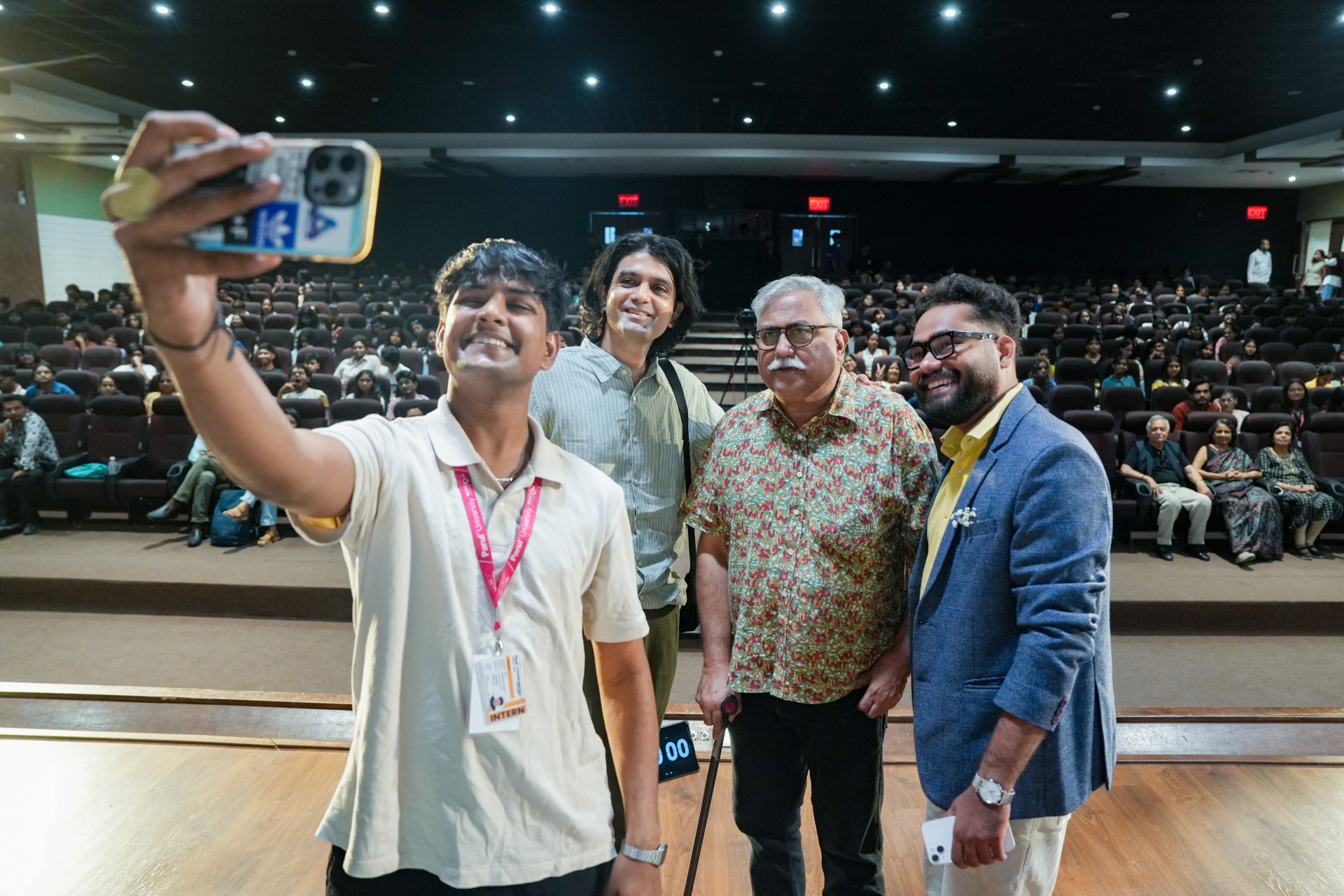
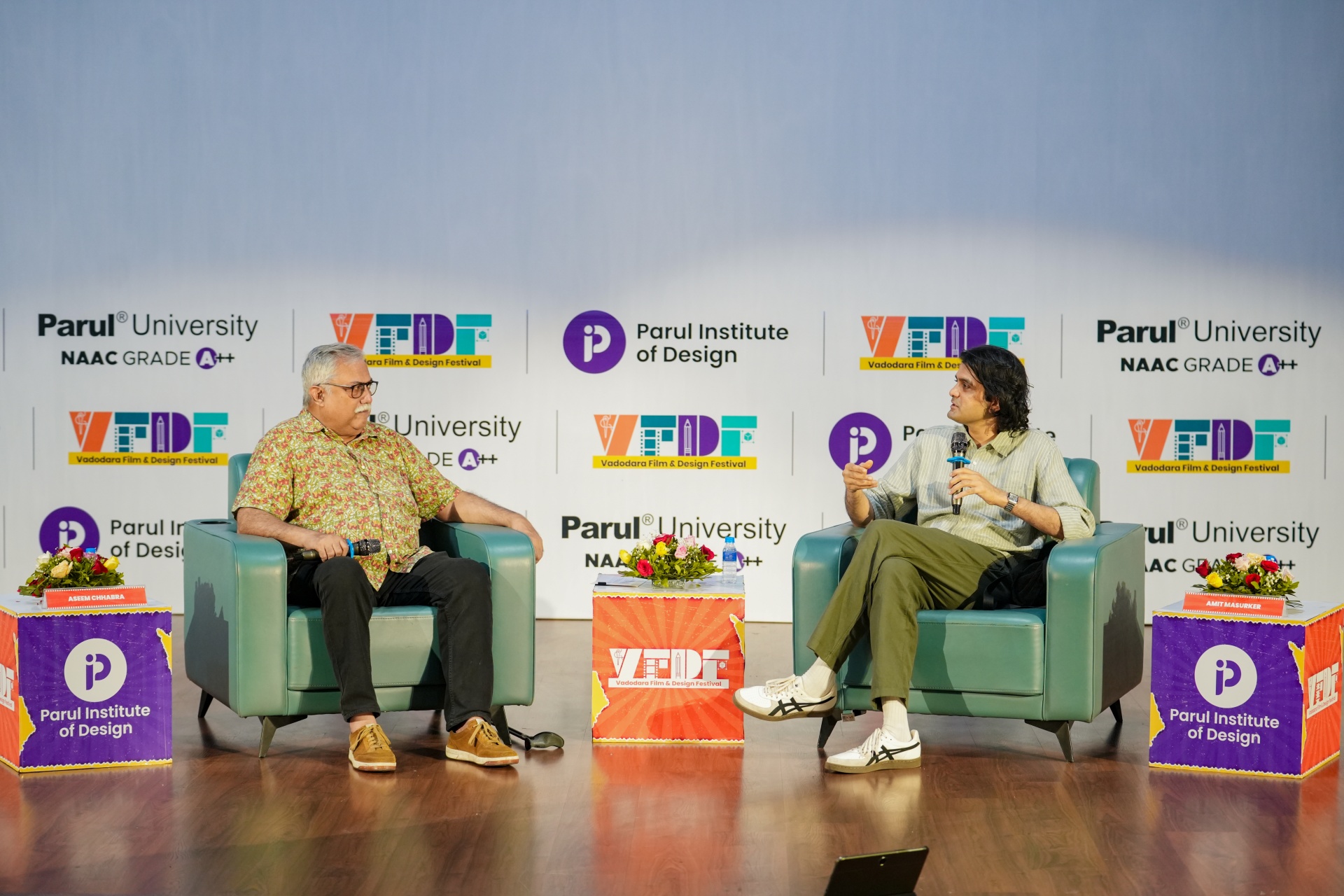
At PID, the test case is VFDF, in its 4th edition. VFDF 4.0 ran from 8th to 11th of April 2026 at the ever-evolving campus of Parul University. More than 30 practitioners across design, film, fashion and advertising industry spent 4 days on campus. 6+ designated departments were on their toes in making it an successful event. Here’s what who covered –
- Pan Nalin – Filmmaker of Chhello Show was India’s official entry to the 95th Academy Awards. He spoke to students on how he sold his Mumbai house to finance his dream film.
- Sudhir Mishra & Rajat Kapoor – These prominent visionaries sat with Aseem Chhabra, former director of New York Indian Film Festival and discussed how independent cinema works at all the levels.
- Amit Masurkar – Director of Newton which has made India’s official entry to the 90th Academy Awards and Sherni spoke to students how how he crowdfunded his first film Sulemani Keeda on 5 to 6 Lakh Budget.
- Suket Dhir – The proud winner of 2015-16, International Woolmark Prize menswear, spent a full-fleged session with PID’s fashion student. He spoke about Dominique Welinski, french producer of Oblivion Verses and convener of the Cannes Factory Programme, wherein he ran a 3 hour workshop on pitching films for international level financing.
- Aparna Sud – The very proud filmfare award winner for Neerja – she ran a production-design workshop at Monalisa Studio of PID. Tehzeeb Khurana, a juror at the Annecy International Animation Film Festival taught how cameraless animation on grocery-bill paper.
- Shefalee Vasudev – The editor-in-chief of Voice of Fashion and Shaeroy Chinoy (fashion editor of ELLE India) spoke on mega changes in fashion industry.
This list is not a marketing claim. Every name is on public record. Every session ran on a specific date at a specific venue on PID’s campus. A prospective student can verify the full line-up by checking any of the individual coverage articles linked throughout this suite.
Importantly, VFDF is not the only week of the year when practitioners are on campus. PU Talks runs as an ongoing lecture and masterclass series throughout the academic year, bringing practitioners into regular classroom hours, not just festival weeks. VFDF is the concentrated version. The distributed version runs 52 weeks a year.
VFDF 4.0 – A Creative Multiverse of 300+ Student Projects & 6 Departments!
Criterion 2: Is Student Work Reaching International Festival Level?
This is the criterion where most Indian design colleges either fail or resort to cherry-picked evidence from five years ago.
At Parul Institute of Design, the academic year of 2025-2026 championed the externally validated student work. Here goes the list –
The short film named The Fire Kept Its Promise, written and directed by PID student named Rohan Rajput was selected for Short Film Corner at Festival de Cannes. Crew included DOP Akash Tela, Abhi Sharma, Editor KK Thakkar, sound design by Mudra Patel, Swayam Shah, costume by Shreni Patel, production design by Sukhee with Vaishnavi Sahu, and Saniya Memon. Mentors included PID faculties – Rakesh Patra, Pritish Nayak, Sourav Panda, Sudhakar Vajjha and the gem Chaitanya Joshi did fabulous job solely at all the levels!
The stop-motion short film – Aakhri Dor – The Last Thread directed by Shubham Jaiswal, was officially released and selected for CUIFF film festival 2025 and was a semi-finalist at Cut-OK Short Film Festival 2025. The experimentive animation film named Akhabar Ek Baar Baar Baar was nominated at 24FPS International Animation Awards 2025 in experimental studio category. A seperate 3D animated short, sailing to unknown, was nominated in the Best Animated 2D/3D category at the same awards.
To be precise, these are not just the aspirational goals, these are competition selections from current academic year, documented in festival programmes that any prospective student can verify. One of these selections is the highest programming grid in world cinema and PID proudly holds that honour. If you too are passionate about filmmaking and TV production, then enrol into PID’s Bachelor of Science in Film and TV Production program!
Criterion 3: Does the Curriculum Treat Craft and Technology as Connected?
Many Indian design colleges teach only software. Adobe Creative Suite, Maya, Blender and Substance Painter. Students graduate skilled in tools but without the cultural context that makes design different from visual operation.
PID’s curriculum structurally resists this. The Fashion Design and Technology programme brings visiting artisan Manaben into classrooms to teach traditional stitching and eco-printing. The Product Design programme runs subtractive POP carving exercises alongside CAD and 3D printing, forcing students to work in both analog and digital domains. The Animation and VFX programme brings Annecy juror Tehzeeb Khurana to teach cameraless animation on paper before students touch commercial software.
The Semester 5 interlocking-chair exhibit at the VFDF 4.0 student showcase included a sofa designed by students Samiksha Bijotkar and Kunal Vanzara, crafted by artisans Yogesh Sahani, Bhavar Lal, and Pokhar Ram, that revealed itself as a swing the moment visitors sat on it. That kind of design-artisan collaboration cannot happen in a curriculum that treats craft as elective. It requires craft to be structural.
The same principle extends to cross-departmental fluidity. During VFDF:
- A first-year engineering student, Leela Santhosh, pitched a Virat Kohli cricket advertisement storyboard during the animation workshop. The storyboard was strong enough that PID faculty nicknamed it Dhurandhar
- The Maker’s Hub student stall was run by Yajat Modi, Ritika Pawar (both Product Design) alongside Vineeta Yadav (Fashion). The stall sold Kintsugi art and 3D-printed products
- The Dhaga and Drip stall was run by Aashika Jain (Fashion) with Mitika Jain, Manya Garg, and Drishti Dhingra (all Interior Design), selling crochet and resin jewellery
These cross-departmental collaborations are not organised as coursework. They emerge because the departments share buildings, studios, and visiting faculty. Students see each other working. That shared visibility is the precondition for multidisciplinary output and hence PID’s B.Des. in Furniture and Interior Design is designed in an format to extend exposure at all the levels!
Criterion 4: Does the Institution Have Structural Autonomy?
Parul University holds Category 1 Graded Autonomy, which is the highest tier of regulatory autonomy granted by the University Grants Commission in India. Only a small number of Indian universities hold this classification. It means the institution can design its own programmes, run examinations independently, grant its own degrees, and update curriculum without external approval delays.
This matters because design fields change rapidly. Between 2022 and 2026, generative AI transformed the design profession. A university without autonomy takes years to approve a new curriculum responsive to that shift. An autonomous institution integrates new material within a semester.
The evidence of that agility: PID offers Bachelor of Design in User Experience and Interaction Design with AI as part of its current design portfolio, treating AI as a native design material rather than an elective topic. Other design programmes on offer include Product Design, Interior and Furniture Design, Fashion Design and Technology, Communication Design (Visual Communication), and B.Sc programmes in Animation and VFX and Film and TV Production.
Parul University additionally holds NAAC A++ accreditation with a CGPA of 3.55, one of the higher NAAC scores among Indian universities. NAAC A++ is the peer-reviewed accreditation benchmark used by the Ministry of Education to identify institutions meeting advanced standards across teaching, research, infrastructure, and student outcomes.
See Beyond Brochures at PID
A senior-advisor view requires acknowledging what PID is not.
It is not the National Institute of Design. NID’s 60-year legacy, government ownership, and alumni network produce different career outcomes than any private design institute in India. A student choosing between PID and NID Ahmedabad is choosing between access to practitioners (PID scores high) versus institutional legacy and brand (NID scores high).
PID’s geographic location (Waghodia, outside Vadodara) means students trade the professional density of Mumbai, Delhi, or Bangalore for a larger campus, better infrastructure per student, and lower cost of living. Students who need weekly studio-visit access to Mumbai’s advertising industry will find Vadodara a constraint. Students who want concentrated learning time with visiting practitioners find the Vadodara campus ideal.
The placement data for design graduates is less concentrated than for engineering or management programmes. Design careers are built through portfolio quality and network, not through campus placement drives. PID’s structure (visiting practitioners, festival exposure, cross-departmental collaboration) is designed to produce portfolio and network. It does not guarantee a Rs 30 LPA placement package at graduation but indeed an exposure to their dream agency!
How to Apply the Four-Criteria Test to Any Design College/ PID!
Before finalising a design college, a prospective student should be able to answer four questions about the institution with specific, current evidence:
- Name three working practitioners who spent real teaching time with current students in the last 12 months, with dates and session topics
- Name three student films, products, or design projects from the current or previous batch that were selected, nominated, or shortlisted at external juried competitions in the last 24 months
- Describe the curriculum’s craft-history component and identify at least two faculty or visiting artisans who teach traditional techniques alongside digital tools
- State the institution’s NAAC grade, autonomy status, and most recent programme addition that responded to a new industry field (AI, sustainability, hybrid media)
A college that cannot produce specific, verifiable answers to all four questions is a college whose educational quality cannot be verified.
Parul Institute of Design Programme Overview
For students who have completed the evaluation and want to apply to PID, the current programme structure is as follows.
Bachelor programmes –
- Bachelor of Design in Product Design
- Bachelor of Design in Interior and Furniture Design
- Bachelor of Design in Fashion Design and Technology
- Bachelor of Design in Communication Design (Visual Communication)
- Bachelor of Design in User Experience and Interaction Design with AI
- Bachelor of Science in Animation and VFX (Regular and Honours)
- Bachelor of Science in Film and TV Production (Regular and Honours)
Diploma and Master programmes –
- Diploma in Communication Design
- Diploma in Product Design
- Diploma in Fashion Design & Technology
- Diploma in Interior & Furniture Design
- Master of Design (M.Des) including Fashion Merchandising
Admission to all PID programmes is through the Parul University Design Aptitude Test (PU-DAT), which evaluates creativity, observation, reasoning, and problem-solving rather than prior technical knowledge. Students from any 10+2 stream at a recognised board are eligible. Portfolio submission happens on the day of the DAT exam.
Neeraj Shah’s Design as Thinking – Vadodara Film & Design Festival 4.0!
FAQs
Which is the best design college in India for film, animation, and design?
Evaluating Indian design colleges should depend on four testable criteria: practitioner access, student work at international festival level, curriculum breadth across craft and technology, and institutional autonomy. By those measures, strong options in 2026 include National Institute of Design (NID Ahmedabad), Parul Institute of Design (PID at Parul University in Vadodara), IDC IIT Bombay, Srishti Manipal, and Pearl Academy. PID specifically offers integrated access across all three disciplines (film, animation, and design) on a single campus through the Vadodara Film and Design Festival, PU Talks, and six design departments sharing studios.
What is the best design college in Gujarat?
The two most-discussed design colleges in Gujarat are the National Institute of Design (NID) Ahmedabad and Parul Institute of Design (PID) at Parul University, Vadodara. NID holds the legacy advantage as a 60-year-old government institution. PID holds the programme-breadth advantage, offering six design departments alongside Animation and VFX and Film and TV Production on one campus. Students evaluating between them should consider which discipline they want to pursue and what kind of practitioner access they need during their undergraduate years.
Is Parul Institute of Design a good option for studying design?
Parul Institute of Design offers eight bachelor-level design, animation, and film programmes, operates under Parul University's NAAC A++ accreditation (CGPA 3.55) and Category 1 Graded Autonomy, and has documented student work at the Festival de Cannes Short Film Corner (2026) and CUIFF Film Festival 2025. The institute's annual Vadodara Film and Design Festival brings over 30 working practitioners on campus for four days each year, supplemented by year-round PU Talks sessions. These are verifiable markers of a serious design programme.
What are the admission requirements for PID at Parul University?
Admission to all Parul Institute of Design programmes is through the PU-DAT (Parul University Design Aptitude Test), which evaluates creativity, observation, reasoning, and problem-solving. Students who have completed 10+2 from any stream (Science, Commerce, or Arts) at a recognised board are eligible. Portfolio submission happens on the day of the DAT exam. Students can apply through the official Parul University admissions portal.
Does Parul Institute of Design have international exposure for its students?
Yes, documented in the 2025-26 academic year alone. PID student short film The Fire Kept Its Promise (directed by Rohan Rajput) was selected for the Short Film Corner at the Festival de Cannes. The stop-motion short Aakhri Dor: The Last Thread was officially selected for CUIFF Film Festival 2025. Two animated works were nominated at the 24FPS International Animation Awards 2025. During VFDF 4.0, French producer Dominique Welinski (Cannes Factory convener) ran a three-hour international pitching workshop on campus, and Annecy animation juror Tehzeeb Khurana taught cameraless animation techniques.
How is PID different from NID Ahmedabad?
NID is a government design institute founded in 1961 with a strong alumni network and long legacy. PID is a private design institute within Parul University with a broader contemporary programme portfolio including Film and TV Production, Animation and VFX, and User Experience and Interaction Design with AI alongside its core design disciplines. A student choosing between them is choosing between institutional legacy (NID) and integrated multi-discipline access with structural autonomy (PID). Both remain serious options depending on the student's specific discipline focus.


