AirX Innovations: PIERC is Empowering Clean-Tech Innovations!
- • What AirX Innovations builds: a living microalgae device that absorbs carbon dioxide and releases oxygen, not an air purifier.
- • How it reached Parul University's PIERC incubator and used 50 lakh rupees to build a lab and a product.
- • The testing, patents, and first orders behind it, including a 25-device custom order.
- • The founders and their plan to take the product abroad.
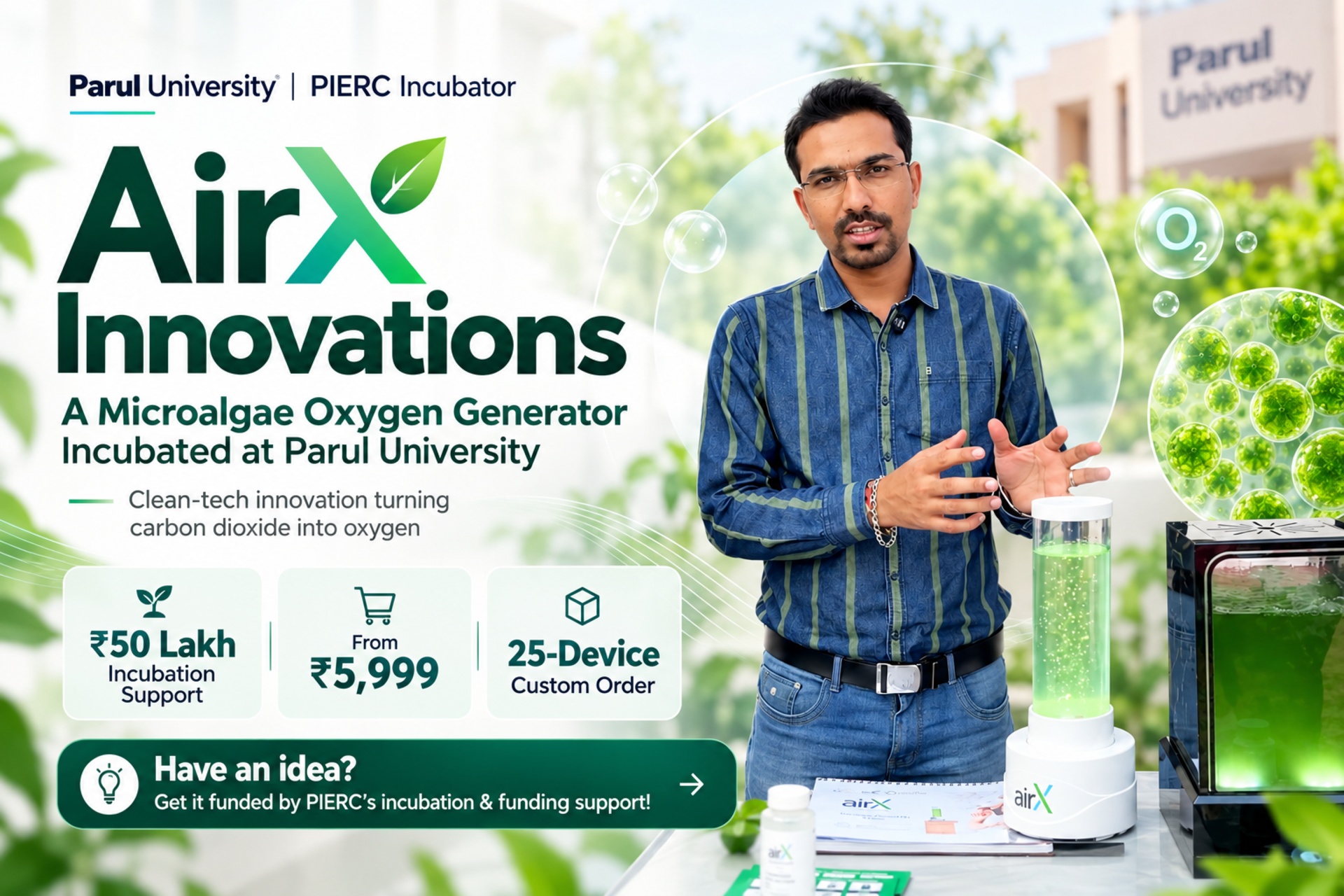
50 lakh rupees
Incubation funding, used over about 18 months
25 devices
Largest order, built in about a week
From 5,999 rupees
AirX O2 Mini desk unit
AirX Innovations, a Gujarat company, builds a living microalgae oxygen generator: a device that uses algae to pull carbon dioxide from indoor air, filter fine particles, and release oxygen. It grew up inside university incubators, took incubation at Parul University’s PIERC, and now ships a range from a 5,999 rupee desk unit to a recent 25-device custom order, with a Saudi client asking about a 2,400-litre installation.
What AirX actually makes?
The founders are firm on one distinction, because customers keep getting it wrong. A filter removes things from the air. AirX runs the opposite reaction: its algae use light and carbon dioxide to make oxygen, the same photosynthesis a houseplant performs, packed into a unit sized for a room. “This is not an air purifier. This is an oxygen generator,” one founder says. “It actually generates oxygen.” That is the company’s whole pitch. It is also its hardest sales problem, which comes up later.
The range runs from a desk unit to a larger hybrid system:
| Product | Price | Intended for |
|---|---|---|
| AirX O2 Mini | 5,999 rupees | Bedrooms, desks, personal spaces |
| AirX office model | Not listed | Offices |
| AirX Hybrid Air Purification System | Not listed | Larger spaces |
By the company’s own testing, quoted on its website, the device performs as follows. These are the company’s figures, not an independent lab’s, and are worth reading as such.
| Metric | Figure (company’s own testing) |
|---|---|
| PM2.5 removal | 78 to 80 percent |
| Carbon dioxide reduction | 59 to 65 percent |
| Noise | 15 dB |
| Coverage | Up to 1,000 square feet |
Who built it?
Four people run AirX, and the split is the point: a device like this sits across three fields at once. Pratik Patel, from a mechanical background, is named as the founder. Shani Pandya is chief technology officer. Kanchan, from biotechnology, keeps the algae alive and productive. Urvish Mandaliya, an MBA, runs operations, marketing, and finance, or, in his own words, everything else. They did not meet in a boardroom. They came together at the innovation centre of Pandit Deendayal Energy University, where Pratik mentored and Urvish was interning while finishing his MBA. Urvish joined as an additional director once his internship ended.
How it reached Parul University
AirX found PIERC, Parul University’s incubation centre, at a campus event Urvish remembers as Nivesh 2.0, through social media and a circulated document. Incubation is the stage where a prototype becomes a company with a product, customers, and a plan, and AirX arrived with a working device already in hand.
The money mattered. AirX was given 50 lakh rupees by incubation support and took approximately 18 months to develop: a biotechnology lab and the equipment, and then the newer hybrid lab and the sensor development. That funding covered the stretch where the product grew from its first form into the one now on sale.
What it has had to prove
A device that puts living algae into a bedroom has to answer one question before any other: is it safe, and does it work? AirX leans on outside reports for both. A lab report from Pandit Deendayal Energy University states that the algae is not harmful to the environment and carries no virus, tested in a vacuum-chamber experiment that compared a plant alone against the device. An SGS India report, listed on the site, found no heavy metals, with no mercury, lead, cadmium, or arsenic detected. Additionally, it has been endorsed by the Science and Technology Business Incubator (STBI) of the Government of Gujarat. AirX owns a registered design titled 410919-001 for the products it sells and says that it has a process patent that covers its method of feeding the algae. The nutrient is its own formulation, and the value lies in the nutrient, not in its location or the process used to prepare it: algae can be obtained anywhere, and the feed and process are not something that a competitor can easily duplicate.
Trust was the first real obstacle. Early on, even potential customers doubted that a living algae system captured carbon dioxide at all, and proving it took most of the early research. The second obstacle is easier to state than to solve: the technology is unfamiliar, so it has to be made easy to understand and easy to look at. AirX added a light-indicator sensor so a customer can see at a glance that the device is working.
Who is buying, and what is next?
The company’s proudest moment so far is an order it called its biggest: 25 custom units, built to a client’s specification and timeline in about a week. A client in Saudi Arabia has asked about a 2,400-litre plant for a bus station, and the team is drafting proposals for governments, including one with a neat logic: plant trees on 80 percent of a site and put AirX on the other 20, sized so the devices remove as much carbon dioxide as the trees.
International plans reach toward Dubai, Europe, Russia, London, and Spain. The obstacle there is paperwork, not technology. Microalgae falls under biotechnology, and the international certificates for biotech products are slow and hard to obtain, so the team is working through the documentation step by step. Research has not stopped. One thread is turning the algae into a gel, which the team believes could extend shelf life and fix a current efficiency defect. Another is a conventional HEPA purifier alongside the algae line.
The founder's read on the journey!
Urvish is blunt about startup life. The downs come more often than the ups, and the discipline is staying in when a proposal is rejected. His advice to students who want to try is specific. Do the research and the market study first. Put the concept in an incubation centre and present it. Understand the market, accept feedback, and create something that has a positive impact on the environment instead of a negative one. If he fears failure, he gets this question around: If you don’t go, you will regret it for your whole life. Explore B.Tech in Biotechnology and B.Tech in Mechanical Engineering at Parul University to discover how scientific research, engineering, and innovation can come together to develop real-world solutions in clean technology and sustainable development.
SOURCE AND CONTEXT. Based on an interview with the AirX Innovations team and the company’s website. Performance figures (PM2.5, carbon dioxide, noise, and coverage) and the product claims are the company’s own, not independently verified here. Founder titles follow the interview; some third-party listings describe them differently, so confirm before publishing. No official AirX website or social URL could be verified at build time.
Explore the incubation ecosystem
PIERC, Parul University’s innovation and incubation center: pierc.org
Lakshya 2047, Centre for Future Skills: paruluniversity.ac.in/academics/lakshya-2047
People and organisations
- AirX Innovations Pvt. Ltd. Microalgae oxygen generator company, Ahmedabad and Delhi
- Pratik Patel, Founder, mechanical background
- Shani Pandya, Chief Technology Officer
- Urvish Mandaliya, Additional Director: Operations, Marketing, and Finance
- PIERC, Parul University, Incubated AirX