- • Red Hat India Challenge at Parul University: A Student-Led Workshop From RHEL to OpenShift
- • How a peer-led workshop took students from Linux basics to OpenShift.
- • How student communities built and delivered the whole event.
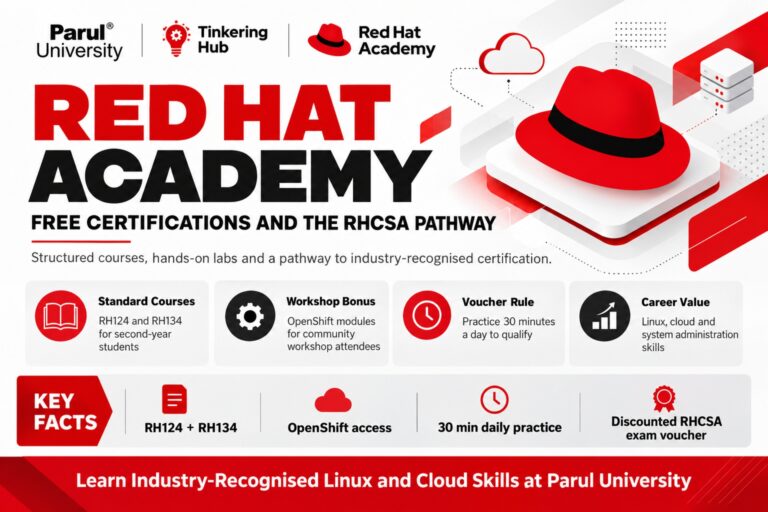
- • The Red Hat Academy courses participants took away from the day.
16 October 2026
Date of the event
Student-led
Senior students taught their juniors
Free OpenShift course
Enrolment for every participant
About Red Hat India Challenge at Parul University
On 16 October 2026, Parul University’s Tinkering Hub and Red Hat Academy jointly organized the Red Hat India Challenge at Seminar Hall 220, Subhash Chandra Bose Bhavan, from 9:30 AM. The event carried a simple line: Learn. Practice. Compete.
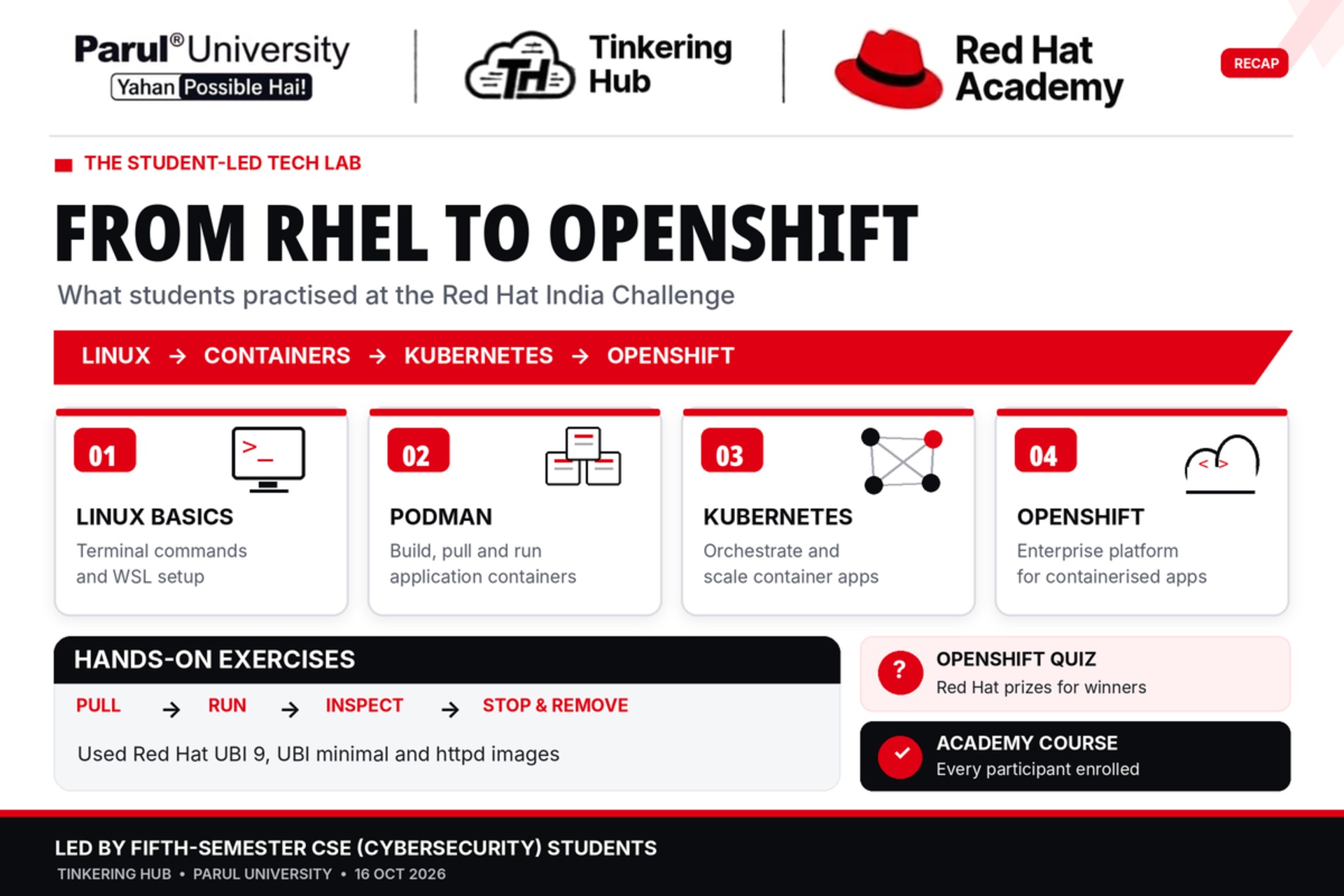
There were two activities conducted during the event. It included a hands-on workshop titled From RHEL to Kubernetes and OpenShift, and a multiple-choice quiz on OpenShift with goodies for the winners. The participants included first-year students along with some students from final years, and everyone worked on their own terminals throughout.
Workshop Topics: Linux, Containers, Kubernetes and OpenShift
The workshop moved from first principles to platform-scale tools. In order, it covered:
- Linux fundamentals, Ubuntu and the Windows Subsystem for Linux (WSL)
- Basic Linux commands and working in the terminal
- Containerisation concepts, with Podman and Docker
- Kubernetes and container orchestration
- OpenShift and its applications
- Red Hat Enterprise Linux (RHEL) and Universal Base Images (UBIs)
- Red Hat Academy courses, enrolment and certification pathways
Peer-Led Workshop: Fifth-Semester Cybersecurity Students as Workshop Trainers
The defining feature of the day was who taught it. Dr. Vaibhav Gandhi, Director of Tinkering Hub, opened the programme. He shared that the experts were the seniors of the participating students. The workshop was run by fifth-semester Computer Science and Engineering students specialising in cybersecurity.
The student team ensured that all participants had a functional Linux environment. They provided an introduction to Linux, and demonstrated the fundamental terminal commands. Harsh Chauhan then led the session on containers, Podman, Kubernetes, and OpenShift, guiding participants through hands-on exercises involving image pulling and container execution.
The student contributors were
- Drishya Nair, Purva Vyas, Harsh Chauhan, Riddhish Dixit and Kandarp Meghani, Fifth-semester CSE (Cybersecurity)
Hands-On RHEL and OpenShift Training: The Kitchen Analogy and Podman Exercises
The trainer then introduced Kubernetes through a practical kitchen analogy. He asked participants to imagine several kitchens preparing fries. If a bulk order of 200 fries arrived while only one of four kitchens remained active, the workload would be inefficiently concentrated in a single location.
Kubernetes addresses this challenge by distributing work intelligently. It determines how many fries each kitchen should prepare and when, ensuring that resources are used effectively. In this analogy, Kubernetes functions as the manager, similar to a principal or coordinator, who keeps all kitchens operating smoothly and efficiently.
Explaining Concepts: Containers, Podman, and OpenShift
The trainer used another analogy to describe the concept behind the tool. The example was about kitchen use, where a container was compared to a recipe that had already been mixed. The same dish would have turned out the same way in every kitchen because the mixture had all the same ingredients and instructions. A container is like a recipe because it puts an application and its dependencies together so that the software can be run on any computer.
Podman is the chef who makes the dish and works with containers. It is actually the engine that allows people to build, share, run, and manage applications in containers.
Kubernetes is the manager who ensures that the dish is prepared in time and is able to handle the number of guests that arrive. It is also the one who can make more chefs and kitchens available for bigger events and take some down when there is a smaller crowd. The tool helps manage, orchestrate, scale, deploy, and operate the pods.
OpenShift is the senior management that allows the company to offer products on top of Kubernetes, such as developers’ tools, automated operations, and security features. It provides enterprise-level features to Kubernetes, including governance, security, and operations.
Following that, participants did the work themselves. They pulled Red Hat UBI 9, UBI minimal and httpd images, ran containers, checked their status, compared a container’s operating system with the host’s, and learned to stop and remove containers. The practical point landed: a web server image of about 310 MB is far lighter than a virtual machine measured in gigabytes.
OpenShift Quiz and Red Hat Prizes for Winners
After the workshop came the Red Hat India Challenge itself, a multiple-choice quiz on OpenShift. Red Hat sponsored the prizes, which included headphones, a portable speaker, a smartwatch, a notebook and a gift box, each carrying the Red Hat logo, to be handed over once winners reach the university.
How Student Communities and Tinkering Hub Powered the Event
Dr. Vaibhav Gandhi used the event to show what student communities can do. The registration link had been built by the university’s own students and hosted on AWS with help from the campus AWS community, while the Red Hat community team ran the event on the ground.
In other words, several student communities, each with its own skill, combined to deliver one event, from the registration page to the technical content on stage. He was clear about the model: every community is run by students, with Tinkering Hub providing the support behind them.
How Students Can Join and Lead Campus Tech Communities
He also set out a route for anyone who wanted in. Join as a participant, answer the later calls for volunteers, and in time help lead a community. He framed it as an open offer, not tied to any sponsor.
That was the key takeaway of the day. The certification pathway matters, but the deeper offer is a way to learn beyond the syllabus and grow into leadership through the campus communities.
SOURCE AND CONTEXT. This article is based on the coverage report of the Red Hat India Challenge held at Parul University on 16 October 2026, organised by Parul University, Tinkering Hub and Red Hat Academy. Student contributor names are published with their LinkedIn profiles; student email identifiers from the source have been omitted.
Connect and Continue
Students interested in Linux, containers, OpenShift and Red Hat certifications can follow the campus communities and explore the Faculty of Engineering and Technology.
Faculty of Engineering and Technology: paruluniversity.ac.in/faculty/engineering-technology
People and organisations
- Dr. Vaibhav Gandhi Director, Tinkering Hub; opened the event
- Harsh Chauhan Student speaker, fifth-semester CSE (Cybersecurity)
- Drishya Nair Student contributor, fifth-semester CSE (Cybersecurity)
- Purva Vyas Student contributor, fifth-semester CSE (Cybersecurity)
- Riddhish Dixit Student contributor, fifth-semester CSE (Cybersecurity)
- Kandarp Meghani Student contributor, fifth-semester CSE (Cybersecurity)
- Red Hat Academy Certification programme partner
- Tinkering Hub, Parul University Supports student-led technical communities