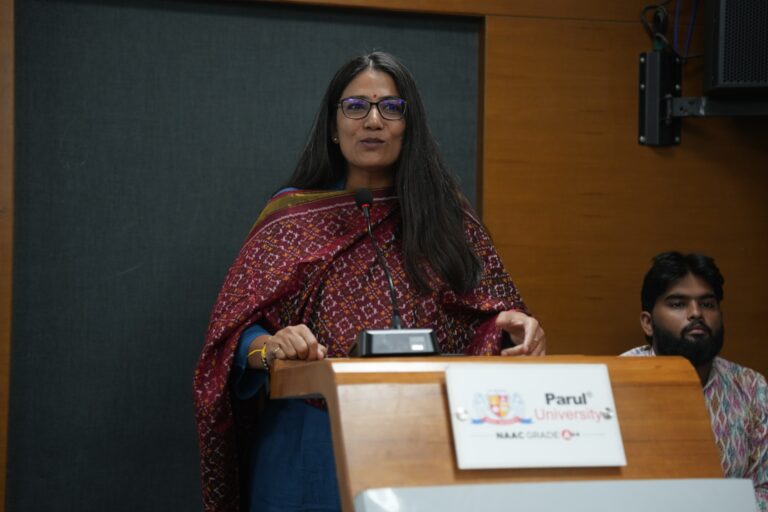
“How does AI actually give a response?” That was the question that opened Day 2 of Parul University’s GCF AI training, and it silenced the room. The answer is not magic. Before an AI can produce any smart answer, it needs massive amounts of well-prepared data. Without data, an AI is just an empty shell. This is the single most important lesson in machine learning:
AI is only as smart as the data you feed it. – A core lesson from the Parul University AI training
Step 1: Data Collection
Every AI project begins by gathering data, and there are several real-world methods companies use to do it:
1. Surveys: asking relevant questions to a large group of people to gather responses.
2. Observations: a record is maintained of how users work/interact with a system without asking them directly.
3. Interviews: sometimes one-on-one or face-to-face conversations are used to accumulate qualitative inferences from the data.
4. Data extraction: Data extraction is gathering data/information from the old systems and databases.
5. Sensors & IoT: In times of AI, physical devices are still useful to collect real-time data about the environment.
6. Web Scraping: programs that can extract data automatically from public domains or web pages.
Step 2: Data Cleaning
Raw data is messy, and messy data produces a bad model. Data cleaning is the process of removing duplicate, fake, or wrong entries so the AI is not confused. The training used a brilliant local example to make this stick: imagine an AI navigation system searching its database for the famous Charminar in Hyderabad. The trouble is, there is also a full-size replica of the Charminar at Ramoji Film City. If the raw data holds both, how does the computer know which is the real monument and which is a movie set? Removing that confusing duplicate is data cleaning. It is exactly why a service like Google Maps must constantly clean incorrect data so its routing stays accurate.
Step 3: Preprocessing and Manipulation
After the fake and duplicate data has been removed, the remaining data needs to be moulded into a useful form. Data preprocessing and manipulation includes sorting, grouping, filtering the data, transforming it and aggregation. The trainer equated it to preparing the vegetables for cooking; you can’t put everything in the pot. The trainer equated this with preparing vegetables for cooking; you can’t just put everything in the pot. All of this is overseen by the more general field of data engineering, which deals with the movement and preparation of data throughout a project.
Step 4: Data Storage (Structured vs Unstructured)
Cleaned, prepared data has to live somewhere. Storage systems fall into two broad families, and the training illustrated them with popular tools. Structured data, neatly organised like a well-formatted spreadsheet, is typically stored in relational databases such as SQL. Unstructured data, such as free-form documents, suits databases such as MongoDB. Knowing which kind of data you have determines how and where you store it, and how easily a model can use it later.
Step 5: ETL Architecture (Extract, Transform, Load)
Tying the whole data journey together is ETL architecture, which stands for Extract, Transform, Load. The trainer described it as an assembly line: raw material is extracted from its sources, transformed into something clean and useful, and loaded into the destination database, ready for a model to learn from. Alongside it sits data modelling, which structures how the data is organised. ETL is how real companies move data at scale from countless messy sources into a single, reliable store, the unglamorous but essential backbone of every serious AI system.
Why This Matters
It is tempting for beginners to rush to the exciting part, building the model. But experienced engineers know the truth: most of the real work in AI is data work. A brilliant algorithm trained on bad data will fail, while a simple model trained on clean, well-prepared data can succeed. That is why students at Parul University practice the full data pipeline hands-on, using real tools at Lakshya 2047, before they ever train a model.