Every year, the world discards a mountain of electronics, and most of it is treated as garbage. Yet inside those discarded devices lies real value. Understanding electronic waste and the science of recovering what it contains is one of the defining sustainability challenges of our time and the subject of research behind a recent Parul University and IIT Palakkad patent.
What Is E-Waste?
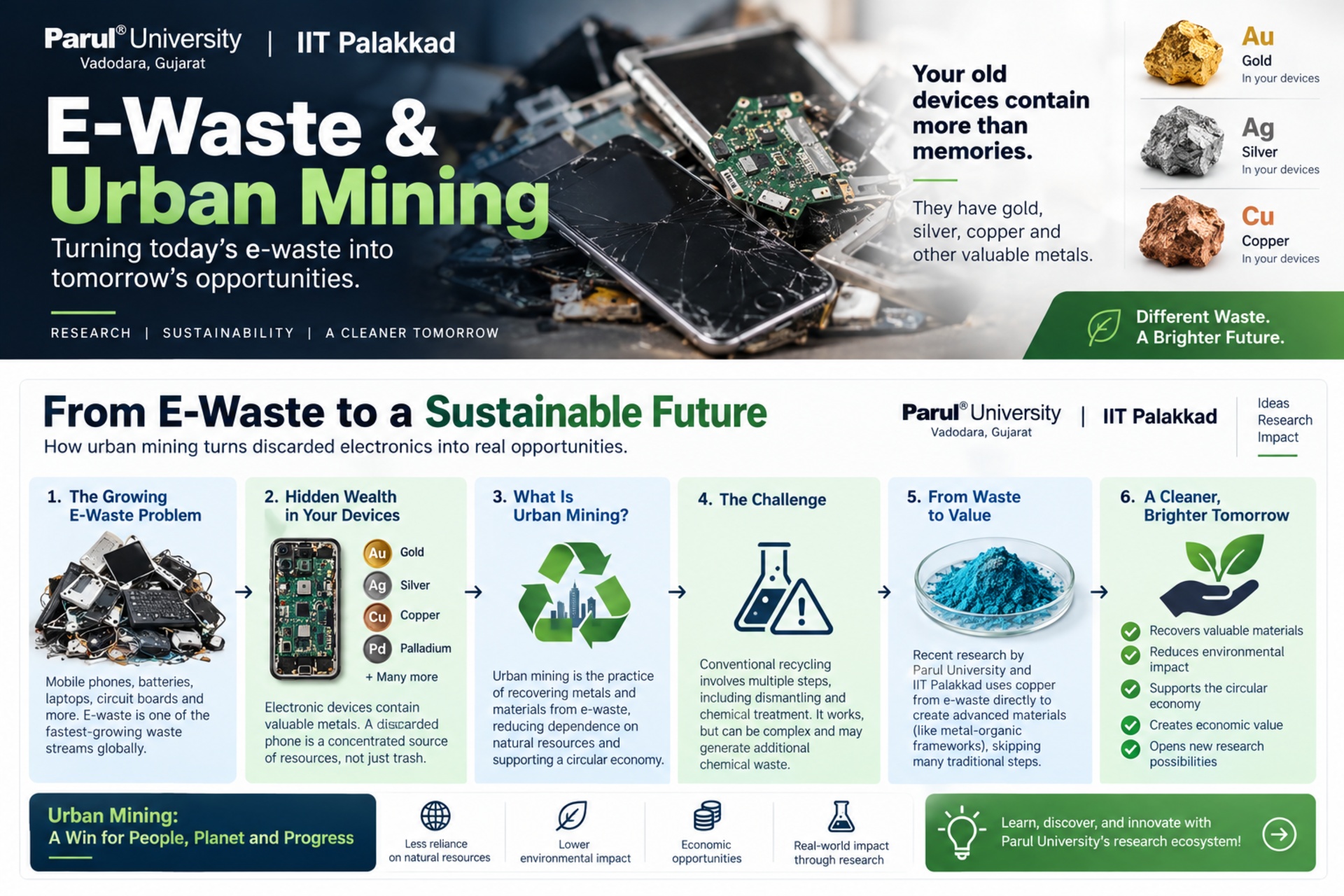
Electronic waste includes mobile phones, batteries, circuit boards, laptops, and many more. With the rising population and technological usage, it’s becoming one of the most rapidly growing waste streams globally. A phone alone can’t be replaced just because it’s broken, but because of battery or storage issues or just a new update.
The Devices
Here is the crucial point: electronic devices are not made of worthless material. They contain metals of significant economic and scientific value, gold, silver, copper, palladium, and other technologically important elements, packed into their components. In effect, a discarded phone is a concentrated source of valuable metals. This is why researchers increasingly describe e-waste not as trash, but as an above-ground resource waiting to be recovered.
What Is Urban Mining?
Urban mining is the next-gen practice of recovering metals and materials from electronic waste. The logic is super-simple: to mine it in a way to reduce dependencies on natural resources and the environment. Recovering these will eventually extract resources, cut waste, and support a circular economy wherein materials are recovered at all levels!
The Catch: Conventional Recycling Is Complicated
Recovering those metals is harder than it sounds. Traditional e-waste recycling often involves several stages: a printed circuit board may be dismantled and cut into pieces, then treated with chemicals or acids to dissolve and separate the metals, which are then converted into compounds such as chlorides or nitrates. Those compounds can serve as raw material for making other products. It works, but it is complex and multi-stage. More troublingly, some conventional recycling creates an environmental contradiction: while treating one kind of waste, the process itself can generate additional chemical waste. Solving that contradiction is where innovative research comes in.
From Waste to Value: The Rise of Valorization
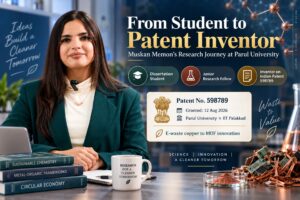
The most exciting shift in the field is from recovery to valorization, not just extracting a metal, but turning waste directly into a high-value material. The Parul University and IIT Palakkad research is a striking example: instead of recovering copper from batteries and putting it through many further processing steps, the team used it directly to build an advanced functional material ( a metal-organic framework). This kind of thinking, treating waste as a starting material rather than a problem to dispose of, points to a more sustainable future for both electronics and chemistry
Importance of Urban Mining
Interestingly, urban mining and waste valorization meet at the heart of sustainable advancement. They aim to reduce dependency on natural resources, reduce the environmental damage from mining and disposal, and recover economic value. As e-waste continues to grow, researchers can recover its value cleanly and turn it into something useful while also solving one of the important challenges. Indeed, a field of chemistry and sustainability with real-world impact. If you want to contribute at these intersections, contact Parul University’s experienced research team to test, validate, and fund your idea globally.
FAQs
What’s electronic waste?
Be it your old laptop, phone, or batteries, this industry is growing tremendously at all levels. With the increased usage of technology and upgrades, urban mining aims to recover metals like gold, silver, and copper!
What’s urban mining and its impact on the circular economy?
Urban mining is the practice of recovering metals and materials from electronic waste without damaging the environment or natural resources, among other factors. Since the metals in electronics are concentrated, recovering them can save energy, reduces natural damage, and support a circular economy at all levels!
How to recover metals from e-waste?
E-waste holds metals such as gold, silver, copper, palladium, and many other elements. The recycling process is mainly focused on gold and platinum. Copper is used in electronics and holds scientific value, with research possibilities intact!