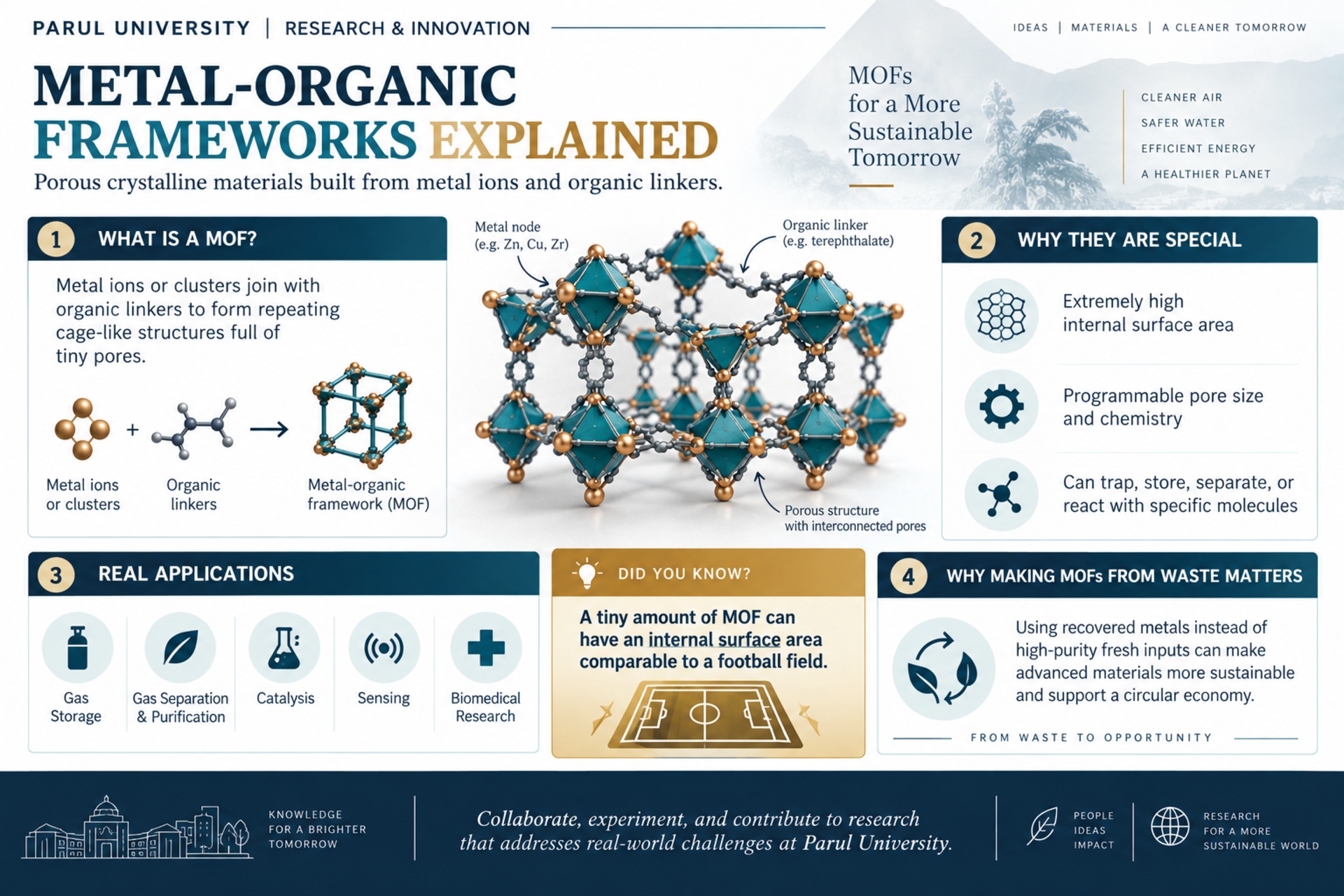
The metal-organic framework (MOF) that Parul University and IIT Palakkad scientists created from e-waste copper is an advanced material. It’s a name that might sound scary, but it’s actually a very interesting and, in today’s world, vital area in science and industry.
What is a Metal-Organic Framework?
Metal-organic frameworks are porous, crystalline materials created by reacting two ingredients: metal components, which are metal ions or metal clusters, and organic linkers, which are carbon-based molecules that link together the metal components. They self-assemble into a repeating, cage-like structure. They form themselves into repeating, cage-like structures together, a little like a molecular scaffold. The trick is how this leaves so much empty space in the molecule: MOFs contain very small, regular pores, which makes them have an extraordinarily high internal surface area. For this reason, they are frequently referred to as the “sponges” of chemistry; mostly, and usefully, space.
Read more about – Parul University & IIT Palakkad Secure Indian Patent for E-Waste Innovation!
Why MOFs Are So Special?
MOFs are extraordinary due to two features. The first is their huge surface area: so much of an MOF is internal pore space that a small amount of MOF can react with a large amount of gas or liquid. Second, and most importantly, they’re tunable. Depending on the metals used and the chemistry of the organic linkers, chemists can create MOFs with pores of a specific size and chemistry, which can be used to capture, store, or react with a specific target molecule. The combination of large surface area and programmable structure makes MOFs so promising.
What can MOFs do? Real Applications
MOFs are far from a laboratory curiosity and have real and increasingly important uses:
Gas storage: they can store gases such as hydrogen or methane, which can be utilised for clean energy storage.
- Gas separation and purification: They have the ability to capture one gas while allowing another to pass through, such as trapping carbon dioxide.
- Structured pores: Can include and catalyse chemical reactions.
- Sensing: They are able to detect certain substances, such as medical and biological ones.
- Biomedical research: From drug delivery to diagnostics, their tunable structure opens many possibilities.
The copper-based MOF was created in the Parul University study for use in electrochemical sensing and detection of substances such as bilirubin (a factor that can be used for diagnosing jaundice) and serotonin (a substance linked to mood and stress), demonstrating how a MOF could be useful in the actual diagnostic context.
Why Making MOFs From Waste Matters
To make an MOF traditionally, high-purity metal compounds are required, which are expensive and require energy to produce. The really interesting future is to build MOFs with recovered metal from waste rather than with the metals found in the rocks of the Earth. Combined with the two concepts of advanced materials and a circular economy, this makes an already useful class of materials even more sustainable and potentially lower in cost. In a field as exciting as MOFs, it’s research that defines the future: finding greener methods to make these materials.
FAQs
What is a MOF in simpler terms?
It’s a porous and crystalline material, including a framework of metal ions that are linked to organic molecules, that organises into a cage-like structure with tiny pores. Hence, MOFs have a higher internal surface area and are called sponges of chemistry!
What are MOFs used for?
Gas storage (e.g., hydrogen or methane storage), gas separation and purification (e.g., carbon dioxide capture), catalysis, sensing of specific substances, and biomedical applications, including drug delivery and diagnostics. They are highly porous and have adjustable pore structure, making them applicable to various fields.
Why is it that MOFs are such significant materials?
They have an extremely large internal surface area and a defined structure: changing the metals and the organic linkers allows chemists to design an MOF to trap, store, or react with a given molecule. Their versatility makes them useful for clean energy, environmental applications, catalysis, and medicine.