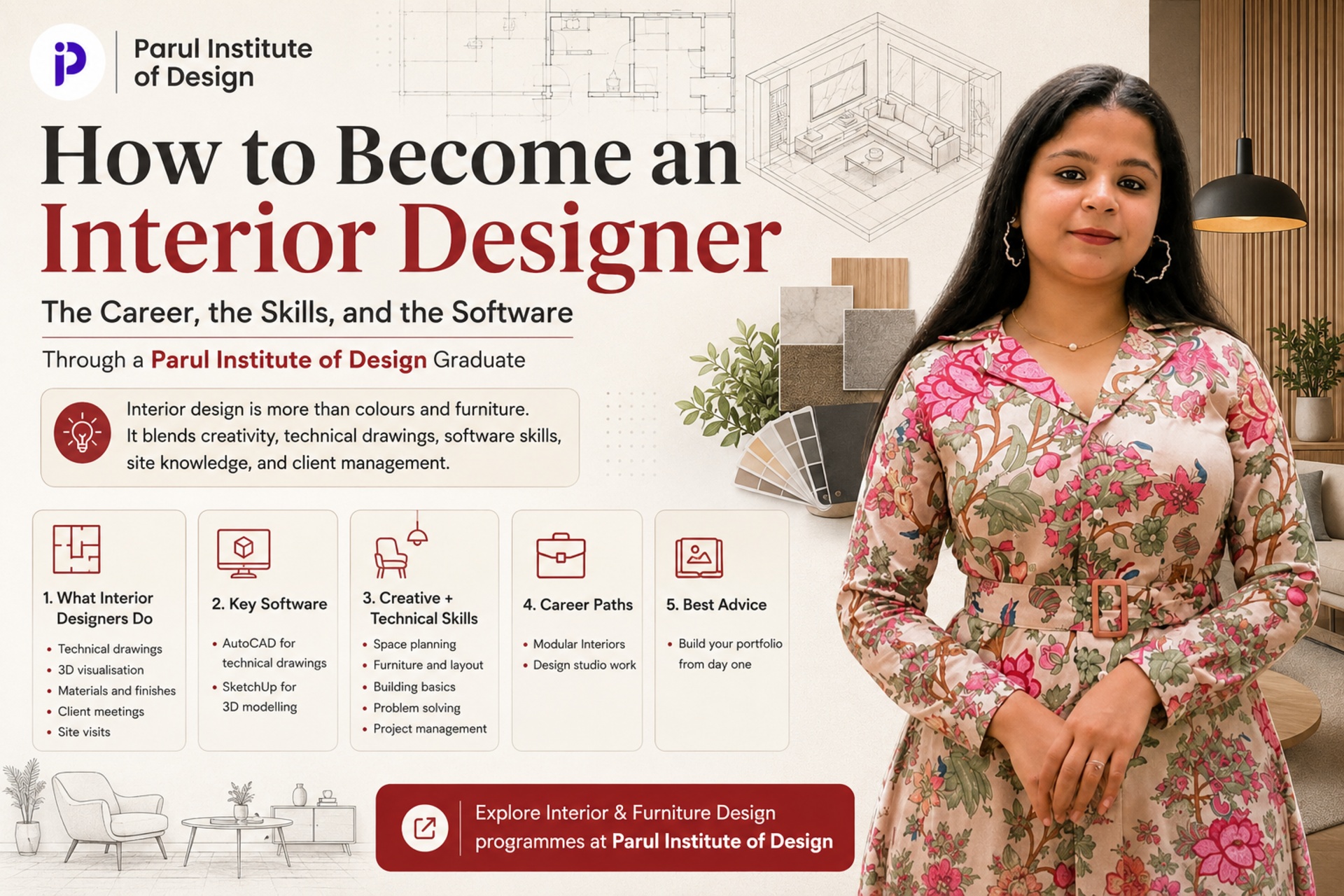
Most people picture interior design as picking colours and arranging furniture. Learning how to become an interior designer quickly corrects that: it is a technical profession involving precise drawings, building constraints, software, and client management. Gurleen Dung, a four-year interior design graduate of Parul Institute of Design, went straight from her degree into a full-time interior designer role, and her early career is a useful, honest map of what the job actually requires.
Roles & responsibilities of Interior Designers!
An interior designer isn’t solely focused on vision or planning; their main objective is to have safe and attractive interior spaces in sync with aesthetic vision as well. Their entire planning includes technical drawings, curating 3D models, finalising materials and managing a project from an idea to the final execution. On a live project, that means talking to clients daily, helping them choose colours and finishes, making decisions within a budget, and visiting sites to ensure the build matches the plan. Design flair matters, but it sits on top of a technical and project-management foundation.
From Store Displays to Brand Strategy – Understanding Visual Merchandising
The Skills and Software You Need!
A serious interior design education builds from broad foundations to specialised technical skill. In the early stage, students learn design fundamentals across sketching, interior, product, and furniture design; later, the focus narrows to furniture design, design thinking, and architecture-adjacent knowledge such as column placement, electrical points, and fire and safety regulations. Two industry-standard software tools are essential, and both were part of Gurleen’s training:
- AutoCAD: For precise technical and construction drawings.
- SketchUp: For 3D modelling and visualising a space before it is built.
This combination, technical drawing plus 3D visualisation, is what lets a designer communicate a space to a client and a contractor accurately, and software fluency is now a baseline expectation in the field rather than a bonus.
Classroom Versus Site: The Real Learning Curve
In a classroom, you can ignore a technical detail that seems too complex. On a real site, that detail becomes a problem you did not anticipate.
Gurleen is candid that the biggest lessons came on the job. In college, a complicated technical detail can be skipped with no consequence; on a real site, unanticipated technical issues arise constantly and must be solved. She also learned the physical constraints of materials, for instance that modular furniture is restricted to ninety-degree angles and cannot easily be curved, a limit no abstract college design imposes.
Understanding these real constraints is a core part of becoming a working designer, and it is exactly why practical, project-based education matters.
Modular Versus Studio: Two Kinds of Interior Careers
Interior design careers split broadly between modular and studio work, and experiencing both is valuable. Gurleen began at a leading modular interiors company, where she built strong technical skills producing drawings and 3D models for real projects, starting with kitchen designs and progressing to larger, more complex work as she proved herself.
She then chose to move to a design studio, APM Studios, specifically to understand how a traditional, non-modular studio operates. That deliberate choice, seeking breadth rather than staying in one lane, is a smart early-career strategy in a field where versatility opens more doors.
You too can transform your creativity into a successful design career with the B.Des. in Furniture and Interior Design & Diploma in Interior & Furniture Design programmes at Parul Institute of Design!
The One Piece of Advice: Build a Portfolio From Day One
Gurleen’s strongest advice for design students is practical and hard-won: start documenting your work immediately, however small. In design, the portfolio is the main asset, and every sketch, 3D model, and drawing adds to it. Leaving portfolio-building until the end, she found, means scrambling to assemble materials under pressure.
She pairs this with a second lesson: cultivate discipline early, because the professional world is far less forgiving of missed time than college is. Both are the kind of advice that only comes from having just made the transition.
Designing India’s Heritage – A Career in Ethnic Wear Design!
FAQs
What’s the process of becoming an interior designer?
Usually, you complete a formal interior design degree or diploma that covers holistic design fundamentals, furniture design, the basics of technical drawing, and building knowledge, such as electrical systems and safety regulations. Besides this, while pursuing the degree, you will also build a strong portfolio, and that’s when site-based and practical experience will help you enter the interior design field!
What are the most popular software programs for interior designers?
Interestingly, the most widely used software is AutoCAD and SketchUp. AutoCAD is used for technical construction drawings, while SketchUp is used for 3D modelling and the entire visualisation process. Hence, using both, it allows a designer to show proper documentation of their vision before constructing it in reality.
Is interior design a technical or a creative career?
The answer is both, as technical and creative skills matter at all levels. Besides these skills, such as aesthetic mindset and creativity, management of technical drawings, material identification, budgets, building regulations, and project management play a primary role in becoming a successful interior designer.
What is the difference between modular and studio interior design?
Modular interior design works with standardised, factory-made components, which brings efficiency but constraints, such as furniture restricted to ninety-degree angles. Studio or traditional design offers more bespoke, custom work with fewer standardised limits. Moreover, experiencing both of them will provide a holistic skill set for the work you’re committed to do!