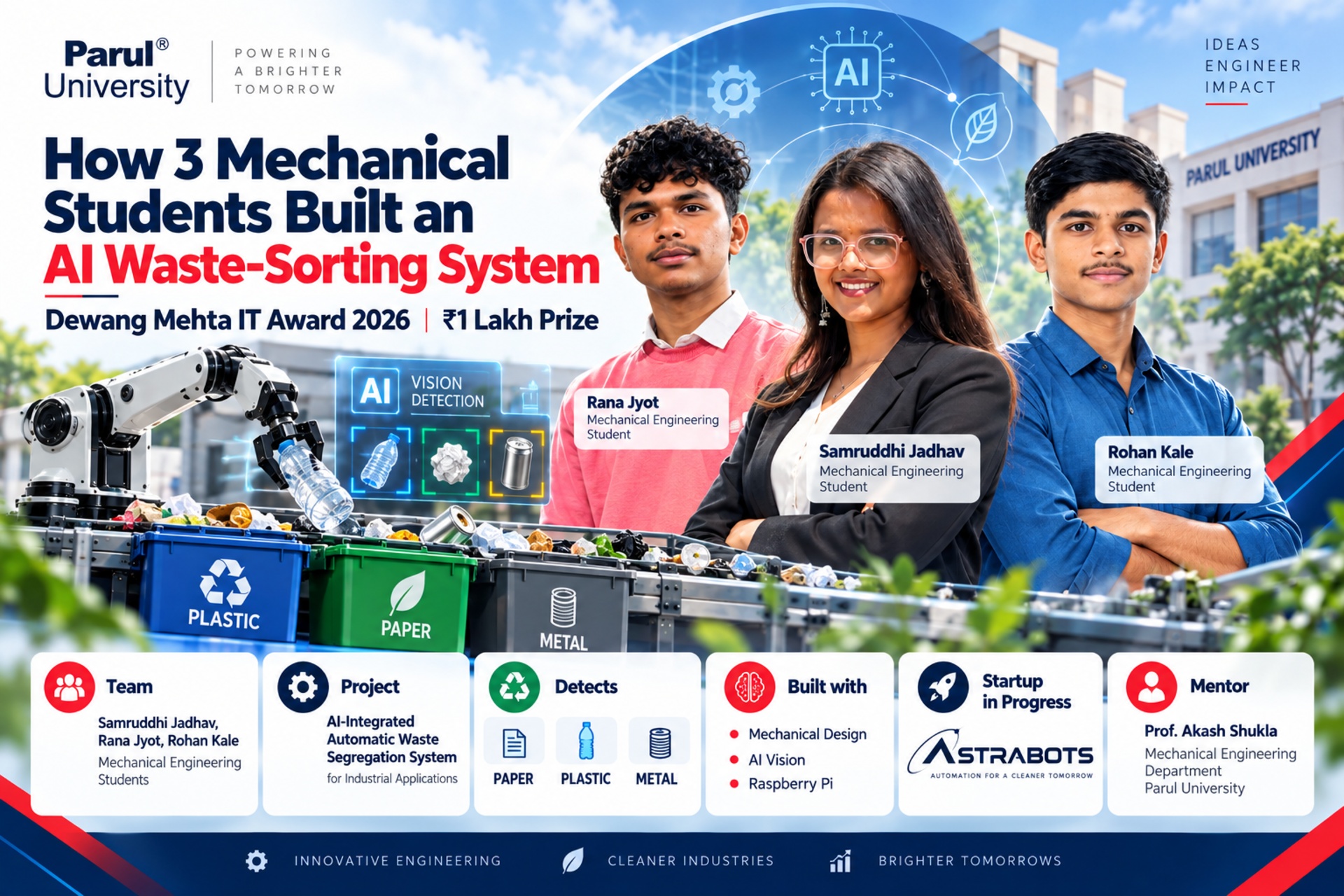
On paper, three Mechanical Engineering students had no business winning an award focused on IT. That is exactly what makes their story worth telling. At Parul University, Samruddhi Jadhav, Rana Jyot Kishorkumar, and Rohan Kale, all from the Mechanical Engineering Department at PIET, won the Dewang Mehta IT Award 2026, along with a Rs 1,00,000 cash prize, for their “AI-Integrated Automatic Waste Segregation System for Industrial Applications.” They did it by refusing to treat their branch as a limit.
Turning a “Wrong Branch” Into a Strength
Anyone would feel that Dewang Mehta IT Awards is for IT students. But these students didn’t get afraid. They saw this as an opportunity.
They took a mechanical project they had already built, an automated waste-segregation system, and gave it a technological brain, integrating AI-based identification and a Raspberry Pi to combine mechanical engineering with electronics, automation, and artificial intelligence. In a field increasingly defined by interdisciplinary work, that willingness to cross boundaries was the whole point.
The Project: An AI That Knows Its Waste
The system tackles a real industrial problem: sorting waste accurately and automatically. Using a camera and AI-based identification, it distinguishes between categories of waste, particularly paper, plastic, and metal, and supports automated segregation based on what it detects. The project began as a purely mechanical automated system; the team’s insight was that adding AI-based recognition would transform it from a machine that moves waste into one that understands it. That upgrade is what made it competitive at a national technology award.
Learning AI as Mechanical Students
None of the team arrived knowing how to build an AI system; they learned it because the project demanded it. Coming from a mechanical background, they expanded into automation, coding, and intelligent systems through project work, workshops, and collaboration. Crucially, they leaned on peers from other disciplines, their friends studying IT helped them understand the technology outside their own training. It is a model of how modern engineering actually works: not one specialist working alone, but a team combining strengths across fields.
The Win, and What It Took
The team’s success came at the 14th edition of the Dewang Mehta IT Awards, where their project stood out in a large field of entries from colleges across the region. Winning, they are quick to note, was not only about having a working model; they also had to explain their idea clearly and demonstrate the system live to the jury, making communication and presentation as important as the engineering itself. Guiding them throughout was their mentor, Prof. Akash Shukla, who introduced the team to the award and encouraged them to enter, alongside support from the university’s innovation and incubation ecosystem.
The team is Samruddhi Jadhav (originally from Kolhapur, Maharashtra, whose father is a mechanical engineer), Rana Jyot Kishorkumar, and Rohan Kale (a member of the ISHRAE Vadodara Chapter and the Indian Institute of Welding), each of whom came to engineering through a diploma and a hands-on love of how machines work.
From Award-Winning Project to Startup
The team does not see the award as a finish line. They are developing the project further under their startup initiative, ASTRABOTS, exploring different versions of the system: a pneumatic model that could offer greater efficiency, and a lower-cost version that could make the technology accessible to companies with smaller budgets. Their focus now is on refining the technology, understanding industry requirements, and extending it to new forms of waste, exactly the kind of journey from campus project to real product that a strong innovation ecosystem is meant to enable. Find the course that motivates you to experiment and innovate at the university’s engineering faculty.
Their Message to Fellow Students
Asked what advice they would give other students, the team’s answer is grounded in their own experience of building something from an idea.
An idea becomes a direction when you put it on paper, but it becomes a possibility when you keep working on it consistently.
– Samruddhi Jadhav
It is a fitting summary of a project that started as a simple mechanical machine and, through consistent effort and a refusal to stay inside one discipline, became a national-award-winning, AI-powered system, and a startup in the making.
Frequently Asked Questions
Who won the Dewang Mehta IT Award 2026 from Parul University?
A team of three Mechanical Engineering students from PIET, Parul University, Samruddhi Jadhav, Rana Jyot Kishorkumar, and Rohan Kale, won the Dewang Mehta IT Award 2026, with a Rs 1,00,000 cash prize, for their “AI-Integrated Automatic Waste Segregation System for Industrial Applications,” mentored by Prof. Akash Shukla.
What is the AI waste-segregation project?
It is an industrial waste-segregation system that uses a camera and AI-based identification to automatically distinguish categories of waste, particularly paper, plastic, and metal, and support automated sorting. Built by Mechanical Engineering students, it integrates AI and a Raspberry Pi with a mechanical system, and the team is developing it further under their startup, ASTRABOTS.
How did mechanical engineering students win an IT award?
By treating their interdisciplinary background as a strength. The team took an existing mechanical waste-segregation project and integrated AI-based identification and electronics, learning the new technologies through project work, workshops, and collaboration with peers from IT. Their success shows how modern engineering increasingly combines mechanical, electronic, and AI skills.


