World Architecture Day 2026: Practising Architects Bring Real-World Insight to Parul University Students
What is World Architecture Day, and why Parul University marks it
World Architecture Day is celebrated every year by those in the field, in honor of the profession, to raise awareness of the value architecture delivers to the community. The International Union of Architects established the day in 1985, and 2026 is set to be the 42nd annual, which coincides with World Habitat Day, which falls on the first Monday of October.
The Faculty of Architecture and Planning has celebrated the day since 2015, making the 2026 edition its 11th. The faculty marks the occasion by bringing practising professionals into the studio, so that students hear about architecture beyond their classroom drawings, through conversation, experience and debate. This was the inaugural session of the 2026 celebration, held in the Central Auditorium on 5 October 2026, under the theme Architecture: People, Places, A Better Tomorrow.
The Inaugural Address
A senior faculty member officiated the event, saying that while professional days are for the professionals, World Architecture day is for the profession. He traced back the word architect to its Greek archi (chief) and tekton (mason or carpenter) and said that while architects were once engaged in all aspects of making a building, the profession has narrowed down to plans and designs with most of the work done by a growing list of consultants. He read through the word ARCHITECT as a set of values, accountability, responsibility, clarity, humility and integrity followed by technology, efficiency, creativity and transformation and reminded the students that the architects do not only design buildings, but shapes lives and the future.
Architecture Keynote Session: Two Practitioners on Creating Spaces That Endure and Matter
The session was structured as the inaugural address followed by two keynote presentations, each introduced by student hosts and followed by a felicitation, and it closed with a vote of thanks and the presentation of a book to the institute’s library. The two keynotes approached a shared question, how to create spaces that endure and matter, from different directions.
Ar. Sameep Padora on Learning from the Past and the Land in Architecture
Ar. Sameep Padora‘s talk was about learning from the past and from the land. Drawing on temple planning, the climate intelligence of the Rajasthani haveli, vernacular masonry and local waste materials, combined with new computational structural tools, he argued that the region is open to knowledge networks and that history can be made productive. His projects ranged from a village temple built by farmers and the Temple of Steps at Nandyal to a student hostel in Kota, a Catalan vault library, art labs at Hampi and housing in Goa.
Ar. Daraius Choksi on the Realities of Architectural Practice
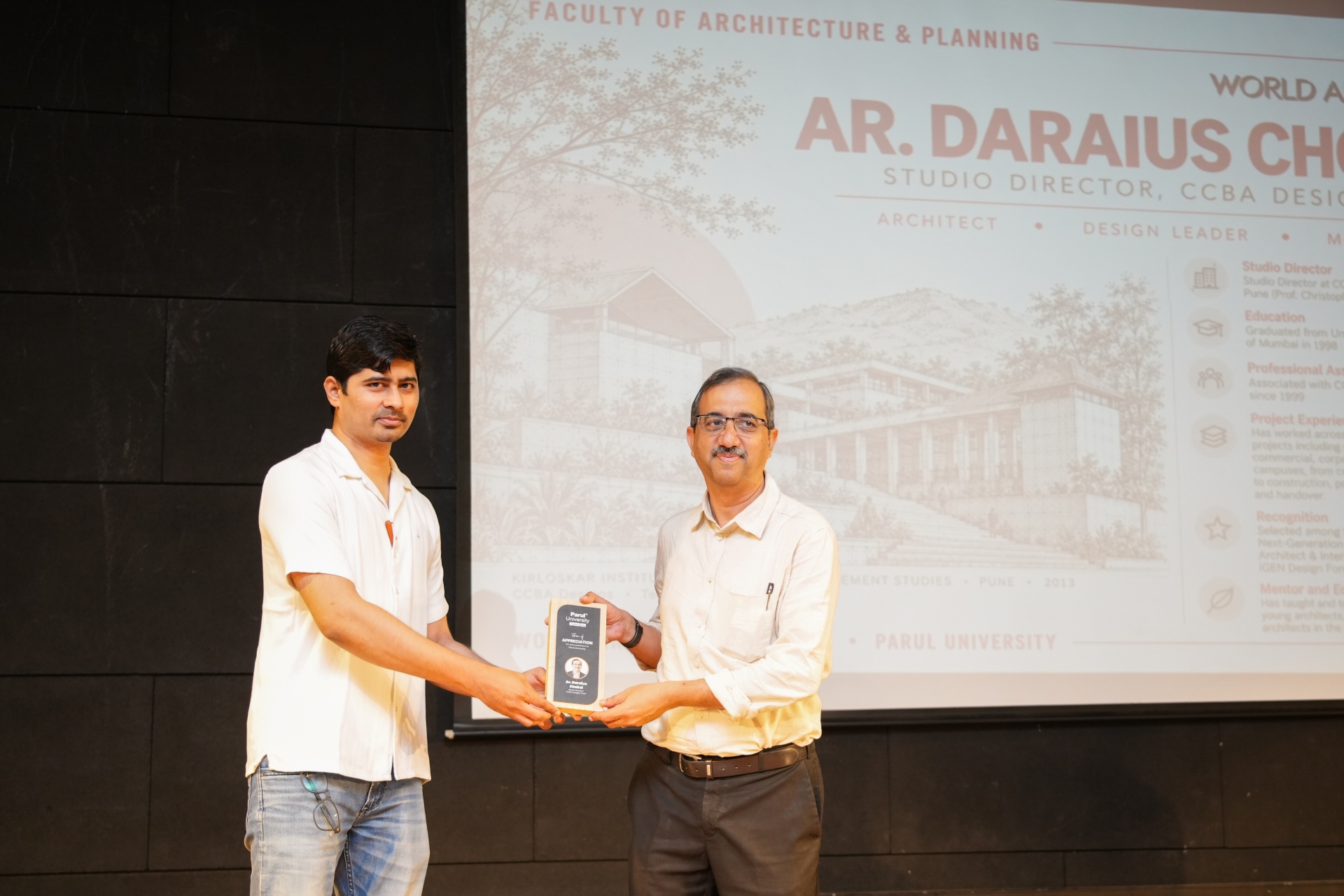
Ar. Daraius Choksi talked about the realities of practice. He shared there are many factors an architect faces and is responsible for including, the long, uncertain life of a large project, the need for perseverance, and the value of simple, durable materials and passive design. His examples included a university campus near Bengaluru shaped by years of negotiation, a lecture hall complex at IIT Hyderabad, and the transformation of a seventy-year-old head office, and he left students with the message to develop their own judgement before relying on tools, in his words, “I before AI .”
Lessons for Architecture Students from Two Practising Architects
Both architects described that an architect is a collaborator and a conductor who must see the whole. They both stressed that the designs should respond to climate, water and the people who are going to use a place. For students, they shared a deep message, stating, take chances and create them, study the work that came before, develop your own judgement before relying on tools, and treat every constraint as part of the design. The session is part of the Faculty of Architecture and Planning’s broader effort to connect studio learning with real-world practice. It also reflects Parul University’s commitment to bringing leading practitioners directly to its design and architecture students.