When we look at a plot of land, we simply see nothing but just a space. But the students of Parul University see it differently, and that’s when the visual mindset & industry exposure make the difference. Meet Bhavya Sri Sai Lalitha Perumalla-a Bachelor of Design student at Parul University. She sees where a wall should stop, how much room a bedroom actually needs, and where the afternoon light will fall. That way of seeing is what an interior design education builds, and Bhavya’s route to it, through a Bachelor of Design at Parul Institute of Design (PID), Parul University, is an instructive map for anyone wondering how to become an interior designer. She also shares her journey in her own words in a video on Parul University’s YouTube channel.
A Second Beginning: Switching Into Interior Design
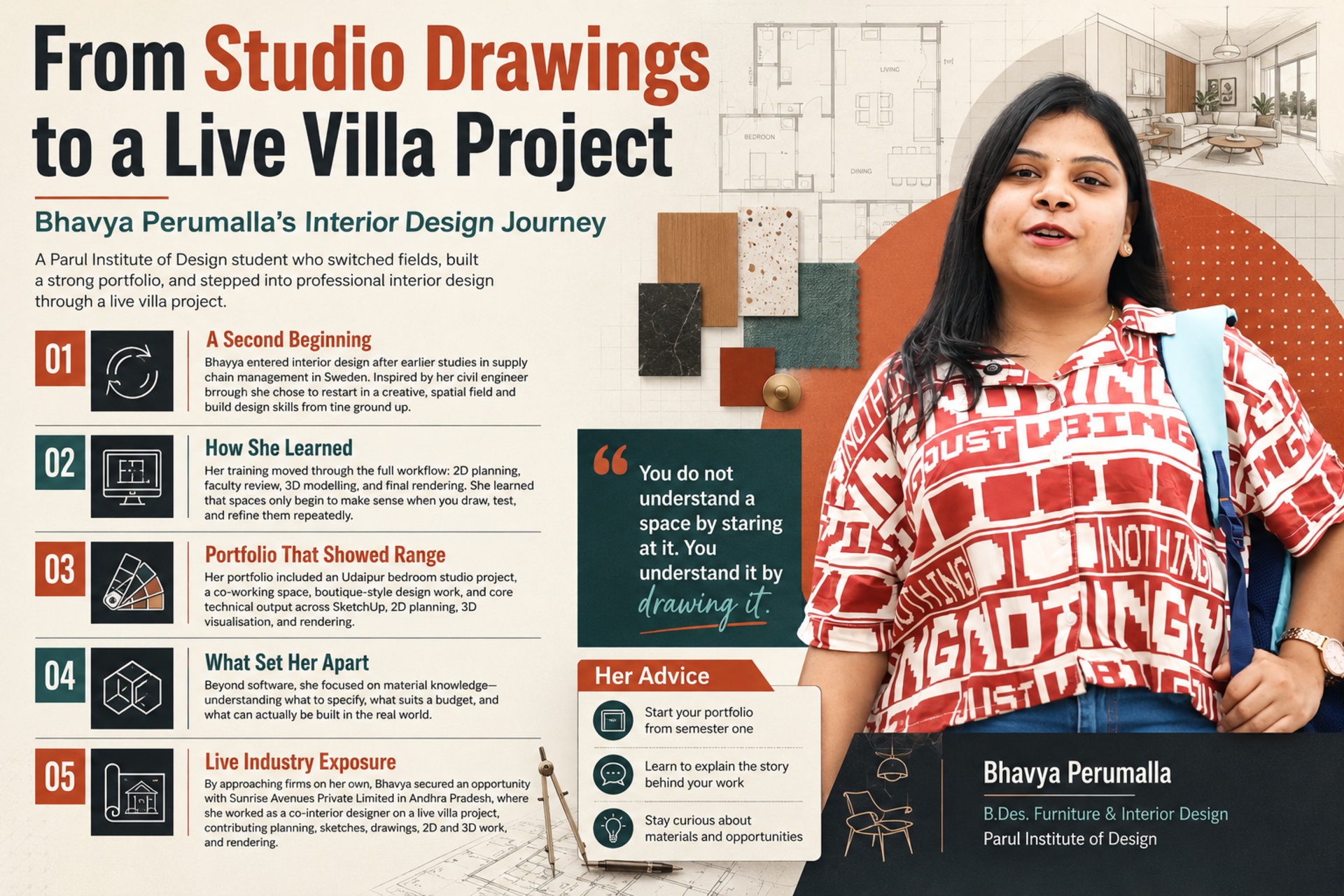
Bhavya’s path did not begin the way most design stories do. Before she ever thought about interiors, she had completed a two-year course in supply chain management and studied in Sweden, an entirely different discipline built around logistics and systems rather than drawing and spatial reasoning. The move to interior design meant starting over, from the basics, in a field she had only understood from the outside.
The interest came, unexpectedly, through her brother, a civil engineer. When she watched him working rigorously on the structural front of the buildings, she found herself drawn to the other side of it. What happens inside those walls, how the light falls in, and how a place can welcome with warmth and exact detail. That’s when she expanded her journey towards interior design!
Role & Responsibilities of an Interior Designer!
Interior designing is far beyond making the space beautiful. That is the visible end of it, but the discipline is far more technical. It’s the planning of measuring, zoning, and visualising a space wherein an idea can be turned into a livable space. It combines creative judgment with practical knowledge on how space should be ideated, designed, and well-arranged. From material selection to how it should be built in reality, an interior designer isn’t simply decorating a room, but they’re shaping the foundations!
Studio, 2D & 3D!
Interior design cannot be learned from theory alone. It combines practical approaches, and with each step, a space is completed successfully. Here’s the entire process.
- 2D – Students are given a plan on which they’ve to work out how the space should be arranged, followed by a drawing!
- Review – Once these drawings are done, they go to faculty, and then they review all the phases of work!
- 3D – Once the 2D part is sorted, the work moves into rooms & elements, and then it moves to 3D modeling.
- Final Rendering-Once 2D and 3D are perfectly done, rendering pulls everything together, and hence, the final picture of the space gets ready!
She illustrates this with a plot of roughly 1,600 square feet. Faced with an empty plot like that, she says, it is genuinely hard to know where anything should go. Clarity arrives only once you start sketching, zoning the space, deciding where each room sits, and working out how the functional areas fit together. Understanding, in other words, is produced by drawing, not by looking.
For Bhavya, this navigation wasn’t as easy as it sounds; she worked on all the levels of interior design, and hence she could achieve her dream package. You too can build your skills, portfolio, and career by doing a B.Des. in Furniture & Interior Design, a Certificate Program in Interior Designing, or a Master of Design in Interior Design!
You do not understand a space by staring at it. You understand it by drawing it, over and over, until its shape makes sense.
– On learning interior design
Building an Interior Design Portfolio!
If there is one piece of Bhavya’s experience every design student should absorb, it is her clarity about the portfolio. In a visual, practical field like interior design, a resume tells an employer about you, but a portfolio shows them what you can actually do, and for design roles, showing beats telling every time. Her own portfolio, by the time she entered the job market, spanned a real range:
- A studio project from Udaipur-Developing interior spaces, including a bedroom from a given plan, through sketches, SketchUp modelling, and rendering.
- A co-working space design-Giving her experience of a work environment rather than a home, with related furniture designs.
- Boutique-style design work-From an external workshop, adding another kind of space to her range.
- Core technical output – Spanning 2D planning, 3D modelling, SketchUp, and rendering.
Her advice on how to build such a portfolio is refreshingly practical. Start saving your work from the very first semester, not in a rush during placement season. Even early, simpler exercises belong in it, because together they show progression, how a student grows from basic drawings to complete projects. And a portfolio is not just images: a designer should always be ready to explain the story behind each piece, the idea, how it developed, and what inspired it, because being able to talk through your own work is often what carries you through an interview.
Why Material Knowledge Sets a Designer Apart
One theme Bhavya returns to is materials, and it is where she believes a lot of design education stops short. Software skills and a good eye are not enough on their own. A designer also has to know what materials exist, what they are used for, and why one might suit a particular project over another. Crucially, this awareness has to be continuous: new products enter the market constantly, and a designer who stops keeping up falls behind. It is one thing to render a room beautifully; it is another to know, before specifying anything, whether a material will hold up, fit the budget, or even be available where a project is being built. Knowing that this judgement matters, and paying attention to it, is itself a mark of a maturing designer.
Taking the Initiative: Finding the Opportunity Herself
Bhavya’s route into professional work says a lot about her approach. While she explored the university’s placement support, a meaningful part of her job search was self-driven: she approached several companies in her area on her own initiative, presenting her work and looking for a place where her skills could be useful. It took persistence, and her portfolio did the heavy lifting once she was in front of an employer, letting her demonstrate her ability rather than merely describe it. That willingness to go and create her own opportunity, rather than wait for one to arrive, is exactly the proactive mindset the field rewards.
The opportunity came through with Sunrise Avenues Private Limited, a real estate and construction firm in Andhra Pradesh, and it came while she was still completing her degree, earlier than she had expected. There, she works as a co-interior designer on a live villa project, alongside an experienced interior designer, contributing sketches, drawings, planning, 2D and 3D work, and rendering. For Bhavya, the value of the role is that it closes the gap between what a classroom teaches and what a real project demands: actual budgets, actual materials, and specifications that someone will genuinely have to build to. It is, in her view, the next necessary phase of learning rather than a finish line.
The Support Behind the Journey
Bhavya credited the creative culture of the campus and her faculty mentors for supporting her throughout. From navigating an unfamiliar environment to receiving feedback from the Faculties & Dean, she is grateful for all the learnings and placement opportunities. The education built on studio practice and real projects, the kind of hands-on, experiential learning that turns a design student into a working professional, is truly remarkable. .
Bhavya’s Advice for Aspiring Interior Designers
Asked what she would tell students coming up behind her, Bhavya keeps her advice close to what actually worked:
- Start your portfolio early – From the first semester. Keep everything and organise it as you go, rather than assembling something in a hurry later.
- Learn to talk about your work – Not just display it. Be ready to explain the idea behind a project and how it developed.
- Take studio work seriously-even when a design gets sent back for the third time. The corrections are where the real learning happens.
- Stay curious about materials – What is changing in the field, in your city, and beyond-as an ongoing habit.
- Go looking for opportunities yourself – Do not wait passively for one to arrive; initiative pays off.