NMR as a research tool, not a formality
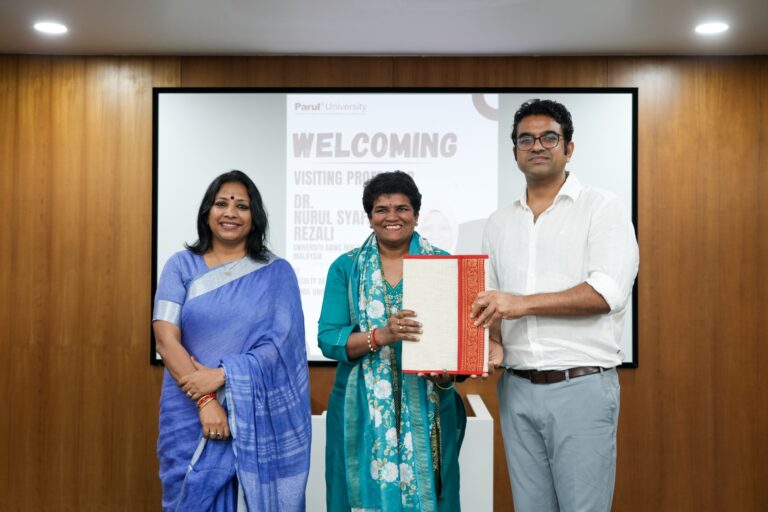
Parul University welcomed Dr. Nurul Syafiqah Rezali from Universiti Sains Malaysia. She taught the students of the Faculty of Applied Sciences at the host university. She was invited as part of the Visiting Professor Programme conducted by the Centre for International Relations and Research (CIRR). Her session was based on the uses of nuclear magnetic resonance (NMR) spectroscopy. NMR in organic synthesis research. The main argument was the gradual shift in mindset: NMR is not a way to understand the finished compound, it is a tool for understanding what actually happens during a reaction. She bought the concept og NMR at the session and connected it with the objective of organic synthesis. The work is to obtain and confirm a target product. When researchers sit with their work they aim for results that will help their field grow, do something for the people to make life better. She explained they have a specific molecular structure in mind, and NMR allows them to test whether the expected transformation has taken place. She asked students to find the key signals that belong to chemical change and to spend their attention on the hydrogen environments and functional groups, where the reaction actually brings out the effect.
Using key signals to confirm a transformation
A major part of the session was learning to confirm a reaction from its spectral evidence. Dr. Rezali told students to develop the ability to predict what signals should appear in the product before they look at the experimental spectrum, then compare the two. Working through transformations of functional groups such as hydroxyl and amino groups, students saw how the disappearance of a characteristic signal and the appearance of a new one together give evidence of a structural change.
She tied this directly to research writing. In papers and dissertations, she said, a researcher should point to the specific signals that demonstrate a reaction succeeded, rather than filling the discussion with descriptions of molecular regions that did not change. The skill is selective reading of the spectrum, not exhaustive listing.
Chemical shift, multiplicity and coupling
The session was related to applied sciences. It covered the topics based on how chemicals work, how it shifts. What testings can give results. The session covered the interpretation of chemical shifts, the position of a signal being set by the chemical environment around a nucleus. The practical part was shown to students. They were shown how electronegative atoms such as oxygen, nitrogen and halogens shield or deshield neighbouring hydrogens and move their signals. Dr. Rezali also researched and worked on multiplicity and coupling patterns. It was to understand how a signal shifts from a singlet to a doublet, or a new splitting pattern. It helps to understand the signals that the environment or neighbouring hydrogens have changed after a reaction.
She further explained about J-values. Also known as coupling constants. It shows how interacting nuclei relate to one another. It is required to determine structural and stereochemical features. Chemical integration was taught as a practical tool. As the relative number of hydrogen atoms behind each signal, read alongside changes in aromatic protons. Or to understand the disappearance of an ethoxy group, can point to processes such as intramolecular cyclisation.
When the experiment doesn't work as planned
One of the more research-oriented parts of the session dealt with reactions that do not give the targeted product. An unsuccessful reaction, Dr. Rezali stressed, does not mean the analysis has failed; the spectrum still carries clues about what happened. By systematically comparing the product spectrum with that of the starting material, noting which signals stayed and which were new, a researcher can propose an alternative structure. She used examples of C-alkylation and O-alkylation to show that a reaction can proceed by a different pathway than expected, and that careful interpretation of the data lets researchers give a scientifically supported explanation for the outcome.
Pairing NMR with infrared spectroscopy
Research-based understanding allows students to understand the field in depth. Dr. Rezali took care of it and explained the new concepts with facts and evidence. She supported that researchers on rare basis depend on a single technique. She paired NMR with infrared (IR) spectroscopy. It shows how characteristic absorption bands find the functional groups. Giving an example of the different N-H stretching patterns of a primary versus a secondary amine, so that the two methods provide complementary evidence for a structure. Her session had topics related to hydrogenation reactions over metal catalysts. Such as palladium, explaining that because the reaction happens on the catalyst surface. It talked about the orientation of the reacting species there influences the stereochemical outcome, and she also asked students to carefully focus on the mechanism. Instead of just learning it give exam. and to report stereochemistry with wedge-and-dash structures.
A set of questions to ask every spectrum
The session closed on a research-oriented habit of mind. Instead of obtaining a spectrum and listing its signals, Dr. Rezali asked students to interrogate the data with a fixed set of questions: What signals should disappear? What new signals should appear? Which should stay unchanged? Has the multiplicity changed? Does the integration match the expected number of hydrogens? Do the chemical shifts make sense for the molecular environment? For students in organic chemistry, pharmaceutical chemistry and related fields, this turns NMR from a characterisation requirement into a way of solving structural problems. Join the science-related courses at Parul University.