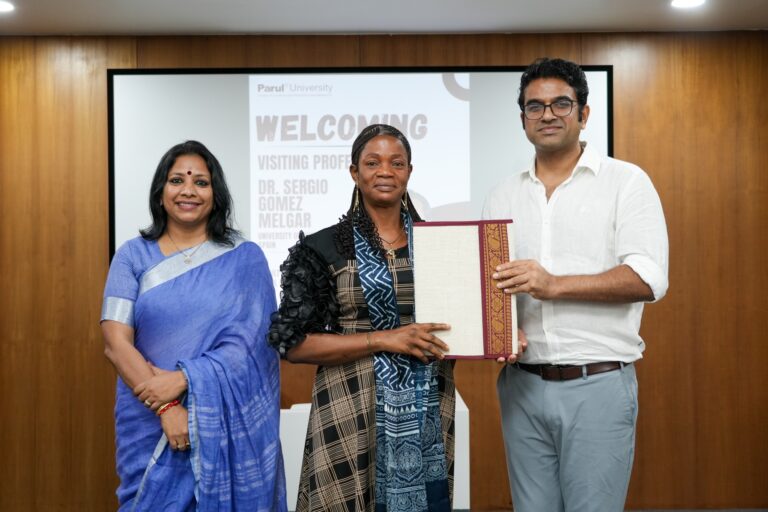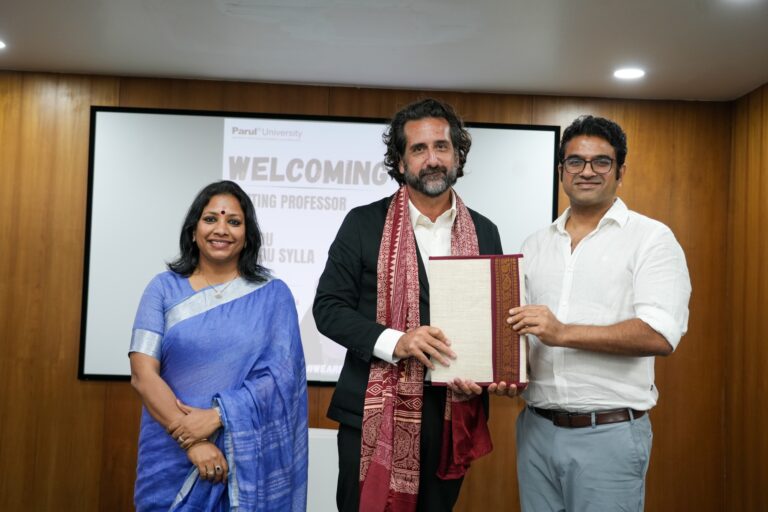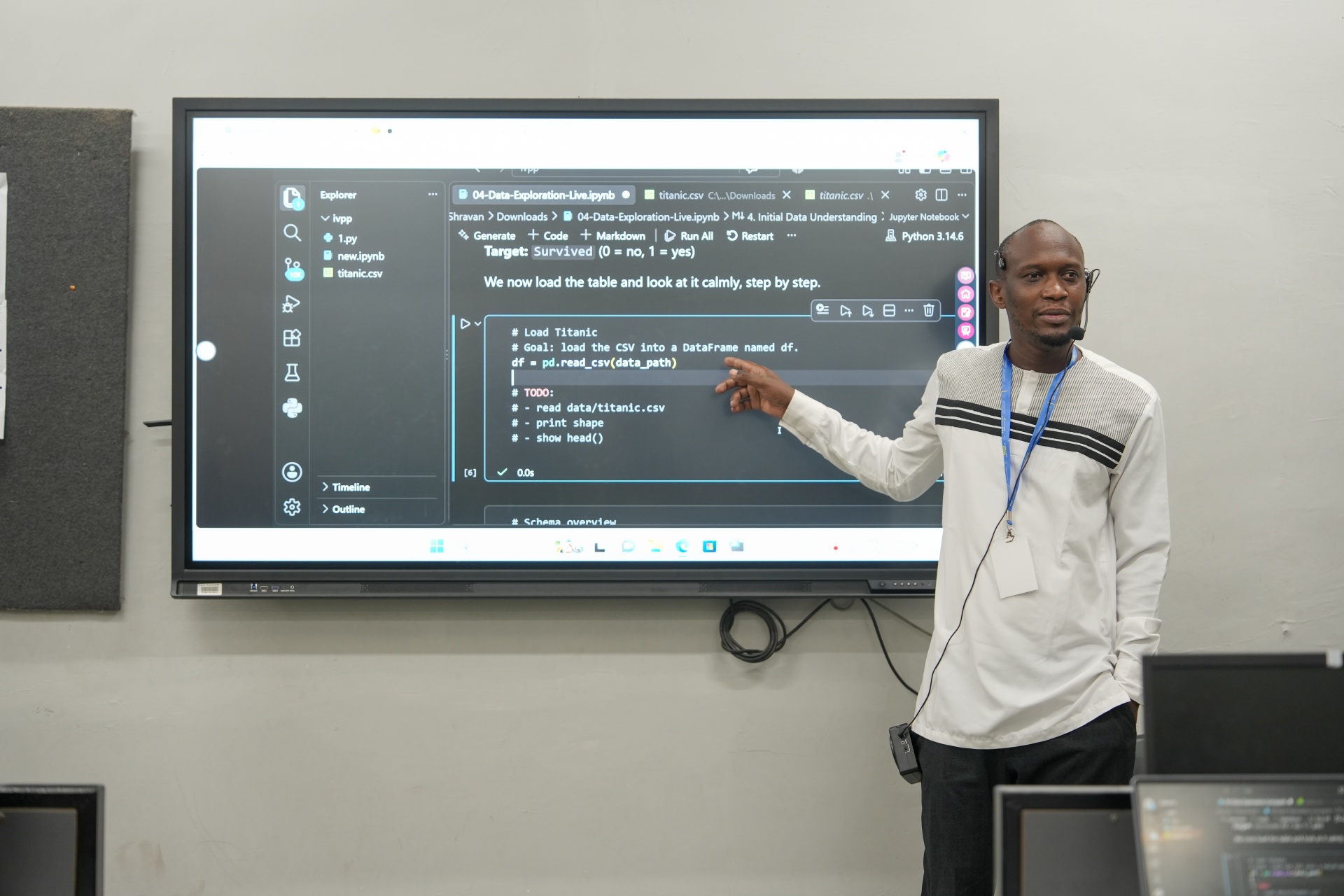
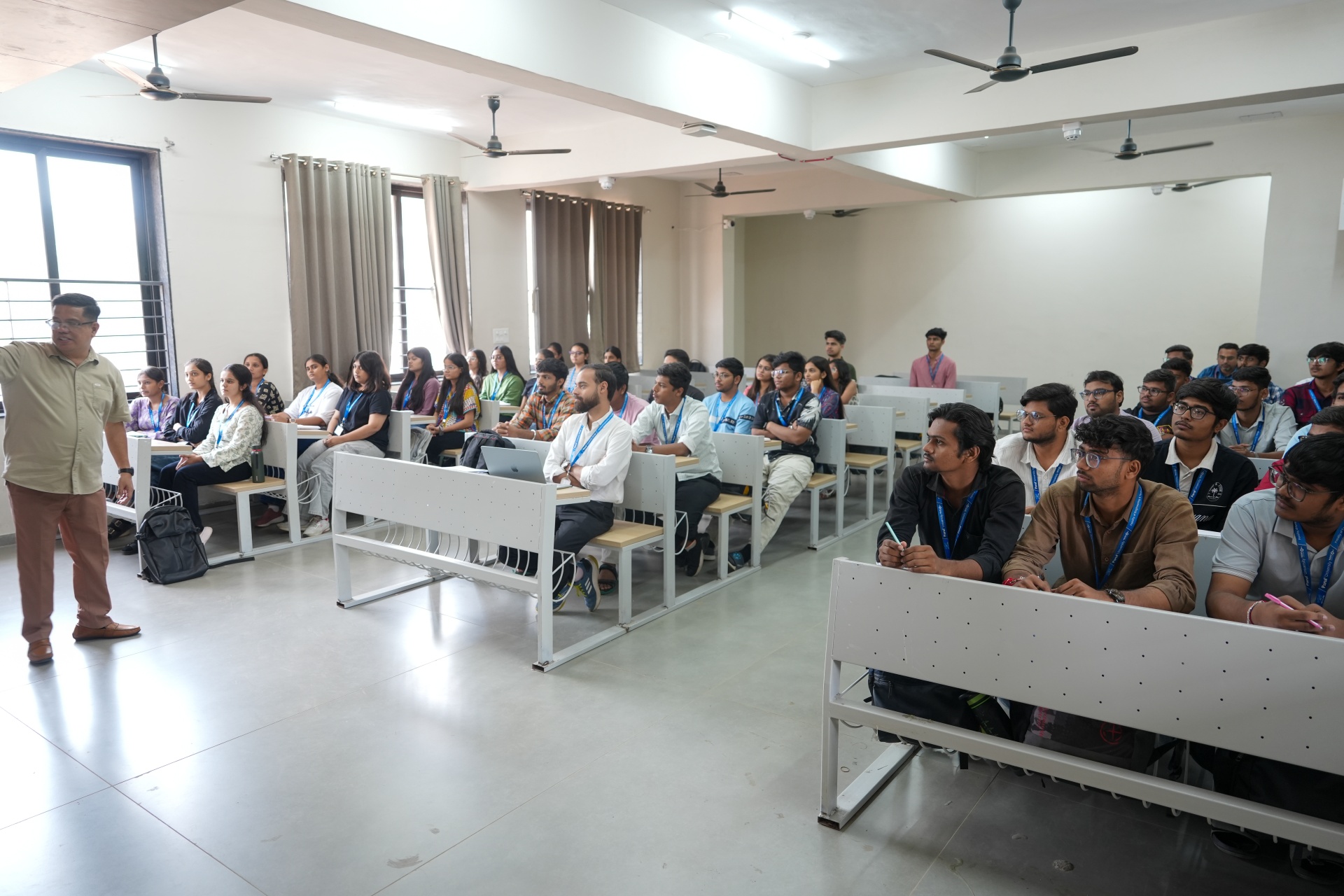
Dr. Seydou Nourou Sylla at IVPP 2026, Parul University!
An AI researcher working on real problems
Dr. Seydou Nourou Sylla is an academic. He works with Université Alioune Diop de Bambey (UADB) and the Dakar Institute of Technology. He is a co-principal investigator on grants funded by IDRC Canada. These grants focus on AI and large-language-model research. His areas of expertise include modelling, natural language processing (NLP), large language models, kernel methods, and frugal AI. He leads research in AI, conversational AI, computer vision, and smart agriculture. It is a core part of the Centre for International Relations and Research (CIRR)’s Visiting Professor Program and was exclusively hosted by Parul University!
Starting from a business problem!
Before any code was written, Dr. Sylla grounded the class in a problem using the PetFinder.my dataset. This dataset contained 14,993 listings and 24 columns of multimodal data, including tabular fields, free‑text descriptions, and images. The task was to predict AdoptionSpeed, a target ranging from 0, the fastest, to 4, meaning never adopted within the window. He framed this task as a resource‑allocation problem, not an animal‑welfare statistic. A reliable prediction at the moment a listing appears allows a shelter to act immediately. After the theory, the class moved into a hands‑on lab using VS Code and Jupyter Notebooks. There emerged a logistical reality: campus Wi‑Fi struggled when many people downloaded files at once. Dr. Sylla solved this problem practically by sharing the dataset on flash drives.
Why analysis beats syntax!
When some students turned to generative AI to fix coding errors, Dr. Sylla addressed this directly. Writing syntax is the easiest part of a data scientist’s job. The real value lies in understanding. Explaining results. He separated AI, machine learning, and deep learning. Taught the three learning paradigms. Supervised learning predicts adoption speed. Unsupervised learning discovers structure. Reinforcement learning focuses on decision-making. He walked the class through the CRISP‑DM process, which contains six stages: business understanding, data understanding, data preparation, modelling, evaluation, and deployment. He drew a distinction between nominal classification, such as cat versus dog, and ordinal classification, such as adoption speed 0 to 4. Mistaking a 0 for a 4 is far worse than mistaking a 2 for a 3. Empirical risk minimization explains the motive for training. It is about finding the parameters that minimise average prediction error.
Raw data, missing values, and outliers!
Dr. Sylla spent time on the unglamorous reality that raw data is rarely ready for an algorithm. He explained the three kinds of missingness. Missing Completely At Random, Missing At Random, and Missing Not At Random. Warned about hidden missing values. For example, a zero in a health column might not mean zero health. Could mean not specified. He said that blind preprocessing can destroy information. Students learned to impute values using the mean for symmetric data, the median for skewed data like adoption fees, and the mode for categorical data. He taught outlier detection using Tukey’s IQR rule. Cautioned against deleting outliers without thought. A pet with photos could be a genuine signal, not an error, and should be considered carefully.
Encoding, scaling, and the golden rule!
On encoding, the instructor showed that one-hot encoding works for nominal data, but one-hot encoding loses the order for ordinal data. That means if your data has a natural ranking. One-hot encoding treats them as unrelated categories, which can decrease the model’s understanding. The instructor also talked about high-cardinality variables, like breed. These have unique values, which can cause problems if not handled right. We learned how to use the handle_unknown parameter. This helps the model stay safe during inference. Meaning, when it sees a category it hasn’t seen before in training, it won’t crash. The instructor explained when numerical scaling matters. For distance-based algorithms, like k-NN, and gradient-based ones, like SVM and neural networks, scaling is important. These models care about the numbers and distances between points. Tree-based models. Like decision trees or random forests. Don’t need scaling. They split data based on rules, not distances. The instructor finished by stressing a rule in the pipeline: never learn anything from the test set. That includes imputation, scaling, and encoding. All of these steps must be fitted on the training fold.